Learn more
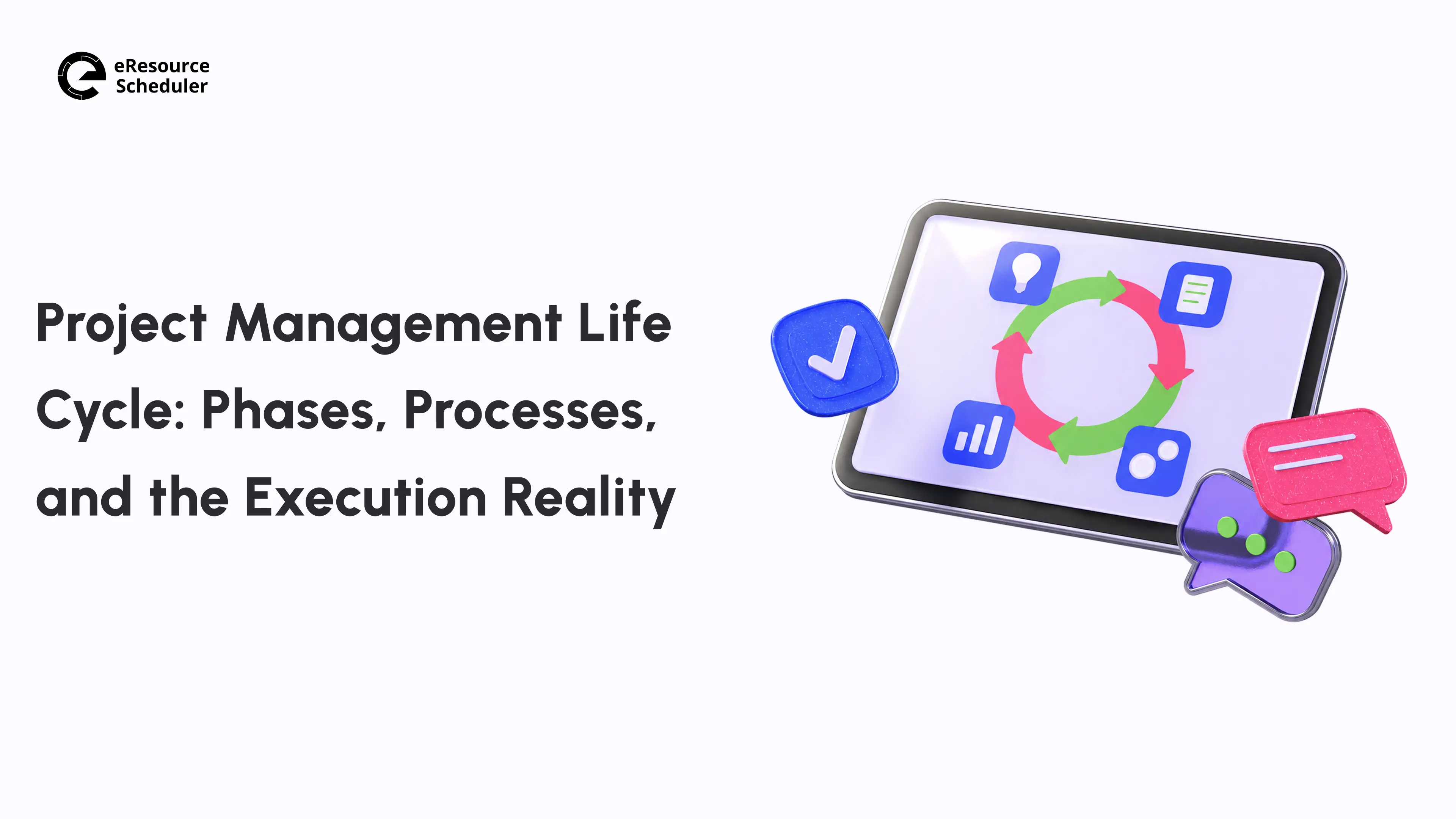
Many teams juggle multiple projects at once these days, which makes structured approaches like Project Cycle Management far more important for keeping things consistent and visible. But what decides whether a project will succeed in the spotlight or quietly slip behind the curtains is how these stages or phases are managed. This is where the Project Management Life Cycle (PMLC) comes into use. It is not just the flow of phases. It is the decision-making structure behind planning, execution, and control.
In this blog, you’ll learn how managers run projects like an orchestra, what has changed in recent project environments, and how modern teams track performance, resources, and outcomes effectively.
The Project Management Life Cycle (PMLC) is a structured process managers use to plan, execute, monitor, and close a project while ensuring it meets scope, time, and cost objectives.
There's a distinction worth making upfront. The Project Life Cycle describes what stages a project passes through. The project management life cycle describes how these stages are actually controlled and carried out.
This practical difference is bigger than most people expect. Knowing a project has an ‘execution phase’ is one thing. Knowing what decisions happen inside it, who owns them, and how the team responds when the plan meets real-world friction is something else entirely.
Understanding what the lifecycle covers sets the foundation. Who drives it at each stage is the next thing worth knowing.
If you've worked with a strong project manager, the difference they make isn't always visible in the deliverables. It shows up in business goals, in staying connected to what the team is actually building, in timelines that are adjusted before they collapse, and in stakeholder conversations that happen on the front foot rather than in response to a missed deadline.
What a manager focuses on looks different from initiation through closure. Though the underlying job stays the same: keep the project coherent, keep people unblocked, and keep things moving in a direction that still makes sense.
| Phase | Purpose | What Project Managers Do | Key Outcome |
| Initiation | Figure out if the project is worth pursuing before committing resources to it | Ask the hard questions. Is this feasible? Does it align with actual business priorities? Who needs to be on board before the work begins? | Everyone walks away with a shared view of what success looks like and agreement on whether it's actually worth chasing. |
| Planning | Turn the approved idea into something the team can realistically act on | Map timelines against real capacity. Define ownership before execution starts. Lock in budgets without relying on best-case assumptions. | A plan people can follow under real working conditions, not one that looks solid until week two. |
| Execution | Get the work moving and keep it from stalling | Unblock teams before small delays compound. Keep communication from breaking down. Make judgment calls when scope or priorities shift unexpectedly. | Steady forward momentum, with the team clear on what they're building and why it matters. |
| Monitoring & Controlling | Catch what is drifting before it turns into a crisis | Watch the data, but also listen for the signals that don't show up in dashboards yet. Step in early, not after the damage is already done. | Problems surface early enough to be addressed. Decisions are made on what's actually happening rather than what the plan assumed. |
| Closure | Learn from the project before the team disperses | Document what worked and what didn't. Hand deliverables over cleanly. Capture lessons while the details are still fresh. | A clear record that makes the next project smoother, not just a box ticked. |
Reality Check
The execution phase rarely goes as planned. Priorities shift mid-sprint. Dependencies slip. People become unavailable at exactly the wrong moment. Tasks routinely run over the estimated time for reasons nobody fully anticipated.
Execution is about far more than doing the work. It's managing communication, clearing blockers, and making real-time adjustments when the plan stops fitting the situation on the ground.
Phases are easier to understand individually. This is also where a lot of teams get into trouble, treating each phase as an individual entity, when the whole point is how they connect.
Constructing a house is a fair analogy. Skip the foundation check at initiation, and no amount of solid execution later can fix what was skipped. Every phase feeds the next, and a breakdown early on tends to resurface at the worst possible moment further downstream. Treating this as a connected resource management process, rather than a checklist of isolated boxes, is what separates teams that consistently deliver from the ones that keep hitting the same problems.

According to the Wellingtone State of Project Management 2026, only 36% of organisations mostly or always complete projects on time, and just 42% stay within budget, yet 52% of respondents believe their organisation has a strong track record of project success. This gap between perception and actual performance often starts with how each phase is managed.
Phases give you the sequence. Processes are what keep things from breaking down inside them.
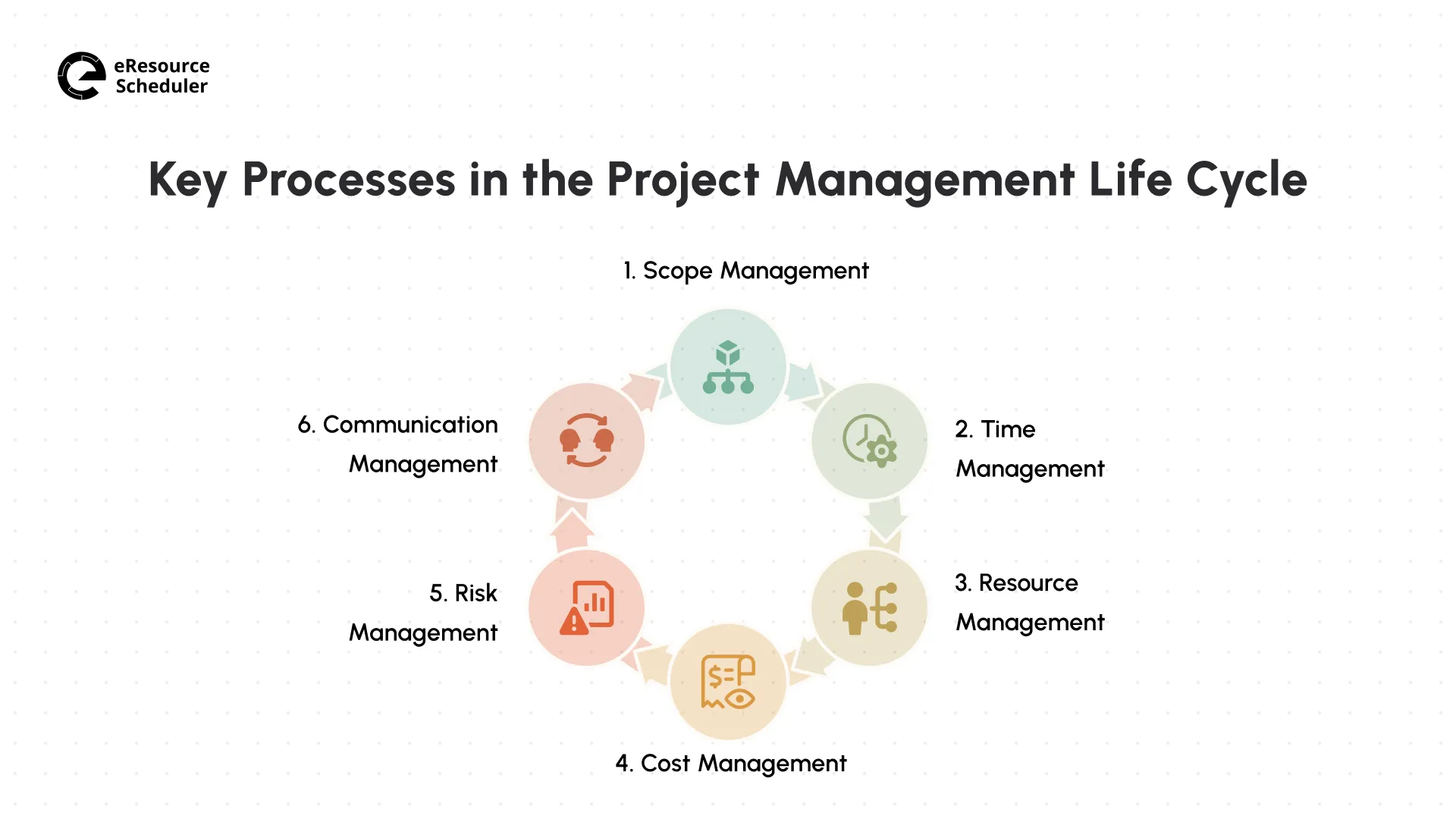
Alongside the defined phases, a set of core processes keeps the project management life cycle structured and on course. These aren't optional layers sitting on top of the lifecycle; they're what make it actually function.
Projects rarely derail because someone did bad work. More often, the scope keeps expanding until the original brief becomes unrecognizable. Scope management sets the boundary around what the project will and won't deliver, keeping the team focused on what was actually agreed on before every stakeholder suggestion turns into a new requirement.
Timelines are misread as scheduling documents. In reality, they represent decisions about what work happens in what order, under what constraints, and with whose involvement. Time management is how these decisions are made deliberately, keeping tasks sequenced in a way that makes sense, flagging delays while there's still room to absorb them, and keeping milestones honest rather than aspirational.
Even a well-structured plan breaks down when the right people aren't available when they're needed. Resource management aligns skills, availability, and workload across teams. In multi-project environments, this gets considerably harder. Most organisations have some version of a resource plan. Fewer have a reliable process to back up the plan.
Did You Know?
According to the Resource Management Institute's 12th Annual State of Resource
Management 2026, 65% of organisations cite a lack of effective process design
or implementation as the biggest inhibitor to getting resource management right.
A project can be hitting milestones and still run into serious trouble if the budget goes unchecked. Cost management keeps financial reality tied to the plan, so managers can track where money is going and whether it still lines up with what was originally expected.
Most project risks don't arrive as surprises. They build gradually while everyone is focused elsewhere. Risk management keeps this slow burn from becoming a full disruption, helping teams identify potential problems early enough to prepare before delivery takes the hit.
A project with all the right inputs, a capable team, a solid plan, and an adequate budget can still go sideways when communication breaks down between workstreams. Communication management keeps everyone informed and aligned from kickoff through closure. In complex projects with multiple moving parts, this matters more than most planning documents account for.
The reality of project management is that the plan you start with rarely survives contact with execution unchanged. What matters is how consistently you balance these processes as conditions shift. Scope creeps and timelines adjust. Resources stretch, and costs follow. Communication gaps open, and risks go unspotted. These processes aren't independent. When one slips, the others feel it.
These processes shape how each phase plays out in practice. Here's what that actually looks like in a real delivery environment.
Consider a US-based IT firm building a SaaS platform from scratch.
| Phase | What Happens in an IT Project | Manager's Focus & Outcome |
| Initiation | A market gap or internal need sparks the idea for a new SaaS product. | Someone has to pressure-test the idea before the team commits to building it. Is there real demand? Is the scope achievable given current resourcing? Getting honest answers here is what makes the rest of the project manageable. |
| Planning | Feature sets are defined, developers are allocated, and sprint timelines start coming together. | The job isn't to plan for the best-case version of the team's capacity. It's to build a roadmap that reflects actual constraints, assigns ownership before gaps appear, and doesn't fall apart the moment something shifts in week three. |
| Execution | Development runs, the interface gets iterated on, and testing happens in parallel with feature builds. | Three teams are moving at different speeds with different priorities. Keeping them coordinated is harder than the roadmap suggests, and scope tends to drift quietly unless someone is actively watching for it. |
| Monitoring | Sprint velocity, bug counts, and resource utilization are reviewed on a rolling basis. | The metrics show what has already happened. A good manager is also reading what's about to happen. Adjusting before a delay becomes official is the difference between catching a problem and reporting one. |
| Closure | The product goes live, and the focus shifts to post-release review. | Launch isn't the endpoint. The retrospective is. What was delivered on time, what wasn't, and why those gaps opened up are questions worth answering carefully before everyone moves on. |
Project management has shifted noticeably over the past few years. Teams are more adaptive, more data-driven, and far less patient with rigid frameworks that can't keep pace.
A lot of this comes down to how the nature of projects has changed. Complexity has increased, skill demand has become fragmented, and teams can rarely afford to lock in plans several quarters ahead without building in room to adjust. Delivery models have had to follow. The frameworks that hold up today are the ones built for flexibility from the start. Not the ones retrofitted when the environment changes faster than the plan can absorb.
No matter how adaptive the model, execution still hinges on how well the people doing the work are managed.
Resource demands shift as a project moves through phases. What looked manageable during planning can break down fast in execution when the team is already stretched or competing priorities haven't been sorted.
When resource planning is weak, the effects tend to compound quietly. Deadlines start slipping. Quality drops as people split attention across too many active workstreams simultaneously. The warning signs don't usually announce themselves clearly either. They arrive as:
By the time a manager raises the issue, the damage has usually spread further than expected. Managing projects today is no longer just about planning tasks and setting deadlines. It requires clear communication and visibility at all stages of the project management life cycle.
Expert Insight
According to Voyage Advisory,
organisations with mature project management practices achieve up to 92% success rates, compared to
just 33% for less mature organisations, proving that structured execution systems significantly
impact outcomes.
eResource Scheduler makes this kind of visibility possible. The software gives managers a centralized view of resource deployment and project progress across teams. When you can clearly see who's doing what and how much capacity is actually available, decisions across the lifecycle stop being guesswork.

With this level of visibility, how the team operates changes in practical ways. Utilization across all active projects becomes something you can actually see. Resource allocation stops relying on whoever was last asked about their availability. Capacity forecasting moves from quarterly guesswork to something closer to real awareness. Progress stops living in scattered status updates and becomes visible in one place.
Proactive capacity planning has become one of the clearer indicators of how mature a team's delivery process actually is. Teams that used to discover workload gaps when someone finally hit their limit can now catch them weeks out and adjust before the schedule ever feels the pressure. It's a different way of running projects, and it tends to show up directly in outcomes.
Execution is blamed the most because it's where things go visibly wrong. By the time a project is struggling in execution, the decisions that caused it were made weeks earlier. According to PMI's 2026 Pulse of the Profession, four out of five complex projects hit some form of negative outcome. Most trace back to how the project was scoped and resourced, not how it was executed.
The project management life cycle gives you the structure to catch these gaps before execution surfaces them. When planning is solid, execution has a real foundation to build on. When it isn't, the lifecycle becomes a mechanism for discovering problems rather than preventing them.
Pairing a well-run lifecycle with the right resource management software gives your team a genuine edge, not just at the planning stage but in consistently delivering outcomes that hold up when you look back at them.


Plan Smarter. Schedule Faster. For Free.
Join thousands already using eResource Scheduler to align teams, time, and tasks seamlessly.
 ALL FEATURES INCLUDED