Learn more
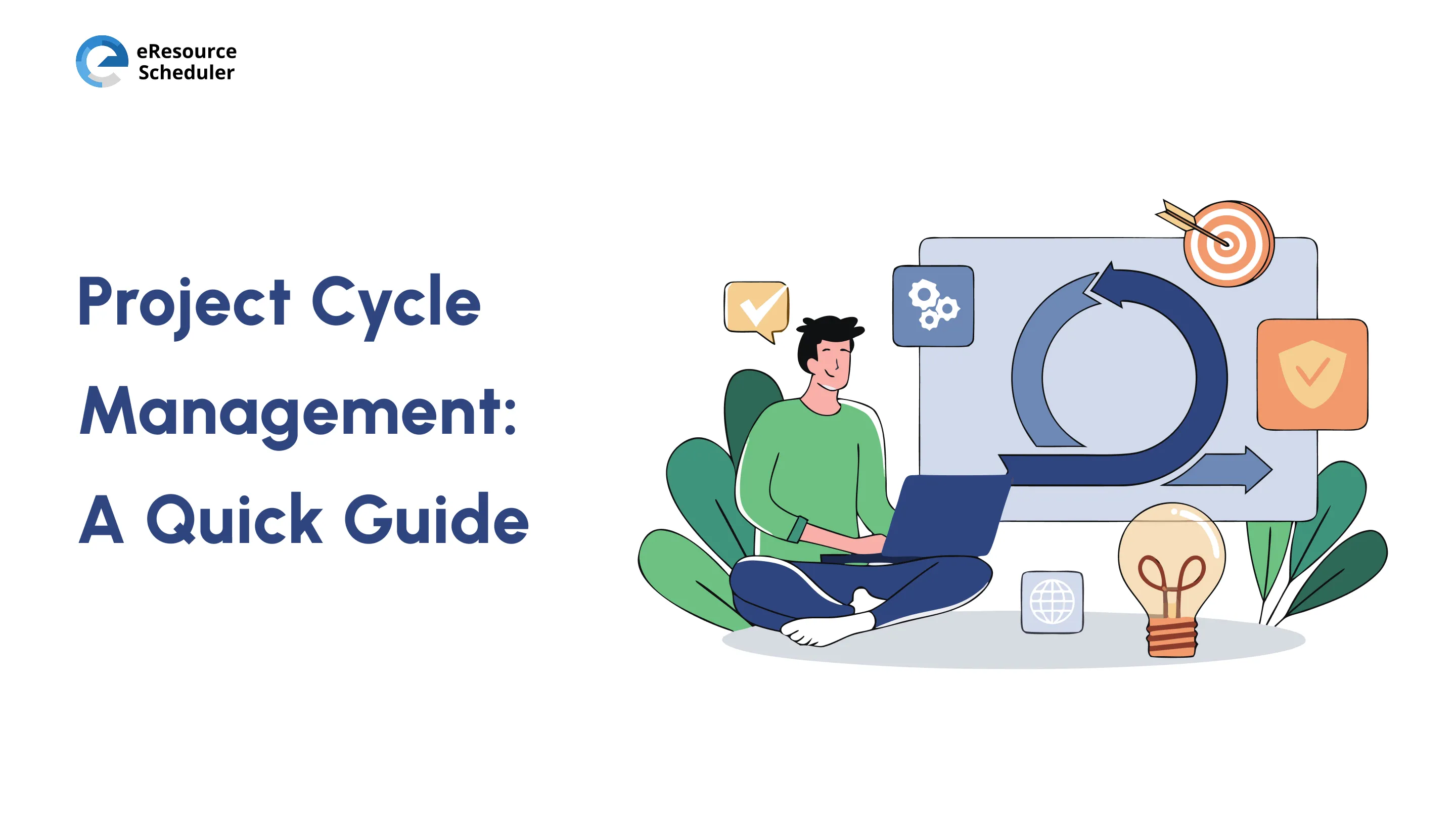
Project Cycle Management (PCM) is the process to plan, run, and review projects. It is a story. And like every good story, it has a start, a middle, and a happy ending. Using PCM, your team can follow a structure every time. Nothing gets missed, and every decision is made keeping the end goal in mind.
What makes a Project Cycle Management different from project management is the treatment of a project. PCM thinks of a project as a cycle. Each phase leads to the next one, and the last phase of one project is connected to the first phase of the next. This blog explains the whats, hows, whens, and wheres related to project cycle management.
Project Cycle Management is the method that keeps the project running smoothly. It passes through initiation, planning, execution, monitoring, and closure. Each phase has a clear goal and set outputs. It is a reusable structure that can be applied to all projects.
Did You Know?
Project Cycle Management started in the international development
sector. The European Commission introduced a formal version in the 1990s. It helped in keeping track of projects.
Today, it is used in construction, government, medicine, and many other fields.
The reason behind most projects failing is not lazy teams. It is because they are not following a clear structure. Project Cycle Management is important because it keeps everyone on the same page, makes sure no step is skipped, and keeps the project on track.
The Standish Group’s CHAOS Report shows that less than 35% of projects finish on time, within budget, and fulfill all requirements.
PCM fixes this. It gives teams three benefits. First, it creates clarity right at the beginning. Second, it builds accountability with checkpoints. And last, it supports learning by reflection. For large projects, it is what makes a difference.
If you are running an organization that deals with complex projects that have set goals, you can use project cycle management. Some common users include:
What all these have in common is that they need to manage many stakeholders, limited resources, and long timelines in a predictable order.
Project cycle management divides the project into five phases. Each phase has a start and an end point. No phase can begin until the one before it is fully done. To make it easy for you to understand the phases, we will follow the cycle of a metro construction project.
Initiation answers the most important question of any project. ‘Is this project worth doing?’
The teams identify the problem, run a study, and formally answer the questions before spending a single dollar or second on the project. Suppose the answer to your question is yes. Now what happens?
City leaders spot a serious problem. Roads are jammed, the population is growing, and air quality is depleting. Government agencies order a feasibility study for the metro. This study will decide whether the project is worth doing. It covers the cost of construction, people who will use the metro, the effect on the environment, and the best possible routes.
The result is reviewed by urban planners, transportation officials, financial advisors, and public representatives. The project receives a formal green flag and moves to planning.
During this phase, every idea is converted into a detailed roadmap. Every requirement is confirmed and approved by the stakeholders.
Now the metro project is under the rule of engineers. They survey the city and pin the locations of stations (underground, ground-level, and elevated). Entry-exit points for tunnels, locations for depots, and control centers are marked.
Approving permits, finalizing designs, and setting aside the budget is next. Before the digging process starts, specialists, ground engineers, tunnel machine operators, signaling technicians, and building contractors are onboarded.
This is the action sequence of the project. It is the longest phase and uses the most resources. It underlines why good planning matters. Any gap in planning shows up as a major problem here. During this phase,
The construction becomes the centre of activity. Tunnel boring machines are put to work. Construction crews build stations at multiple locations. Tracks spread, electrical systems connected, and networks installed.
Teams actively manage traffic and barriers above the ground to prevent unwanted accidents. Environment checks are done across all worksites.
Monitoring runs with execution. The job profile of a monitor is to spot issues before they cause disputes. Don’t wait for a small delay to grow into budget overruns or missed deadlines. All you have to do is:
When digging, one of the tunnel machines hits a patch of soft clay. The monitoring system detects this and notes that the process is late. It will take 4 more weeks than planned. In this case, project managers update the project timeline. They open a formal review with the tunneling contractor and adjust the schedule for that station.
It marks the end of a project. This phase is the underdog of the project cycle. Teams cut it short when they are in a hurry. But this is the phase that lays the groundwork and shapes the delivery of the next project. It involves:
Metro construction is done. Final safety checks are done, and it gets the regulatory approval. Now, the project authorities are formally closing the project. Budgets, timelines, and checklists are compared, and the system is ready to run.
The lessons learned are documented. Which ground survey is more accurate? Which contractor setups reduced delays? Which monitoring alerts came too late? All of this is for future metro projects.
Managing a complex project with multiple phases? eResource Scheduler helps teams track resources, milestones, and capacity across every phase of the project cycle in real time. Book a demo to see how it works.

Project cycle management, project life cycle, and project management life cycle are often used as if they mean the same thing. They do not. Mixing them up leads to confusion. Here is how they are different:
| Aspect | Project Cycle Management (PCM) | Project Life Cycle (PLC) | Project Management Life Cycle (PMLC) |
|---|---|---|---|
| What it is | A full management system with review gates, governance, and built-in learning loops | A description of the natural phases a project goes through from start to finish | The specific steps a project manager follows to plan, run, and control a project |
| Focus | Keeping the whole organization accountable and improving with every project | What actually happens during a project, and what the work looks like | What the project manager does day to day inside a single project |
| Scope | Wide scope: Covers the whole organization, multiple projects, and all stakeholders | Medium scope: Covers one project from start to finish | Narrow scope: The project manager’s own process within one project |
| Governance | Has built-in review gates with formal yes or no decisions at each phase | No built-in governance. It depends on whatever method the team uses | Governance varies. May or may not include structured review points |
| Learning loops | Built in. The closure phase captures lessons that are used in the next project | Not built in. Depends on whether the organization chooses to add it | Not built in. Learning is a choice the manager makes, not a required output |
| Best suited for | Large projects with many stakeholders and big budgets | Any project. The idea applies across all industries and methods | Delivering a single project where the focus is on what the manager does |
You should only use project cycle management when projects are complex, involve many stakeholders, carry large budgets, and will repeat similar undertakings. It is a good fit for:
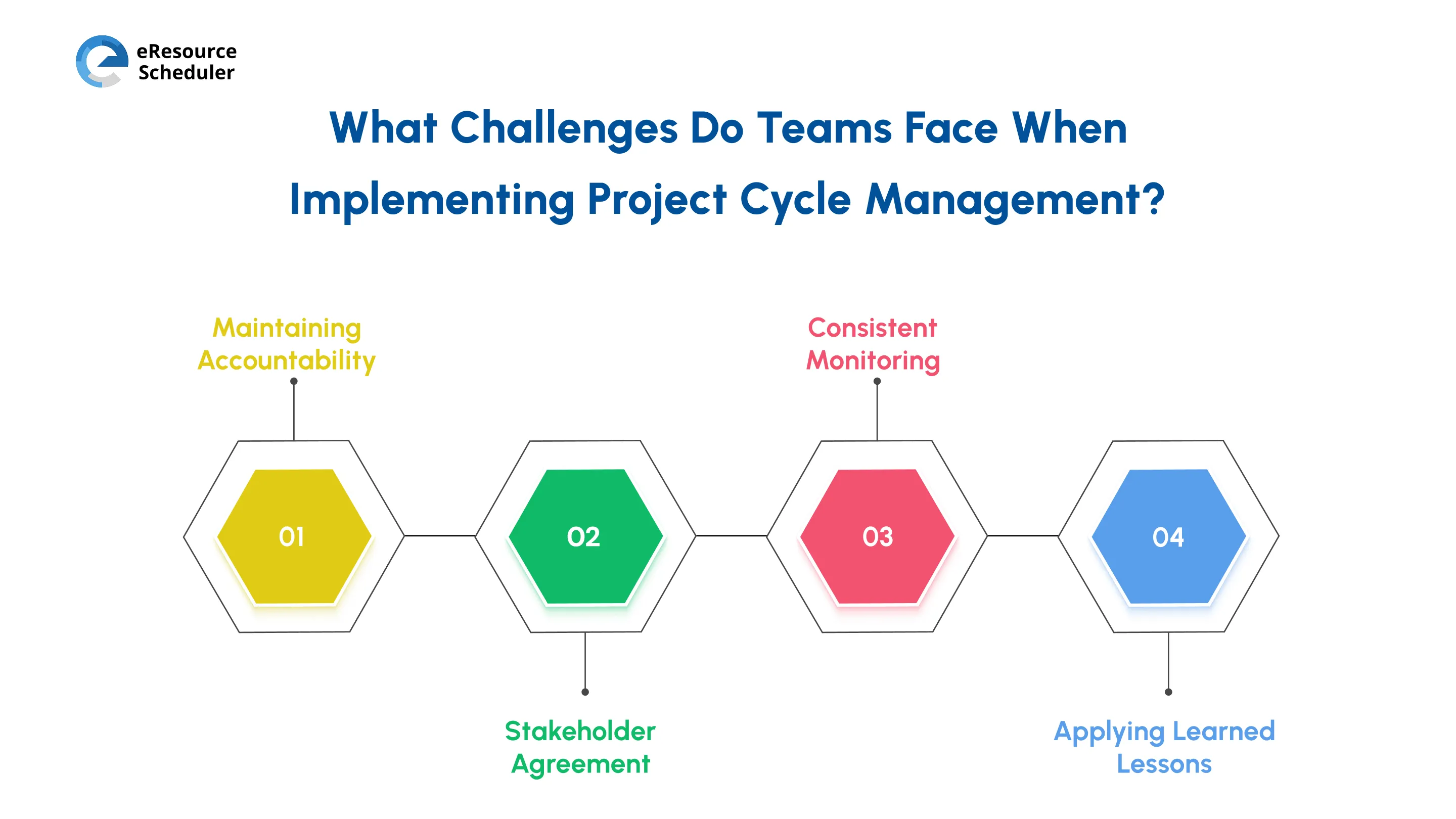
Project Cycle Management has clear benefits. But they have no advantage if not used properly. Teams usually face these challenges:
1. Teams ignore reviews when switching phases when they lack time. Skipping removes the accountability from the PCM. This is a common happening in planning and execution.
2. All the involved parties must agree to the objectives. If they are not on the same page during initiation, disagreements pop up in execution. This leads to conflicts and project may shut down.
3. Monitoring will only work if you have the latest data. When teams do not have systems that can compare planned vs actual progress live, monitoring slows down and creates gaps.
4. Many teams treat capturing learned lessons as a check-box exercise. Even when the lessons are documented, they bear no fruit if not put into action.
Enterprises run many projects at once. Each project operates at a different phase of cycle. In this case, PCM needs central oversight and state-level management to work properly. Project Cycle Management works best when teams have the following.
Industry Insight:
Scaling Project Cycle Management is as much about building
organizational maturity as it is about following the right process. According to PMI Pulse of
the Profession® 2024 - Summary & Key Insights, the average project performance rate across
organizations is 73.8%, meaning roughly 1 in 4 projects still fail to meet their business goals.
Resource planning and project cycle management are two sides of the same coin. It is built into every phase of the cycle. Checking on the status of available resources in initiation. Setting realistic schedules for resources in planning. Having all the needed resources and machines in execution. Checking if all resources are working as per plan in monitoring.
Successful resource planning means:
When you treat resource planning as an afterthought, projects run into same problems. It becomes a never-ending cycle of:
Did You Know?
According to a KPMG study, 50% of IT organizations had at least one project failure in the previous 12
months. Poor planning and resource management were among the top reasons.
Resource limitations happen in almost every project. The real question is, ‘Are teams ready to respond to them quickly?’ Listed below are some of the tried and tested approaches that are useful.
1. Resource needs should be finalized during planning. This includes checking who is available and outsourcing specialists and contractors.
2. Do not lock in the resource plan at the start. Update the plan at every phase gate as per the scope, schedule, and contractor availability.
3. If an organization is running many projects, a bottleneck in one project affects another. Seeing resource demand over the portfolio helps managers fix conflicts early.
4. Include backup options for every resource plan. It helps for long projects where there is a 99.9% change of conditions changing. The options should keep in mind all factors.
5. Invest in a resource management software that gives you all-around information on available and occupied resources. Provides you with live timesheet updates and generates comparison reports.
eResource Scheduler gives project managers real-time visibility into resource availability, utilization, and allocation across every phase of the project cycle. Start a free trial to see how it works in your environment.

Project cycle management gives teams a reusable, accountable structure for completing complex projects. Here, the value is gained in controlling unplanned decisions. It prevents scope creep, budget overruns, and disagreements between stakeholders.
The metro construction project discussed in the blog is a perfect example of why structure matters. Once a project involves thousands of workers, billions in budget, years of work, and a few dozen stakeholders, instincts stop instincting.
Project Cycle Management gives the framework for a project. Resource planning becomes the operational backbone of that project. For teams that want to improve their planning and delivery, introducing a resource management system provides a starting point.
1. How long is each phase of PCM?
Usually, it depends on the size of the project. A small company may finish initiation and planning in a few weeks and execution in a few months. A railway construction project may take years to complete execution. What matters is the project must meet every requirement at each phase before the next one can start.
2. How will I know if the project cycle management is working?
Look for these four signs.
1) Projects finish on time and within budget
2) Problems are detected during monitoring phase
3) Phase gate reviews are giving out factual decisions
4) Lessons are being implemented in the next project
3. Can I use the same PCM for multiple projects?
Yes. You can use the same cycle for all projects of your organization. It does not matter if they are going on at the same time. It provides central oversight to manage project portfolios.
4. What tools support PCM?
Most organizations use different tools for each phase. Some of these tools include feasibility study templates (initiation), scheduling software (planning), communication platforms (execution), budget tracking tools (monitoring), and document archiving (closure). You can also use resource management software that connects all phases seamlessly and closes the gaps between planned vs actuals.
5. Does PCM work for IT and software projects?
Yes. PCM works wonders for IT projects that run in phases, have clear deliverables, and need stakeholder sign-offs at key points.


Plan Smarter. Schedule Faster. For Free.
Join thousands already using eResource Scheduler to align teams, time, and tasks seamlessly.
 ALL FEATURES INCLUDED