Most teams do not have a problem with ideas. They have a problem with too many of them competing for the same people, the same time, and the same budget. When everything feels urgent and teams have resource conflicts, nothing truly gets the attention it deserves. That is exactly where the project prioritization process breaks down; not from a lack of effort, but from a lack of structure.
This blog breaks down how to prioritize projects in six clear, repeatable steps that actually hold up when priorities shift, resources shrink, and leadership changes direction.
Simply put, project prioritization is the process of ranking projects based on their strategic value, resource requirements, risk profile, and business impact, so your team focuses on work that moves the needle first.
It is not just about labeling things "high," "medium," or "low." Real prioritization in project management means making deliberate trade-off decisions before a single resource is committed. When done well, it prevents the costly downstream effects of context-switching, bottlenecks, and scope creep.
According to the State of Project Management 2026 report by Project Software, only 50% of projects are deemed successful, with project failure rates rising to 13% in 2026, up from 12% the previous year. The report also found that 50% of organizations have no access to real-time KPIs, making it nearly impossible to make informed prioritization decisions mid-flight.
Before jumping into steps, let us address the common misconception: prioritization is not a gut-feel exercise. The best way to prioritize projects is to agree on your criteria upfront, score every project against those criteria, and then make decisions based on evidence instead of seniority or noise.

Common criteria for prioritizing projects include:
Did You Know?
Research published in the International Journal of Lean Six Sigma (Mariani & Mancini, 2026) found that organizations applying data-driven project portfolio selection using machine learning on historical critical success factors significantly improved both governance quality and resource allocation outcomes compared to teams relying on manual scoring alone.
The most straightforward answer to this question is: before execution begins, but the process does not end there. Priorities are established during the project intake and portfolio planning phase, typically before resources are allocated. However, they must be revisited continuously as business conditions evolve. A priority set in January can be completely wrong by March. This is why the project prioritization process needs a scheduled review cadence, not a once-a-year conversation.
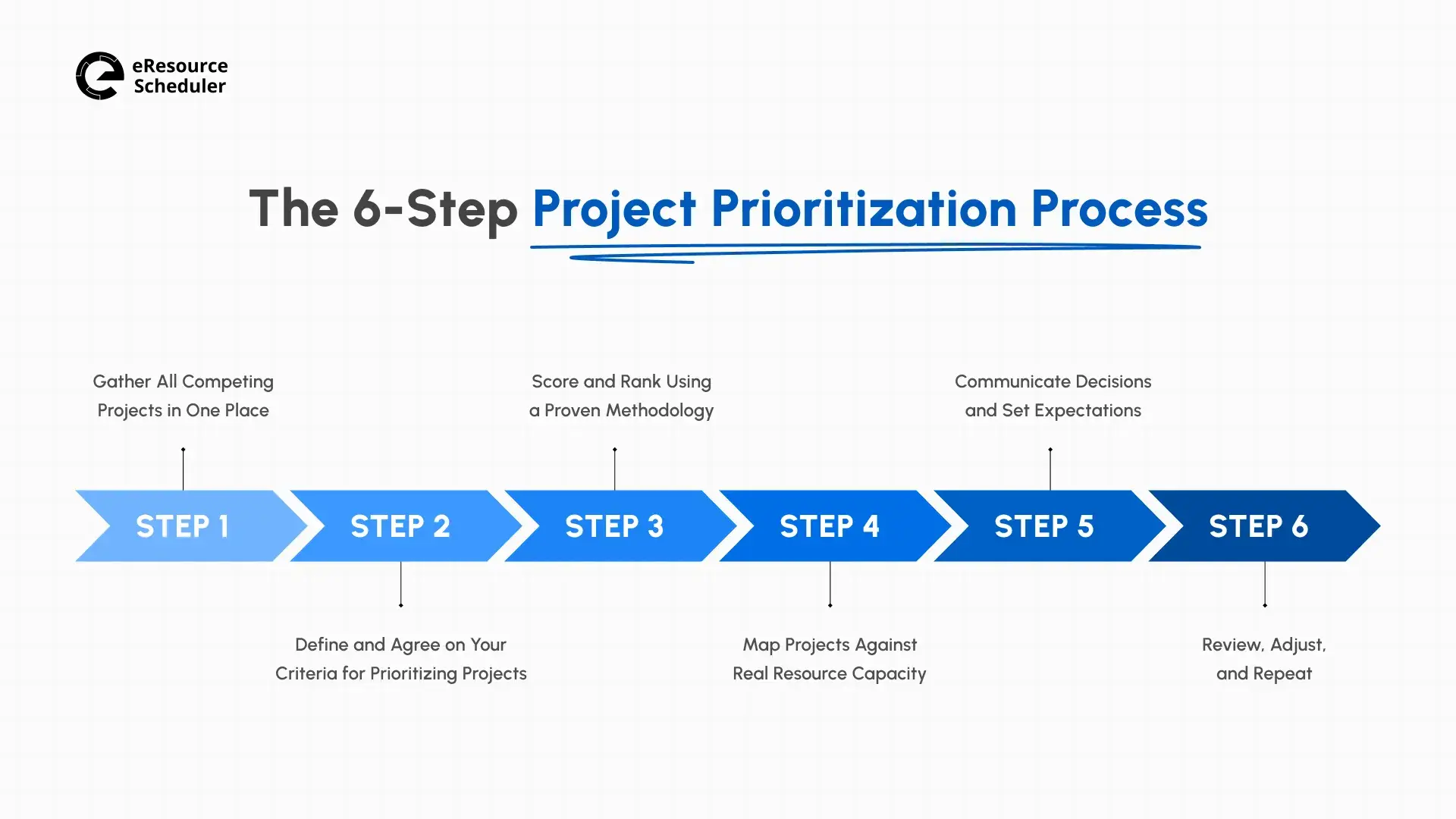
You cannot prioritize what you cannot see. Start by creating a single inventory of every active and incoming project across departments, teams, and functions. This sounds obvious, yet most organizations still manage this in disconnected spreadsheets.
A centralized view removes politics from prioritization when a marketing team and an engineering team both request resources; decisions grounded in a shared project list are far more defensible than those based on whoever last spoke to the manager.
Pro Tip
Include not just approved projects, but also projects that are "under consideration." Many deprioritization decisions happen too late because informal work gets a head start before it is ever formally assessed.
This step is where most project prioritization frameworks fall apart. Teams skip directly to scoring without first agreeing on what they are scoring against. The result is a ranking that reflects individual biases rather than collective strategy.
Get your stakeholders in a room or a shared document and agree on four to six criteria for prioritizing projects. Assign a weight to each one. For instance, strategic alignment might carry 30% weight while resource intensity carries 20%. Whatever your model, make it visible and shared.
This is also the right moment to define your task priority levels: what constitutes a P1 versus a P4, how urgency differs from importance, and what threshold a project must clear to even enter the queue.
Once your criteria are locked, it is time to score. This is where project prioritization methodologies do the heavy lifting. A few worth knowing:
There is no universal winner among these project prioritization methodologies. The best one is the one your team will actually use consistently.
Prioritization without resource context is just wishful thinking. Step four is where you match your ranked list against actual capacity, like who is available, when, and at what skill level.
This is the most common point of failure in the project prioritization process. A project scores highly on strategic value but requires your two most stretched engineers for the next six weeks. Without this overlay, you end up rubber-stamping a plan that will fail in execution.
How do you manage projects and prioritize tasks when resources are limited? The answer is resource demand modeling. Forecasting what each project needs in terms of time, skills, and budget, then comparing that demand against available supply before finalizing priorities.
Resource scheduling tools make this analysis visible. When capacity data is connected to your priority decisions, you stop running everything at half speed and start making real trade-offs.
Pop Quiz
Your marketing team has three campaigns ready to launch, two product updates pending, and one compliance requirement with a hard deadline. How do you manage projects and prioritize tasks across all of them?
Answer: Start with the compliance deadline (non-negotiable), score the rest on strategic alignment and resource availability, and defer or reduce scope on the lowest-scoring items rather than spreading your team thin across all five.
Prioritization that stays inside a spreadsheet solves nothing. Once your ranked list is finalized and mapped to capacity, it needs to be communicated to every team lead, project owner, and relevant stakeholder.
This step is particularly important when handling changes in project timelines or priorities. When a new request arrives mid-quarter or a business priority shifts, the communication layer is what keeps the team aligned. Without a documented priority stack, every change triggers a full renegotiation.
When sharing prioritization decisions, be explicit about:
Transparency here is not a soft skill but a necessity.
A priority list is not a monument. Market conditions shift. Clients escalate. Resources get pulled. Budgets change. Changes in project timelines or priorities are not exceptions but a norm. Build a regular review cadence into your process: weekly at the task level, monthly at the project level, and quarterly at the portfolio level.
During each review, ask three questions:
1. Has the strategic value of this project changed?
2. Has our resource availability changed?
3. Are there new projects that outrank anything currently in flight?
This is also the moment to revisit your criteria for prioritizing projects, especially if your organization's goals have shifted. Scoring models built around last year's priorities will misrank this year's opportunities.

Marketing teams operate under a specific version of the prioritization challenge: high output expectations, lean teams, and constant requests from across the business. How to prioritize marketing tasks with limited resources deserves its own consideration.
The Content Marketing Institute's 2026 B2B Marketing Report (conducted with MarketingProfs, surveying 1,000+ B2B marketers) found that while 9 in 10 marketers now use AI to generate content, fewer than 4 in 10 report it has actually improved performance. The implication is clear: speed without prioritization still produces the wrong output, faster.
For marketing teams, effective prioritization in project management looks like this:
The goal of ‘how to prioritize projects’ is not to work more. It is to make confident, defensible decisions about where your team's energy goes and to protect that decision when someone inevitably asks why project X is ahead of project Y.
A disciplined project prioritization process backed by agreed criteria, real resource data, and a regular review cycle turns your portfolio from a reactive backlog into a strategic engine. The six steps above are not theory. They are the operating rhythm of high-performing teams.
eResource Scheduler is a resource management and scheduling software used by organizations across 29 countries. It helps project-driven teams make smarter capacity decisions, manage resource demand, and align people to priorities in real time.


Plan Smarter. Schedule Faster. For Free.
Join thousands already using eResource Scheduler to align teams, time, and tasks seamlessly.
 ALL FEATURES INCLUDED