Learn more
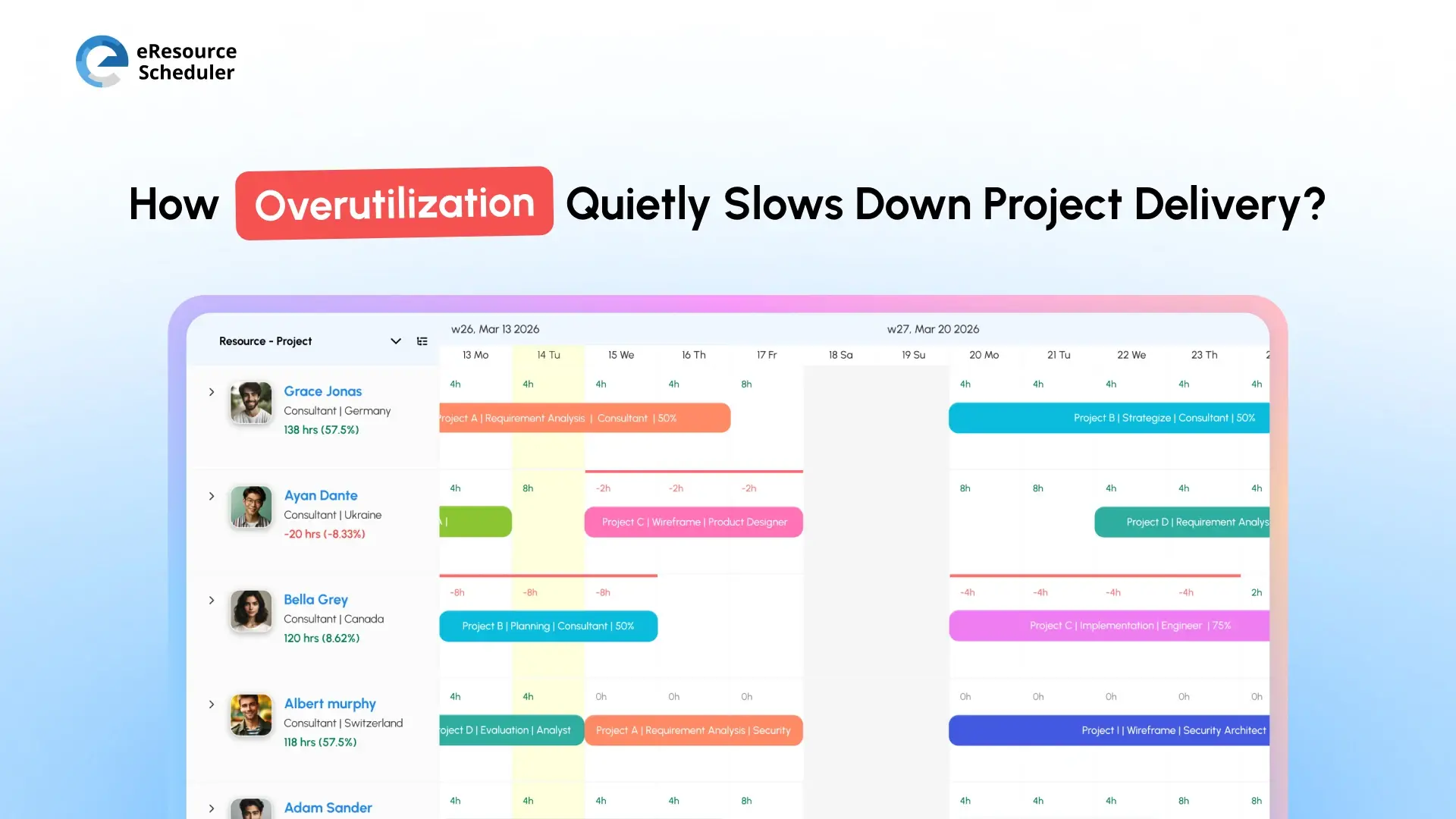
At eResource Scheduler, we have helped track scheduling patterns across industries and team sizes for years, and we keep hearing the same story. Most project delays start when someone’s allocation quietly crosses 100%, and the schedule carries on as if nothing has changed. We’re writing this blog because this moment deserves a conversation. Most project teams have what they need to prevent this situation. But they are not using it correctly.
If you are already using resource management software to manage and schedule your team, this blog will help you use it more effectively. If you are not using one, it might show exactly why the software is worth your attention.
According to Eagle Hill Consulting’s Workforce Burnout Survey, 55% of the US workforce is currently experiencing burnout. This is not just a wellness headline. This is a project delivery problem hiding behind full calendars and people staying late.
TL;DR
1. Overutilization means consistently assigning more work than an employee’s available capacity allows.
2. Overutilization often goes unnoticed until projects are already behind schedule.
3. One overloaded team member can hold up three to five dependent tasks downstream.
4. The sustainable productivity target sits between 70% and 80% utilization.
5. Real-time visibility and resource capacity planning are your strongest prevention tools.
Overutilization, in plain terms, is what happens when you ask your team to deliver more than they genuinely have time and energy for. This condition continues even after a week has passed, not just during a tough sprint.
When someone is scheduled across three simultaneous projects at 120% capacity across all, that’s not high performance. That’s a ticking clock on quality, morale, and delivery.
This is where managers trip the most. Being busy and being overutilized feel similar from the outside, but they lead to very different outcomes.
| Dimension | Being Busy | Being Overutilized |
| Workload | High but within available capacity | Consistently exceeds available hours |
| Duration | Temporary, tied to a sprint or peak period | Prolonged and becomes the default state |
| Output Quality | Maintained throughout | Degrades over time as fatigue sets in |
| Employee State | Energized and focused | Fatigued, disengaged, and stressed |
| Visibility to Managers | Usually visible and planned for | Often invisible without the right tools |
| Recovery | Natural once the peak period ends | Requires active intervention to reverse |
Now we know that being busy is just a phase, but being overutilized is becoming the reality for most. But it is not limited to humans. Overutilization spans across categories, which we will cover next.
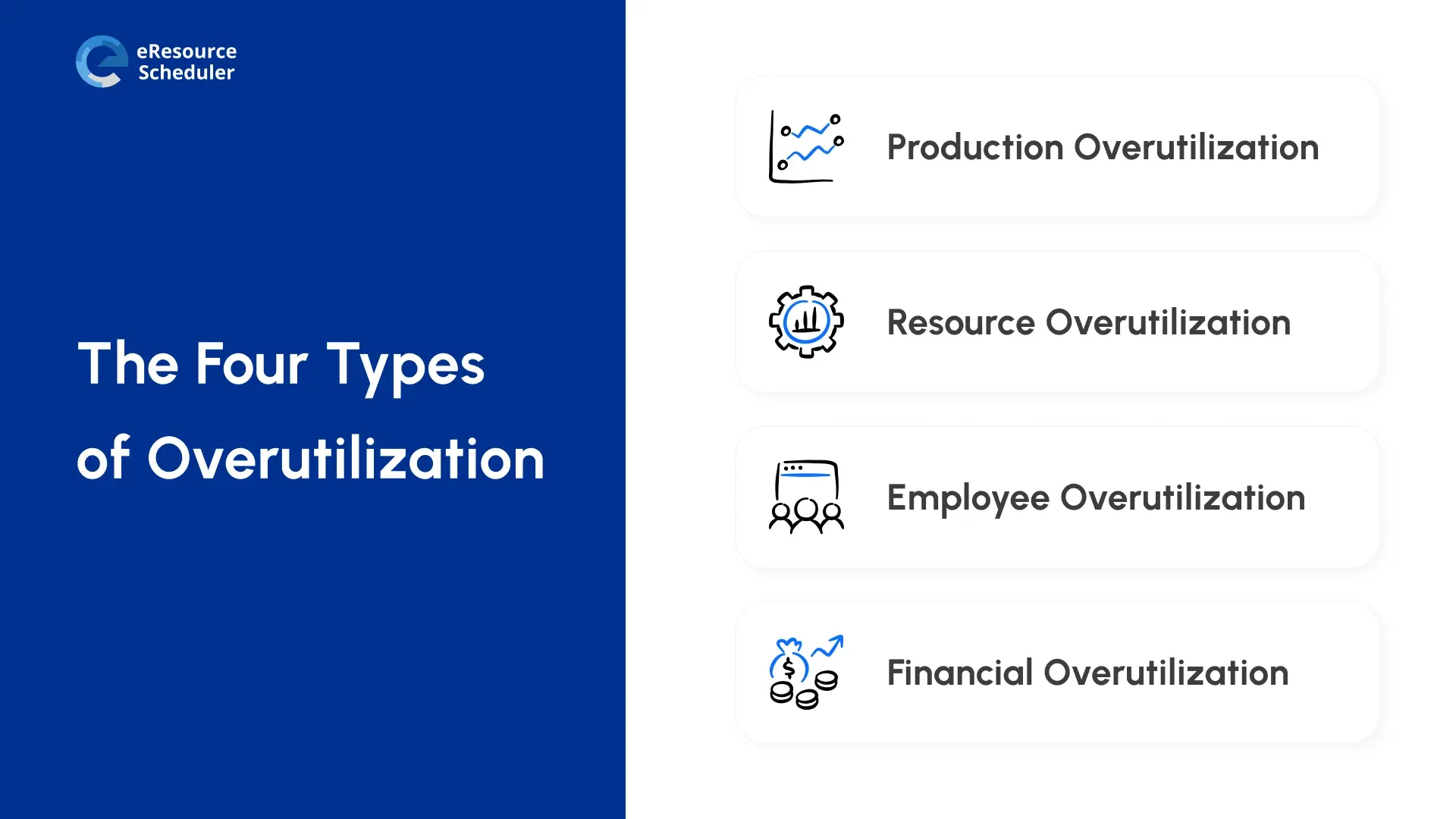
Overutilization is not a single concept. You’ll see four types discussed across projects and operations contexts.
This article focuses on employee overutilization and its direct effect on the project delivery timeline.
What Is a Healthy Employee Utilization Rate?
The range that you must keep in mind is
70% to 80%.
According to the SPI
research from Deltek, the average utilization rate across consulting and professional services
organizations sits at just over 71%. Top-performing organizations target 80% as their goal for optimizing
resource allocation.
Targeting 100% sounds efficient. But in practice, it means zero buffer when something
goes wrong. At 70%-80% range, your team has room for meetings, unexpected blockers, handoffs, and actual
thinking time without crossing into the burnout territory.
Knowing what the healthy range looks like is a starting point. Understanding what breaks when you leave that range is where the real cost becomes visible.
Just picture this. Amelia is your strongest project lead. She’s running three projects simultaneously. Each occupies roughly 40% of her time. On paper, that’s approx 120%. In practice, she is constantly switching contexts. Abandoning smaller handoffs to focus on what’s most urgent. Spending her evenings catching up on messages that fell through during the day.
Nobody was able to flag this because they were not looking at all three projects in the same frame at the same time. This is one of the factors that causes overutilization not just of Amelia but also of several other employees in the organization.
Overutilization doesn’t happen because of bad intentions. It comes from gaps in planning visibility. The most common causes are:
When your organization is running short on headcount without realizing it, these causes compound faster. One skill shortage and two scope changes can push a key resource from 75% to 115% in a single planning cycle.
Research from Meditopia shows that teams that experience high burnout have 18-20% lower productivity. This is not a marginal dip; this is nearly a fifth of the team’s output quietly disappearing.
The American Journal of Preventive Measures calculates that disengagement and burnout over a one-year period costs an employer an average of $3,999/employee. That’s close to $200,000 for a 50-person team. It combines hidden annual losses, missed client deadlines, and the cost of replacing the people who eventually leave.
Knowing the cost of overutilizing your employees is important. Understanding how it derails your projects, step-by-step, is what makes the case for hanging it.
This is a part most project reviewers never reach. Overutilization doesn’t add a flag to your project tracker labeled ‘delay incoming’. It works its way slowly and quietly. By the time you notice it, the cost of recovery has already multiplied.
When one person is running at over 110% capacity, they make their own calls for priority. The task that feels less urgent gets deprioritized. Suddenly, tasks listed as ‘in progress’ haven’t actually progressed in reality. The project manager adjusts the time by a few days/weeks. The client is sent an email with the revised date. The team strives to catch up. Result:
This is also the point where the team’s morale and collaboration break down. Overloaded employees do not have the bandwidth to include communication, follow-ups, and problem detection. The resource conflicts between teams add a layer on top of everything else you are already managing.
The impact of overutilization on project pipelines is cumulative. Here is how the sequence typically plays out.
Getting ahead of time pressure requires you to see capacity problems coming, not responding to them when they have already arrived, which affects milestones and the budget.
Research Extract:
A policy analysis by the State
Health Value Strategies program and the Robert Wood Johnson Foundation found that
overutilization in any system consistently generates waste, reduces output quality, and drives up costs over
time. The pattern holds across sectors: when systems run beyond sustainable capacity, both quality and
efficiency decline together.
Ready to see what your team’s utilization looks like? Explore eResource Scheduler and get a live view of your team’s capacity. Book a demo today!

Once you see how overutilization damages timelines, naturally, the next question arises. What does getting it right actually look like?
| Factor | Optimal Utilization | Overutilization |
| Workload | Matched to available capacity | Consistently exceeds available hours |
| Productivity | Stable and sustainable | Declines under sustained pressure |
| Output Quality | Consistent | Increases in errors and rework |
| Employee Wellbeing | Engaged and energized | Burnout and chronic stress |
| Delivery Predictability | High | Frequently missed |
| Retention | Stronger | Elevated voluntary turnover |
Moving from overutilization to optimal utilization is a process, not a one-time adjustment. Here is where to start.
1. Schedule based on actual available capacity, not assumed theory.
2. Set live utilization alerts so managers are notified before someone hits overload.
3. Rebalance workloads proactively. Especially when scope changes or someone is on leave.
4. Build buffers proportional to the actual complexity of each project, not the optimized one.
5. Use timesheet data weekly to compare planned against actual efforts.
6. Build a habit of forecasting resource demand weeks ahead so your decisions are data-backed.
To get started on the right footing, understand how to measure resource utilization. It is necessary to review utilization rates before you set any targets.
One of the core reasons overutilization goes unnoticed is a lack of a single source of truth. There is no complete picture of who is working on what across all active projects. Spreadsheets go stale. Status meetings happen once a week. By the time problems surface, they have already started affecting delivery.
A purpose-built resource management software closes the gap. It gives you:
eResource Scheduler is an all-in-one resource management system that gives you all these in one place. It lets you see utilization across all active work and reassign tasks before bottlenecks form. Back every scheduling call with data and not assumptions.
This means the decision to move a resource or adjust a deadline is grounded in what’s actually happening in real-time. Not on what someone assumes must be happening.

When your team operates within a sustainable capacity range, the improvement shows up quickly and consistently.
Quick Tip:
Before changing anything in your scheduling process, run a utilization
audit. Pull actual hours against planned hours for your best performers. The gap between those two numbers will
show you exactly where the overload is sitting. That is your real starting point.
Most project teams do not struggle because they lack commitment. They struggle because their efforts and commitment are measured. Capacity is not.
That’s the shift worth making. Not a new tool, not a new process, not a bigger team. Just an honest, consistent answer to one question. Does the work you are assigning actually fit within the time and capacity your people have?
When the answer to this question becomes visible, everything downstream gets easier.
Match work to actual capacity. Build buffers that reflect real project complexity, not the optimistic version. Give your team visibility into their own load before it becomes unmanageable. When these three things are in place, you stop spending your time reacting to delays and start spending it preventing them.
The work doesn't get lighter. The planning just gets more honest.
1. How do you improve project delivery efficiency?
Start by checking how your resources are allocated before you look at anything else. Overutilized teams are the most common reason projects run late. When you match workload to actual capacity, build realistic buffers, and track planned hours against actual hours weekly, delivery becomes more predictable without anyone having to work harder.
2. What is the most common challenge faced by project managers?
Overutilization of key team members. Most project managers are managing deadlines, budgets, and stakeholders simultaneously, and resource overload often goes unnoticed until a milestone slips. Without cross-project visibility into who is working on what and how much, it is very easy to assign more work than your team can realistically deliver.
3. Which activity is most crucial in project scheduling to avoid delays?
Capacity planning. Knowing your deadlines matters, but knowing whether your team actually has the hours to meet them matters more. Scheduling without a capacity check is the most direct route to overutilization, and overutilization is the most direct route to delays. Build your schedule around available capacity first, then work outward from there.
4. How does resource allocation affect project delays?
Directly and significantly. When work is assigned without checking actual availability, the most relied-upon team members get overloaded first. They slow down, make more errors, and create bottlenecks at every handoff and approval stage. Every delayed task pushes dependent tasks further out. What starts as a small allocation mismatch compounds quickly into a full project overrun.
5. How do you prioritize tasks when your team is overloaded?
Focus on what is blocking other people first. Identify which tasks, if delayed, hold up the most downstream work and protect those above everything else. Redistribute tasks that do not require specific expertise to team members who have available hours. If the overload cannot be redistributed, the timeline needs to move. Keeping an unrealistic deadline in place only deepens the overutilization.


Plan Smarter. Schedule Faster. For Free.
Join thousands already using eResource Scheduler to align teams, time, and tasks seamlessly.
 ALL FEATURES INCLUDED