Learn more
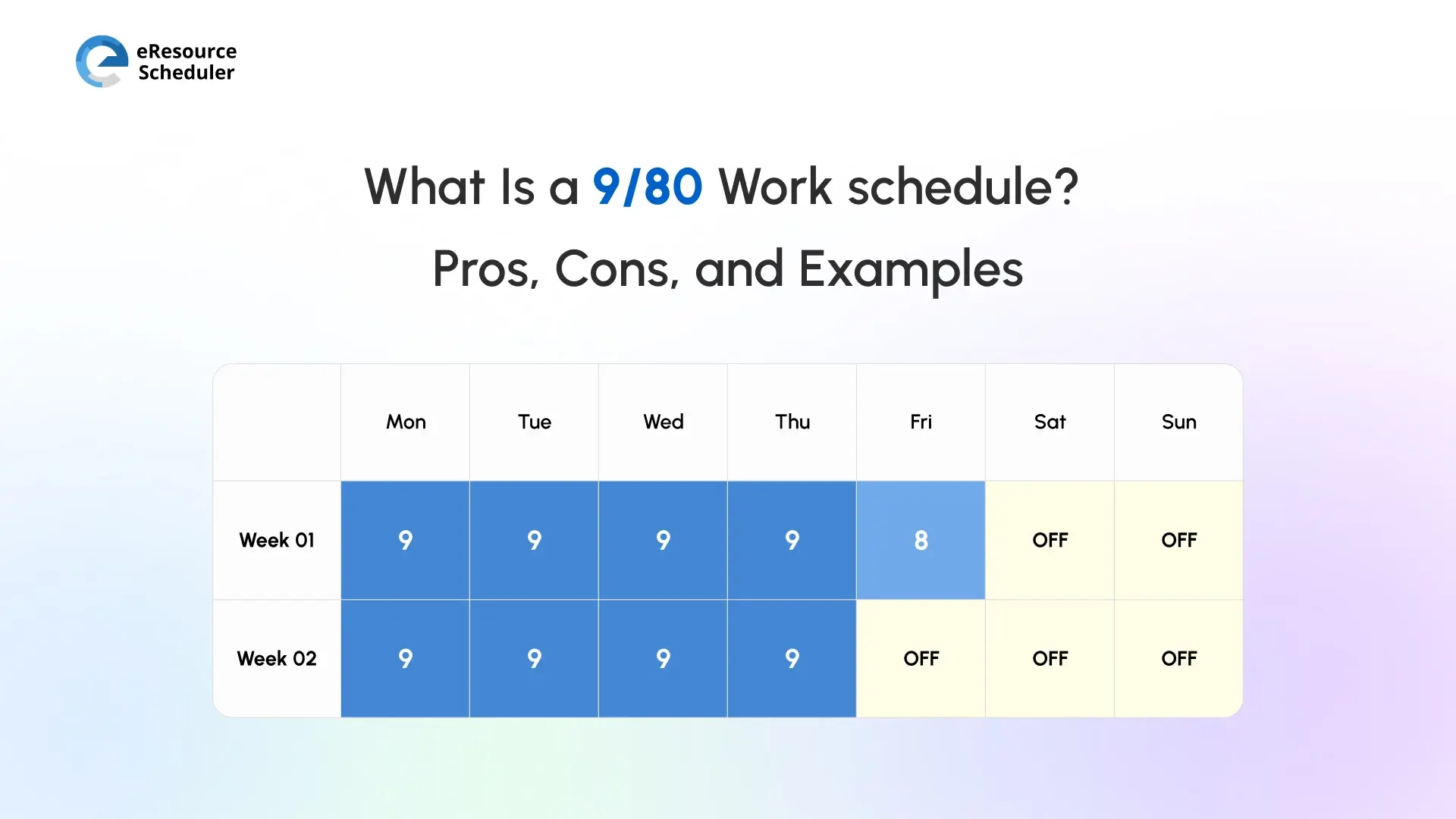
A 9/80 work schedule compresses a standard two-week work period into nine days, letting employees work 80 hours across this shorter timeframe. Essentially, it means working longer days for eight days, with one shorter day, and gaining a three-day weekend every other week.
For organizations, implementing this setup requires careful planning to avoid gaps in coverage or uneven workloads. Many teams rely on resource scheduling software to map shifts, track hours, and ensure the schedule aligns with project needs without disrupting operations.
In this article, we break down what a 9/80 work schedule means, explore how it works, look at examples across industries, examine its pros and cons, and understand the best practices for implementation.
A 9/80 work schedule is designed to give employees a compressed workweek without reducing total hours. In simple terms, it allows a full-time employee to complete 80 hours over nine days instead of ten across two weeks.
Understanding what a 9/80 work schedule means is crucial for both employees and managers, as it changes daily routines, team availability, and payroll calculations.
The structure typically involves working eight 9-hour days and one 8-hour day, followed by an extra day off every other week. To make this arrangement functional, organizations often turn to resource scheduling software, which helps track hours, manage overlapping projects, and ensure coverage across teams.
With this foundation, it becomes easier to see how a 9/80 schedule works in practice and explore 9/80 work schedule examples across different industries.

Gartner’s 2024 future-of-work framework highlights that HR leaders are prioritizing flexibility and experimenting with non-traditional work arrangements, such as four-day workweeks and flexible workweeks, as key talent strategies. Implementing a 9/80 schedule requires thoughtful planning to ensure workloads, meetings, and deadlines remain aligned. The structure typically follows:
Understanding these mechanics provides the foundation for 9/80 work schedule examples, showing how different industries implement this model in practice.
Examples vary by industry, depending on how teams manage client demands, deadlines, and internal coordination. While the core structure remains consistent, organizations adapt the model to ensure coverage, maintain productivity, and avoid disruptions.
Consulting firms often stagger team schedules so client coverage remains uninterrupted. Longer workdays are aligned with project delivery cycles, while alternating Fridays off are planned around low client activity periods.
Firms use the 9/80 work week more actively outside peak seasons. During non-filing periods, accounting and audit teams adopt compressed schedules, while busy seasons may require reverting to traditional structures to meet compliance deadlines.
Agencies align extended workdays with campaign production cycles, allowing teams uninterrupted creative time. Off days are staggered to ensure client communication and approvals continue without delays.
Engineering teams leverage longer workdays for deep, focused work on design and development tasks. Engineering teams are split to ensure project continuity, especially in environments where timelines are tightly interdependent.
IT teams structure schedules to maintain system monitoring and support coverage. Alternating days off and adjusted on-call rotations ensure operations remain stable while offering flexibility to the workforce.
Such a schedule is often adopted to balance operational efficiency with evolving workforce expectations. When implemented with clear planning and visibility, this structure can create measurable 9/80 workweek advantages across both employee experience and business outcomes.
An extra day off every other week gives employees predictable downtime. This helps reduce burnout, improves morale, and allows better personal planning without impacting total working hours.
Longer workdays can create extended focus windows, especially for roles that require deep work. Fewer interruptions across the week often translate into better output quality and faster task completion.
Flexible schedules are increasingly seen as a competitive differentiator. Offering a 9/80 work week can help organizations attract and retain talent without changing compensation structures.
Another one of the 9/80 workweek advantages is that with a built-in long weekend, employees are less likely to take unplanned leave. Personal errands and appointments can often be managed without disrupting the workweek.
With the right tool, managers can align workloads, stagger time off, and maintain consistent coverage, ensuring that flexibility does not come at the cost of delivery.
While a 9/80 work schedule offers clear benefits, it also introduces operational and workforce challenges (Curious to know more about operational and workforce challenges? Read more about it here) that organizations need to evaluate upfront. Without the right structure in place, the same flexibility that drives engagement can lead to inefficiencies or employee strain.
Longer workdays can lead to physical and mental fatigue, especially in high-intensity roles. Over time, this may offset the benefits of the extra day off if workloads are not balanced properly.
Coordinating meetings and deadlines becomes more complex when teams operate on alternating days off. Without proper planning, this can lead to delays or missed alignments across teams.
Not every role or individual can adapt to extended work hours. Customer-facing roles or employees with personal constraints may find the schedule difficult to sustain.
Tracking overtime becomes more nuanced under a 9/80 structure. Misalignment in how hours are calculated can lead to compliance risks, especially across different regions or labor laws.
With staggered schedules, teams may experience gaps in communication. Important updates or decisions can be delayed if key stakeholders are unavailable on overlapping workdays.
| 9/80 WORK SCHEDULE | |
| Advantages | Disadvantages |
| Improved work-life balance | Fatigue and burnout |
| Increased productivity | Scheduling conflicts |
| Higher employee retention | Not suitable for all employees |
| Reduced absenteeism | Issues with overtime |
| Better resource utilization | Miscommunication and collaboration issues |

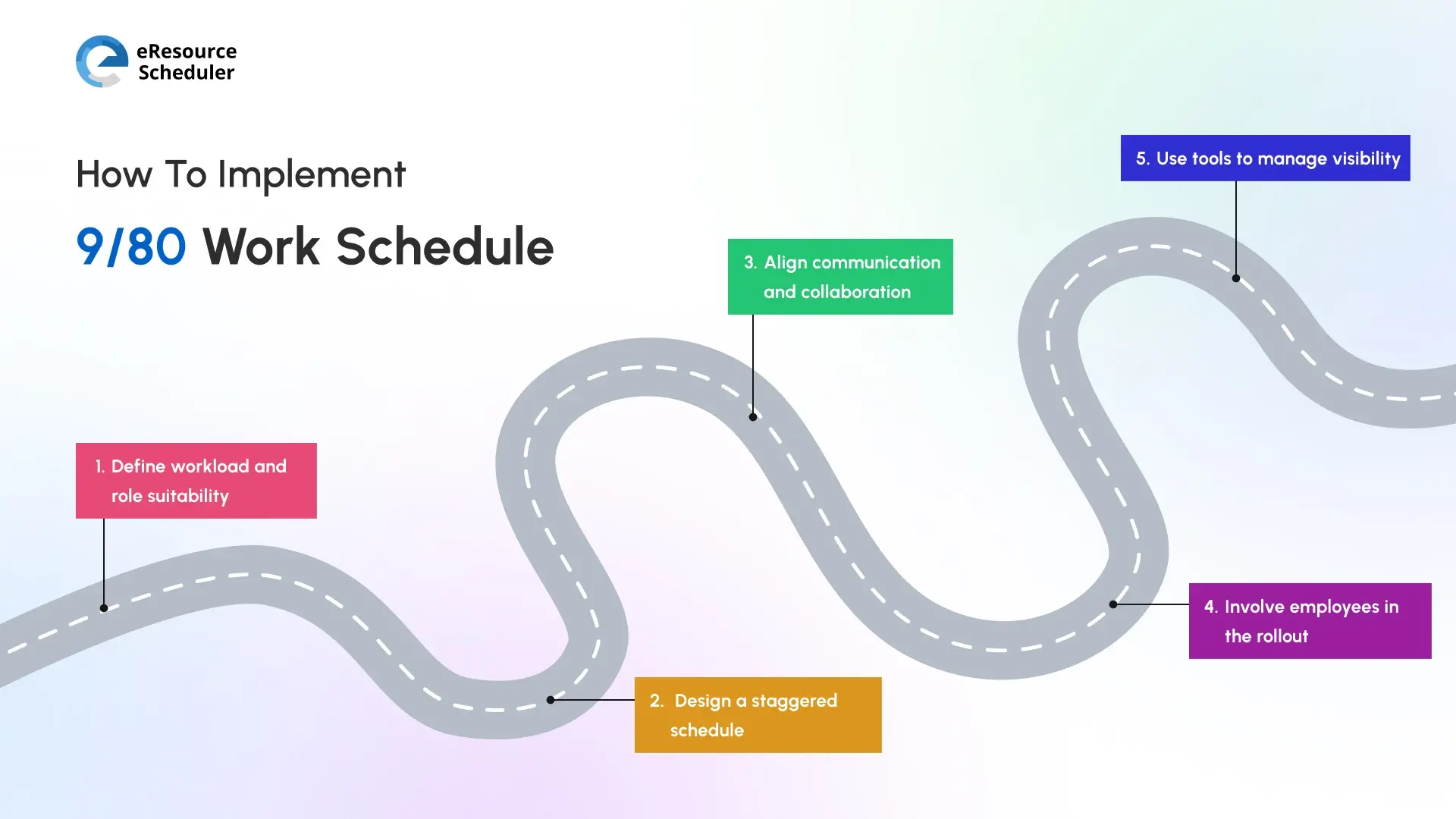
Implementing is less about shifting hours and more about redesigning how work gets done. Research that examined the relationship between flexible working arrangements and employee performance shows that flexible work arrangements are most effective when supported by clear coordination, structured communication, and employee alignment, as these factors directly influence performance and outcomes.
Not every role fits a 9/80 structure. Start by identifying teams where work can be planned in advance and does not require constant real-time availability. Roles with project-based output tend to adapt better than purely reactive ones.
To maintain coverage, split teams into groups with alternating days off. This ensures business continuity, especially for client-facing or operational functions. Flexible staffing models are often recommended to avoid service gaps.
Compressed schedules require intentional collaboration. Teams must define overlapping work hours, meeting cadences, and handoff processes to prevent delays and miscommunication.
Work models perform better when employees are involved in the design process, with research showing that participatory approaches improve adoption, increase engagement, and reduce resistance to change.
Implementing a 9/80 work week at scale requires clear visibility into availability, workloads, and timelines. Resource scheduling software helps map shifts, track capacity, and ensure that flexibility does not disrupt delivery.
Managing resource schedules requires more than shifting hours. Capterra’s article ‘The “Where” of Work Has Been Upended—Next Is the “When”‘ highlights that flexible work models often struggle with workload tracking, productivity measurement, and inconsistent availability, making structured scheduling essential for operational stability.
Everything looks good on paper. It succeeds or fails in how teams are actually staffed, scheduled, and kept available. The difference shows up in coverage gaps, missed handoffs, or a week that runs smoothly without anyone noticing the shift.
Here’s how a typical 9/80 workweek is put into action:
Week 1
Week 2
Now layer in how teams actually operate. One group takes Friday off in Week 2, while another works. Client calls still get answered. Deadlines don’t move. Work doesn’t pile up for Monday.
Where this gets real is in the details. A developer hands off a task on Thursday evening, knowing the next touchpoint is Monday. A consultant schedules client reviews only on overlap days. A manager spots two critical resources off on the same day and adjusts before it becomes a problem.
The schedule stays the same. The execution changes everything.
A 9/80 work schedule puts pressure on how well resources are planned and tracked. eResource Scheduler supports this with clear visibility into resource availability, structured capacity planning, and integrated timesheets.
Teams can map workloads across alternating schedules, track actual hours worked, and ensure utilization stays balanced without disrupting delivery. Thinking about implementing the 9/80 schedule for your team? Book a demo and see how eResource Scheduler can help.
1. How many hours are worked in a 9/80 schedule each week?
A 9/80 work schedule totals 80 hours over two weeks. This is typically split into 44 hours in the first week and 36 hours in the second, depending on how the 8-hour day is structured.
2. What are the rules for a 9/80 schedule?
A 9/80 schedule requires completing 80 hours across nine days, with a clearly defined workweek split to ensure accurate overtime calculation. Organizations must also ensure compliance with labor laws and consistent tracking of employee hours.
3. How does a company benefit from a 9/80 work schedule?
Companies benefit through improved resource utilization, better employee retention, and more focused work periods. When managed well, it supports flexibility without impacting overall productivity or delivery timelines.
4. What are the best practices for implementing a 9/80 workweek?
Successful implementation depends on clear workload planning, staggered schedules for coverage, defined collaboration windows, and accurate tracking of hours. Consistent communication and structured scheduling are critical to avoid disruptions.
5. What tools help manage a 9/80 work schedule effectively?
Managing a 9/80 work schedule requires visibility into availability, workloads, and actual hours worked. Tools that support resource scheduling, capacity planning, and timesheets help organizations maintain balance and ensure consistent delivery.



Plan Smarter. Schedule Faster. For Free.
Join thousands already using eResource Scheduler to align teams, time, and tasks seamlessly.
 ALL FEATURES INCLUDED