





 Learn more
"You can't manage what you don't measure." That's Peter Drucker.
He said this about management broadly. In 2026, it applies almost surgically to how businesses track and account for employee time.
There is a number that should make every CFO sit up straight: $588 billion.
That is how much employee distractions and poor time management cost U.S. businesses every single year, according to research cited across multiple workforce productivity reports. The figure does not even account for what gets lost in the gap between hours worked and hours accurately recorded.
That is the productivity problem, and it is real. But it is not the same problem as the one this guide is about.
A workforce can be genuinely busy and still have no idea where its hours actually went, who logged what, or whether the numbers on a timesheet bear any resemblance to the work that happened. That is the time tracking problem. It is separate from the productivity problem, and in many ways, it is more fixable, because it does not require changing how people work.
Getting time tracking for business right is less about new technology and more about closing that gap. It requires changing how that work gets recorded.
What is time tracking, exactly? Time tracking is the systematic process of recording how work hours are allocated across tasks, projects, clients, or cost centers over a defined period. Businesses use team time tracking to improve payroll accuracy, control project costs, meet compliance requirements, and understand how labor is actually being spent.
This chapter explains what time tracking is, why it matters more now than ever, and what separates organizations that use it as a back-office checkbox from those using it as a genuine competitive advantage.
The price of getting this wrong is not abstract, and it is not small. Two independent sources, looking at the problem from different angles, land on roughly the same conclusion.
An estimate widely cited across the payroll industry puts a floor on the damage from manual error alone: human error in manual payroll processing creates an error rate of one to eight percent of total payroll.
HiBob went further, surveying 2,000 US employees, including 541 HR and finance professionals, in 2025, and found the gap shows up even at organizations that employees assume have this under control:
Multiply that last figure across a mid-size workforce, and the number stops looking like a rounding error. It starts looking like a trust problem with a price tag attached.
Time that was genuinely worked but poorly directed, and time that was recorded but never actually worked, or vice versa, both of these things are fixable. Both require the same starting point: taking time tracking seriously as a strategic function, not an administrative afterthought.
DID YOU KNOW? Healthcare is the fastest-growing vertical in time tracking software adoption, expanding at a 15.1 percent compound annual growth rate, well ahead of the broader market's already strong 13.38 percent. The driver is not a productivity culture. It is audit trails.
When the cost of a tracking gap is a regulatory finding instead of a billing dispute, accuracy stops being optional and starts being existential.
These two terms get used interchangeably in most workplaces. They are not the same thing, and confusing them is often the first reason a system breaks down.
Time tracking is the act and process of recording how time is spent. That can mean a live timer, a manual entry, a mobile app, or a biometric clock-in.
Timesheets are the structured output of that tracking. A formalized record organized by period (daily, weekly, biweekly), showing who worked, when, on what, and for how long.
Think of a time tracker as the input mechanism and the timesheet as the output document. The quality of the timesheet is entirely dependent on the quality of the time tracking behavior and tools that feed it. You cannot fix a bad output by reformatting it. You fix it by fixing what feeds it.
This distinction matters in practice, not just in theory. Most timesheet problems are actually time tracking problems in disguise.
Take a manager who spends every Friday afternoon chasing down missing entries. That is not a timesheet problem. It is the downstream symptom of an input system nobody designed to be easy, fast, or habitual. Fix the output without fixing the input, and the same chase starts over next Friday. The fix has to start at the source.
At its simplest, time tracking answers the question: where did our time go? At its most sophisticated, it answers: where should our time go next?
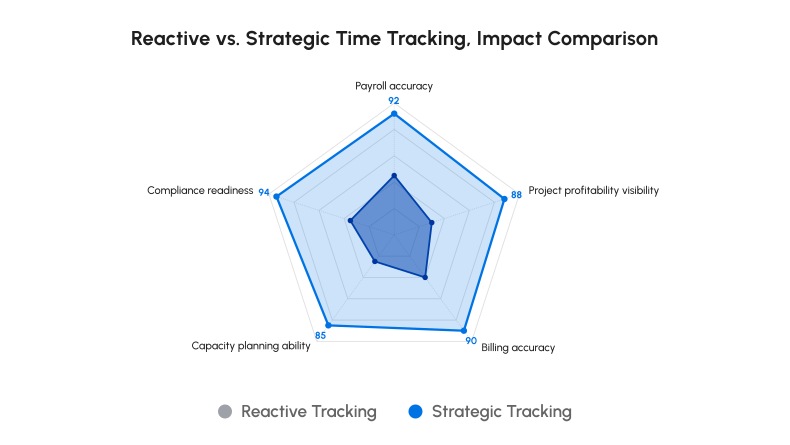
Once you know what is a timesheet really for, the answer is more than one job. The modern timesheet software does four jobs at once:
Most organizations only use their timesheet software for job one. The smartest ones use them for all four, and the gap between those two groups tends to show up directly on the bottom line.
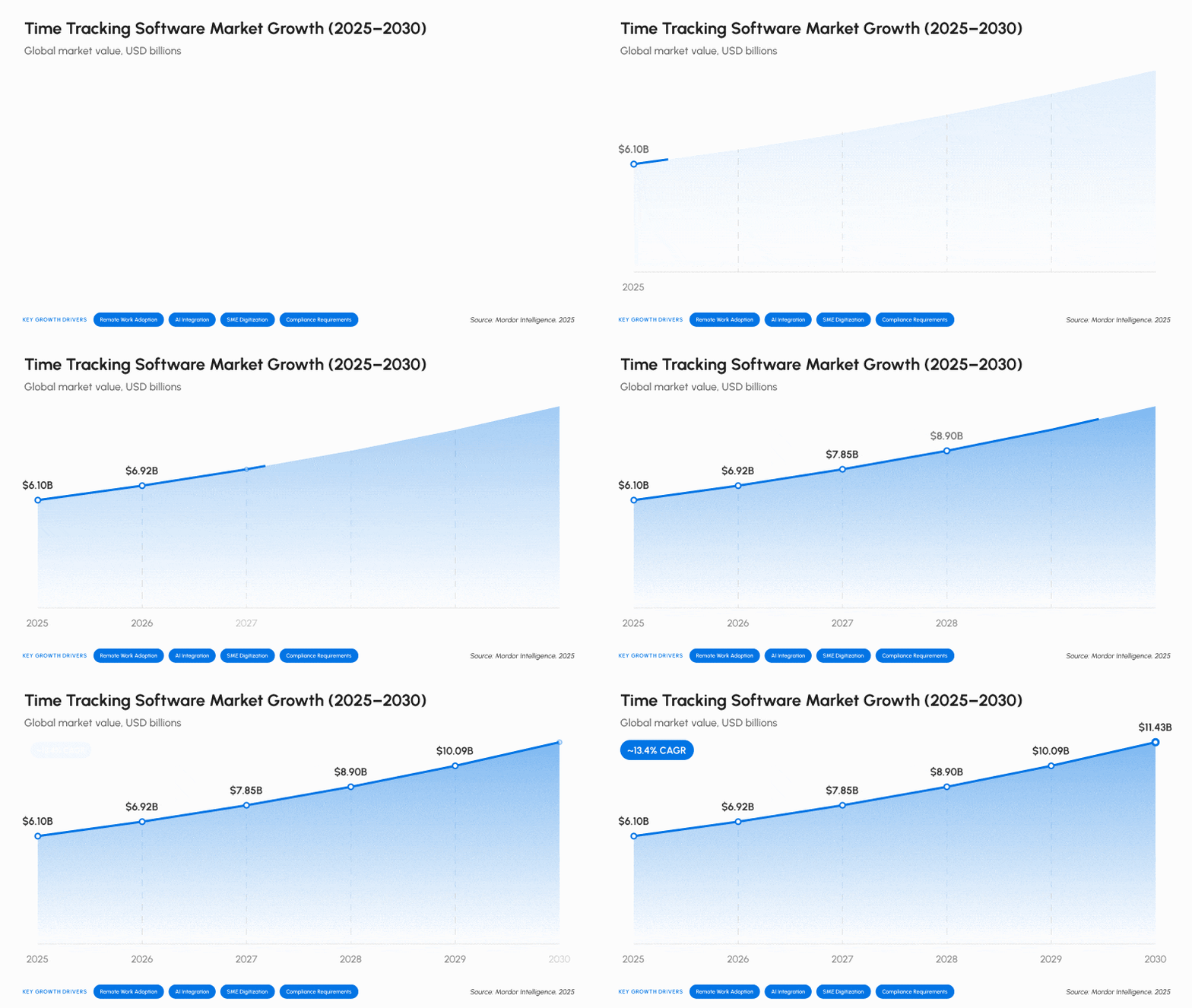
If you ever wondered whether time tracking is a genuine strategic priority or just a back-office checkbox, the market data answers clearly. The global employee time tracking software market stood at USD 6.1 billion in 2025 and is forecast to reach USD 11.43 billion by 2030, reflecting a 13.38 percent compound annual growth rate. Cloud deployment holds a commanding 77.8 percent market share, while SMEs account for 62.8 percent of global revenues. (Source)
That last number is telling. Having a time tracker is no longer just an enterprise concern. Small and medium businesses are driving the category's fastest growth, because they have the most to lose from getting it wrong and the most to gain from getting it right. A large enterprise can absorb a percentage point of payroll error inside its general ledger and barely feel it. A 30-person agency cannot.
The industry itself is shifting in a specific direction: from recording time to interpreting it. Vendors are not just competing on whether they can log an hour accurately anymore. They are competing on what they can tell you once thousands of those hours accumulate.
What is a timesheet today looks very different from what it was a century ago, even if the basic job has not changed. Understanding where timesheets came from helps explain why so many organizations still treat them like administrative overhead rather than strategic assets. The tool has changed dramatically over the past century. The underlying attitude toward it, in a lot of organizations, has not changed nearly as much.
Frederick Winslow Taylor's scientific management movement introduced the idea of measuring labor inputs against outputs with the same rigor an engineer would apply to a machine. Punch cards and paper logs were the tools. The goal was simple: pay workers accurately for the time physically spent on site. Time tracking, at this stage, had nothing to do with strategy. It was a wage dispute prevention mechanism, and not much else.
Law firms, accounting practices, and consultancies adopted billable hour models, and the entire relationship between time and money shifted. Time became a product that could be sold in discrete units. Timesheet compliance became a revenue function, not just a payroll function, because every unlogged hour was now a dollar amount that simply evaporated rather than a wage calculation that someone could double-check later.
Microsoft Excel democratized team time tracking. For the first time, any team, anywhere, could build its own tracking system without IT involvement or a vendor contract. The unintended consequence was fragmentation. Every team did it differently, inconsistently, and with wildly varying degrees of accuracy, which made it nearly impossible to roll data up to a company-wide view that meant anything.
Dedicated timesheet software like Harvest, Toggl, and Replicon moved timesheets into the cloud. For the first time, integration with project management, payroll, and invoicing became technically straightforward rather than a custom engineering project. Time data became connectable to business outcomes in a way spreadsheets had never allowed, because the data finally lived in one place instead of forty.
Remote and hybrid work made accurate team time tracking non-negotiable for distributed teams who could no longer rely on a manager glancing across the office to know who was working. AI-powered employee time tracking software now auto-categorizes work, detects patterns, flags anomalies, and surfaces recommendations before a human ever has to ask for them. The timesheet is becoming a live operating instrument rather than a static record filed away after the fact.
eResource Scheduler sits at this intersection, helping organizations move from passive time tracker recording to active workforce intelligence, using proper timesheets aligned with resource scheduling, financials, and management reports.
Myth: Time tracking is about surveillance. It is a trust issue, full stop.
Reality: The trust problem is real, but it is not caused by tracking itself. It is caused by tracking without transparency. A 2025 ExpressVPN survey of 1,500 US workers found that 56 percent report stress and anxiety connected to workplace surveillance. But the same body of research consistently finds that the variable driving that stress is disclosure, not the existence of tracking.
Employees who know what is being tracked, why, and who can see it respond very differently from employees who discover monitoring after the fact, often through a passing comment from a manager or a line item in a tool they never agreed to.
The lesson for leaders is not to avoid time data. It is to be transparent about it. Tell people what you are tracking, tell them why, and give them visibility into their own data, not just access for the people reviewing it. Trust is not damaged by visibility. It is damaged by surprise.
The honest answer is: any organization where people's time is a cost, a resource, or a billable commodity. That covers a wider range than most leaders assume, and it is worth walking through deliberately rather than assuming your organization is obviously in or obviously out.
Consultancies, agencies, law firms, and accounting practices all live and die by billable accuracy, and the industry data on this is sobering.
SPI Research's 2025 Professional Services Maturity Benchmark, based on 403 firms surveyed across IT consulting, management consulting, and related fields, found that average billable utilization fell to 68.9 percent in 2025, an all-time low and a fourth consecutive year of decline, sitting well below the 70 percent threshold SPI considers the minimum for healthy margins.
That gap between actual and target utilization is not a vague inefficiency. It is unbilled hours sitting on a P&L that a firm is already paying for. A single misallocated hour multiplied across 50 client engagements is real revenue leakage, and at scale, it is the difference between a firm that is busy and a firm that is profitable.
Construction, engineering, and software development need time data to understand whether projects are on budget, to build better estimates for future work, and to identify which project types are actually profitable once labor costs are fully allocated rather than guessed at.
Shift-based scheduling, staff allocation to patient care, and compliance documentation all depend on accurate time records. Healthcare is the fastest-growing sector for time tracking adoption, driven by audit requirements and the need to tie labor directly to patient care outcomes rather than abstract attendance.
Visibility into distributed work cannot rely on physical presence, and that workforce is not shrinking. Upwork's Future Workforce Report projected that 36.2 million Americans would work remotely by 2025, roughly 22 percent of the workforce.
For a manager who can no longer see who is at their desk, time data becomes the proxy for understanding workload, capacity, and collaboration patterns across time zones, not as a surveillance mechanism but as the only remaining signal that previously came from physical presence.
This is the point at which informal time awareness breaks down, and payroll errors start compounding rather than staying as isolated incidents. This is usually the moment time tracking for business stops being optional and starts being structural.
Below this size, a founder can usually still hold the whole operation in their head. Above it, that mental model stops being reliable, and most of these businesses are one audit or one payroll dispute away from finding that out the hard way.
A mid-size digital marketing agency with 50 employees, each earning an average of $25 an hour, was running on a spreadsheet-based timesheet system. Time was logged at the end of each week from memory, and the drift showed up exactly where you would expect it to: an average of 30 minutes per person per day, sometimes over-reported, sometimes under-reported, with no consistent pattern anyone could correct for.
The math:
The cost:
Why does this track with the broader data:
HiBob's 2025 survey also found that 42 percent of employees who experience payroll errors say they happen monthly or every pay cycle, not as rare exceptions. A 50-person team running on memory based logging, with no payroll specialist catching the drift early, is exactly the kind of organization where that frequency becomes normal. The correction burden lands squarely on whoever owns administration, pulling them away from work that actually grows the business.
The fix:
Pro Tip The Two Minute Habit That Fixes Most Timesheet Problems Most timesheet inaccuracy does not come from dishonesty. It comes from distance, the time between doing the work and writing it down. Ask your team to log hours before they log off each day. Two minutes daily beats twenty minutes of guessing every Friday.
Most organizations think they are doing good time tracking. In reality, very few are doing it well. The gap between believing you have a handle on something and actually having one is exactly where most of the cost in this chapter has been hiding. Here is what separates good time tracking from the version most teams are stuck with.
Good time tracking is a habit and a structure, not a feature you switch on.
The difference is not primarily about the tool, although the tool matters. It is about treating time data as a strategic asset rather than a compliance requirement. Two companies can run the same software and get completely different value out of it, depending on which list above describes how they actually use it.
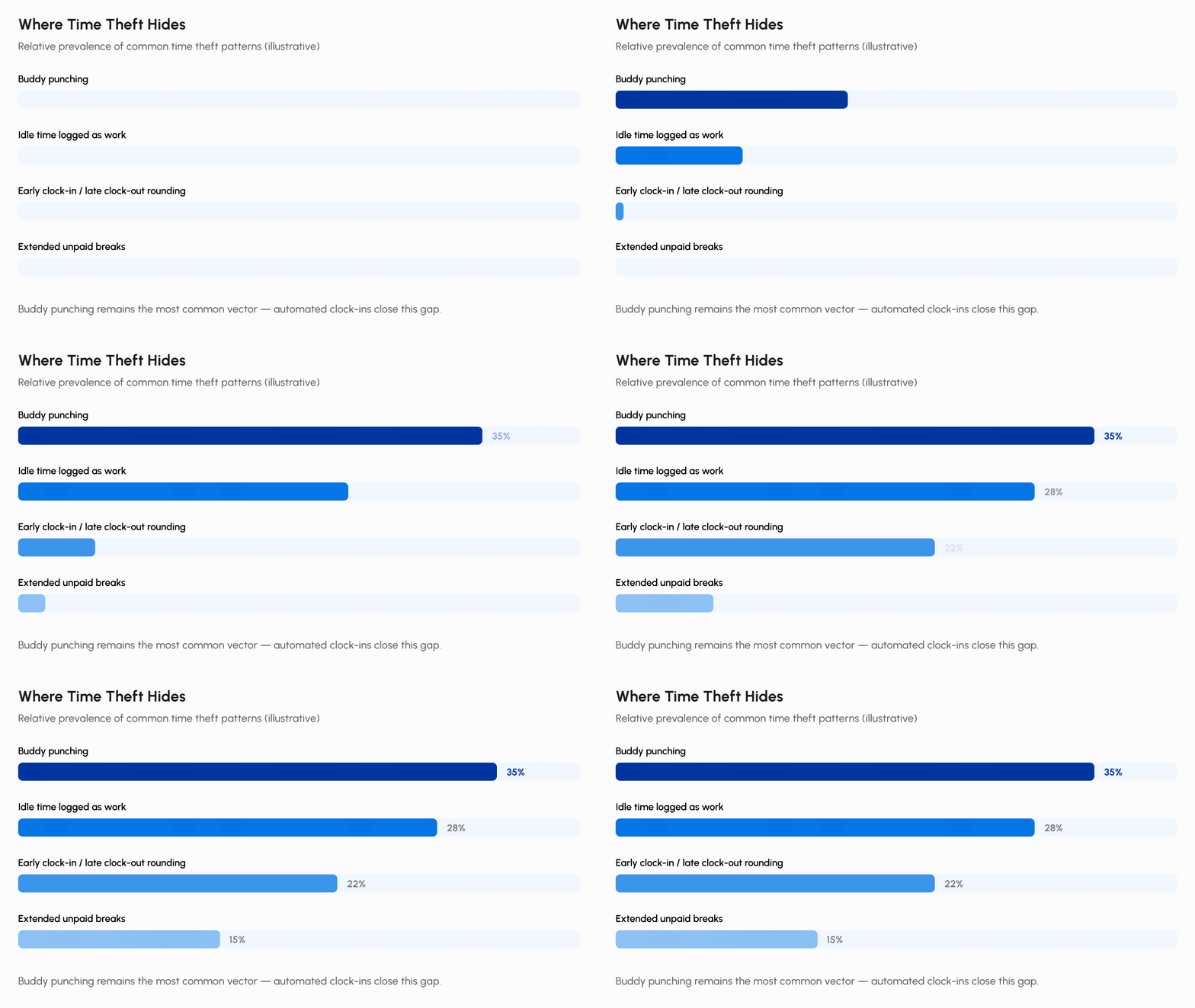
There is one category of time tracking failure that rarely makes it into boardroom conversations, and it deserves more attention than it gets, partly because it is uncomfortable to talk about and partly because most leaders assume it does not apply to their team.
This is not a story about dishonest employees, and framing it that way misses the point entirely. It is a story about systems that make dishonesty easy and accuracy hard.
A shared paper sign-in sheet or an honor system spreadsheet invites exactly this kind of drift, not because people are bad actors, but because the system has no friction against it. There is no consequence built into the process, so the path of least resistance quietly wins.
Move to a tool with geofencing, photo verification at clock-in, or biometric checks, and the behavior all but disappears, not because employees become more honest, but because the system stops making dishonesty the easiest option on the table.
It is worth pausing on a pattern that shows up across almost every organization that gets time tracking wrong: the absence of ownership. Nobody is lying in this chain. Everybody is simply trusting the layer above them.
The trust chain, link by link:
Why this is rarely one department's job, even though it gets treated as one:
A system that works has to account for all four of these stakeholders at once. This is part of why so many timesheet rollouts that focus only on the software, without addressing who is accountable for what, end up producing the same bad data in a shinier interface.
The fix is smaller than most leaders expect. Not a new department. Not a dedicated headcount. Just two things:
Naming an owner and having recurring reviews close more of the gap described in this chapter than any individual feature in any individual tool.
Spreadsheets introduce human error at the point of entry and provide zero automated validation, anomaly detection, or real-time project costing. Every manual step is another chance for the number to drift from the truth, and there is no system in place to catch the drift before it compounds.
Between payroll error rates of one to eight percent and the 64 percent of employees who report real financial stress or disruption from payroll errors, inaccurate timesheets are not a rounding error. They are a trust problem with a measurable cost, and one that most P&Ls do not even label correctly.
The global time tracking software market is on track to exceed $11 billion by 2030. This is not a niche tool category. It is core workforce management infrastructure, and treating it as an afterthought is increasingly out of step with how the rest of the market is moving.
Fixing the output, the timesheet, without fixing the input, how and when time is actually recorded, produces temporary improvement at best. The fix starts upstream, every single time.
Payroll is just one output. Project costing, capacity planning, billing accuracy, and workforce intelligence are all available from the same data set if the system is designed to surface them, rather than just store them.
This chapter has answered the question of what is time tracking and made the foundational case for why it matters.
Time tracking is not an HR admin function. It is a business intelligence function that happens to sit inside HR admin, which is precisely why it gets under-resourced and under-prioritized in organizations that have not yet made the connection. When it works well, it connects your labor costs to your business outcomes in real time. When it does not, you are managing one of your biggest expense lines in the dark, making decisions on stale or distorted numbers without realizing it.
The chapters that follow will go deep on every dimension of making time tracking and timesheets work, from choosing the right methodology and tools to driving adoption across resistant teams, to connecting your time data to project profitability, payroll compliance, and workforce planning.
By the end of this guide, you will have both the strategic framework and the operational playbook to build a time tracking system that actually earns its place in how your business is run.
Before evaluating tools or redesigning your timesheet process, spend one week collecting honest data on how your team currently logs time. Ask three questions.
If the answer to question three is no, or "sort of, but it takes a week to compile," you have identified your starting point. Everything else in this guide builds from there. There is no shame in a no here. Most organizations, including plenty of successful ones, are starting from exactly that answer.

 ALL FEATURES INCLUDED