Look back at your team’s worst delivery month. The one packed with missed deadlines and slipped dates. Chances are it was not a slow month. It was probably your busiest one, the stretch when utilization hit its highest mark.
This is the utilization paradox. Pushing people toward fully booked calendars does not buy you more output; it buys you gridlock. Most teams learn to read utilization numbers as if a higher score is always the win, then wonder why full calendars keep producing late work.
Here is where this gridlock actually comes from, the math behind it, and how to fix it without hiring a single extra person.
Resource utilization is the percentage of available working hours a person, team, or system spends on productive work. The utilization paradox kicks in once this number creeps toward 100%. Instead of squeezing out more value, you get longer queues, lower handoffs, and burned-out people, because full utilization leaves zero slack in the system. Without slack, an urgent request, a sick day, or a scope change ripples through everything scheduled behind it. You are now spending your week firefighting instead of finishing work.
Picture a five-person design team booked at 100% for six weeks. A client asks for a same-day revision. Since nobody has any open capacity, this request bumps three other projects, and all three are now running late. Multiply this across a quarter, and you can see why ‘fully booked’ and ‘on schedule’ rarely mean the same thing.
Don't Fall for the 100% Trap
A fully booked calendar looks great on a report. It just doesn't hold up in real life. The moment one thing you didn't plan for lands on your desk, that "efficient" schedule bends, and everything behind it slides with it.
Once you see this pattern in one team, you start noticing it everywhere resources get scheduled tightly.
This isn't limited to any one industry or team size. It shows up wherever hours, hardware, or computers get scheduled at their limit, starting with the people actually doing the work.
This paradox is clearly visible in professional services and consulting teams that track billable hours down to the quarter. According to Certinia’s SPI analysis, billable utilization fell to 66.4% in 2025, the lowest point in its surveying history. This was even when firms pushed harder to keep people booked. The drop matters because it was despite tighter scheduling, which tells you utilization alone was never the lever these firms needed to pull.
The same paradox is playing out in AI infrastructure. Enterprises rushed to reserve GPU capacity expecting scarcity, locking in contracts years in advance. Instead, a 2026 analysis of enterprise Kubernetes clusters found average GPU utilization sitting at just 5%. This means most of the expensive capacity sits idle at any given moment. Capacity that is not matched to real demand behaves exactly like a team booked past its limit. It is expensive to hold and unable to be flexed when it is actually needed.
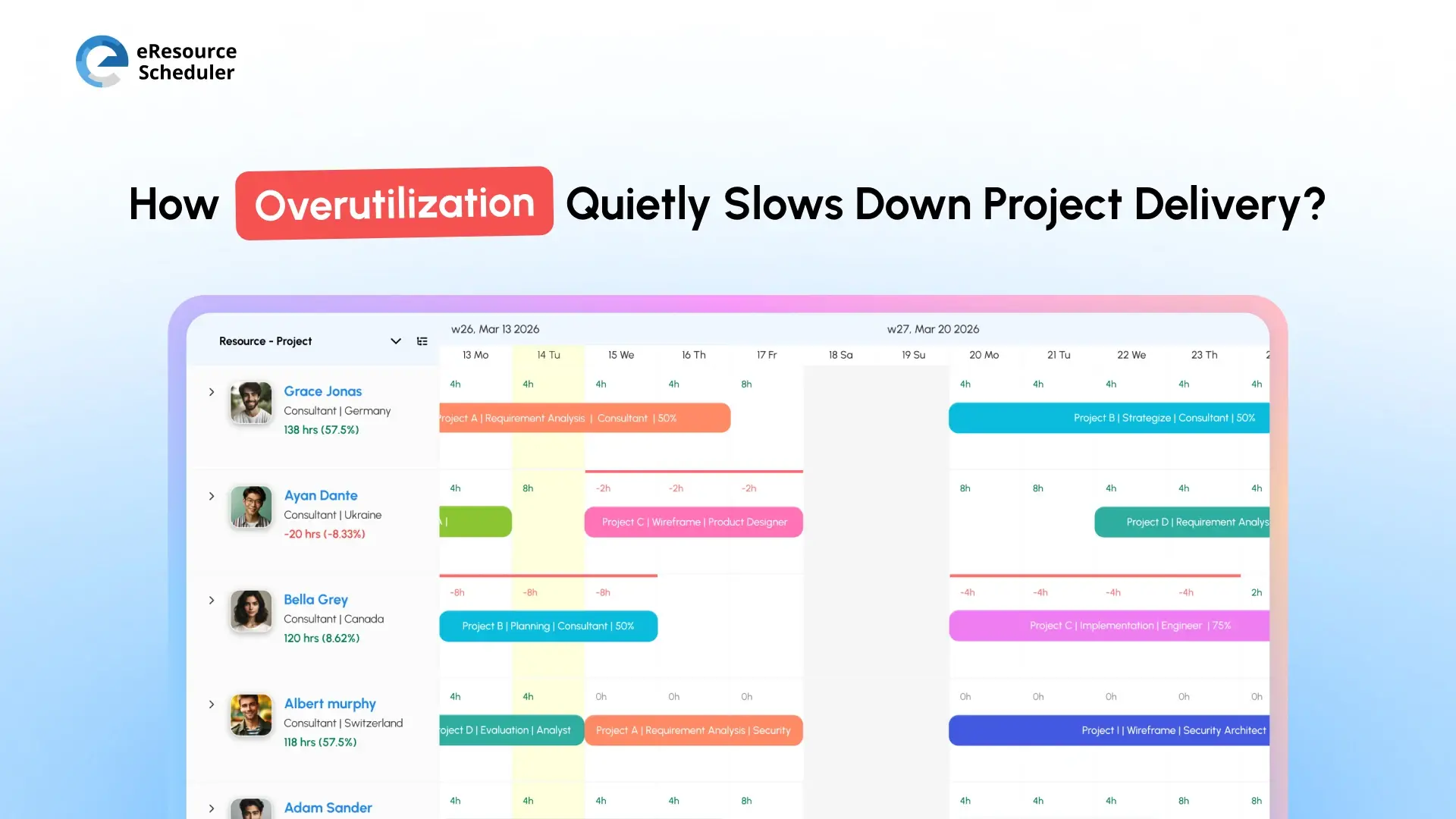
Workflow design is where the paradox either gets solved or gets backed in permanently. Teams built around matrix reporting lines (where people answer to more than one lead) are especially prone to over-scheduling. No single manager can see the full picture of what someone is already carrying. Add in shared specialists who get pulled into multiple projects at once, and utilization climbs past what any one person can sustainably track. Let alone actually control.
Once you know where to look, it helps to name the mechanics driving it, and it starts with a few core concepts.
Three ideas explain almost everything that goes wrong once utilization climbs too high, and they all trace back to the same underlying math.
| Traffic Jam Effect | The Queuing Theory | Tokenized Assets | |
| Meaning | Congestion builds fast once a system crosses a load threshold, not gradually | Wait times follow predictable queuing math that curves sharply upward as load nears full capacity | Compute tokens and API calls queue the same way people or tasks do |
| Where You'll Spot It | Highways, project pipelines, support ticket queues | Call centers, ticket systems, sprint boards | AI inference systems, shared compute clusters, rate-limited APIs |
| The Warning Sign | A single new task suddenly takes far longer to clear | Backlog keeps growing even though nobody added extra work | Latency spikes even though total demand looks flat on paper |
| Root Cause | Zero buffer left to absorb even one unplanned unit of work | Arrival rate creeping close to service rate, leaving no breathing room | Token throughput running near the ceiling of allocated capacity |
| Trigger | One urgent request landing on an already full schedule | A short staffing gap or a sudden spike in incoming tickets | A traffic spike or a batch job competing for the same compute pool |
| What To Do About It | Keep planned load closer to 70-80%, not 100% | Track queue length, not just hours booked | Monitor token throughput the way you'd monitor WIP |
Every row here points to the same conclusion. The closer any system runs to full capacity, the more fragile it becomes. This fragility carries a real, measurable cost the moment your team crosses this threshold.
Running a team at full capacity does not feel stressful. It costs you in ways that rarely show up on a utilization report.
When everyone is fully booked, one unplanned task ripples through the whole pipeline. Overutilization eventually slows project delivery because no one has room to absorb the unexpected work without pushing something else back.
A fully booked team switches between tasks (constantly), since nothing has room to finish before the next thing starts. Every switch resets the mental effort that was already invested in the previous task. So the actual working time gets eaten up by re-orientation rather than progress, even though the calendar shows nothing but ‘productive’ hours.
Rushed handoffs mean less time to catch mistakes before they ship. Quality erosion usually shows up weeks after the schedule got tight (not the day it happened), which makes it easy to miss until rework, client escalations, or repeat support tickets start piling up and eat into the very capacity you were trying to protect.
Myth: If utilization is too high, the fix is hiring more people.
Reality: Adding headcount to a system with no work-in-progress limit just gives you a second overloaded queue instead of one, since the new hires get pulled into the same unbounded workflow everyone else is stuck in. Fixing the flow comes before adding capacity, not after.
A team stretched thin cannot say yes to new work, even good work. This is one of the quieter ways overallocating resources backfires. You end up protecting the existing schedule rather than growing the business, and the opportunities you turn down rarely get offered twice.
Innovation needs unstructured time, the kind that does not show up on a timesheet. When every hour is booked against a deliverable, nobody has room to test a better process, question an inefficient step, or explore an idea that has not been asked. Over time, teams stop proposing better ways of working simply because there is never a slot to try them.
Fatigue compounds the longer full utilization runs, and it rarely announces itself early. Chronic overload is one of the most common precursors to burnout, and burnout doesn’t stay contained to one person’s output. It spreads through a team’s morale, slows collective decision-making, and tends to push your strongest performers toward the door first.
Costs like these usually trace back to one culprit hiding in plain sight. Work In Progress.
Work In Progress (or WIP) is the number of tasks actively being worked on at once. Grasping why it matters more than a utilization percentage starts with basic capacity math.
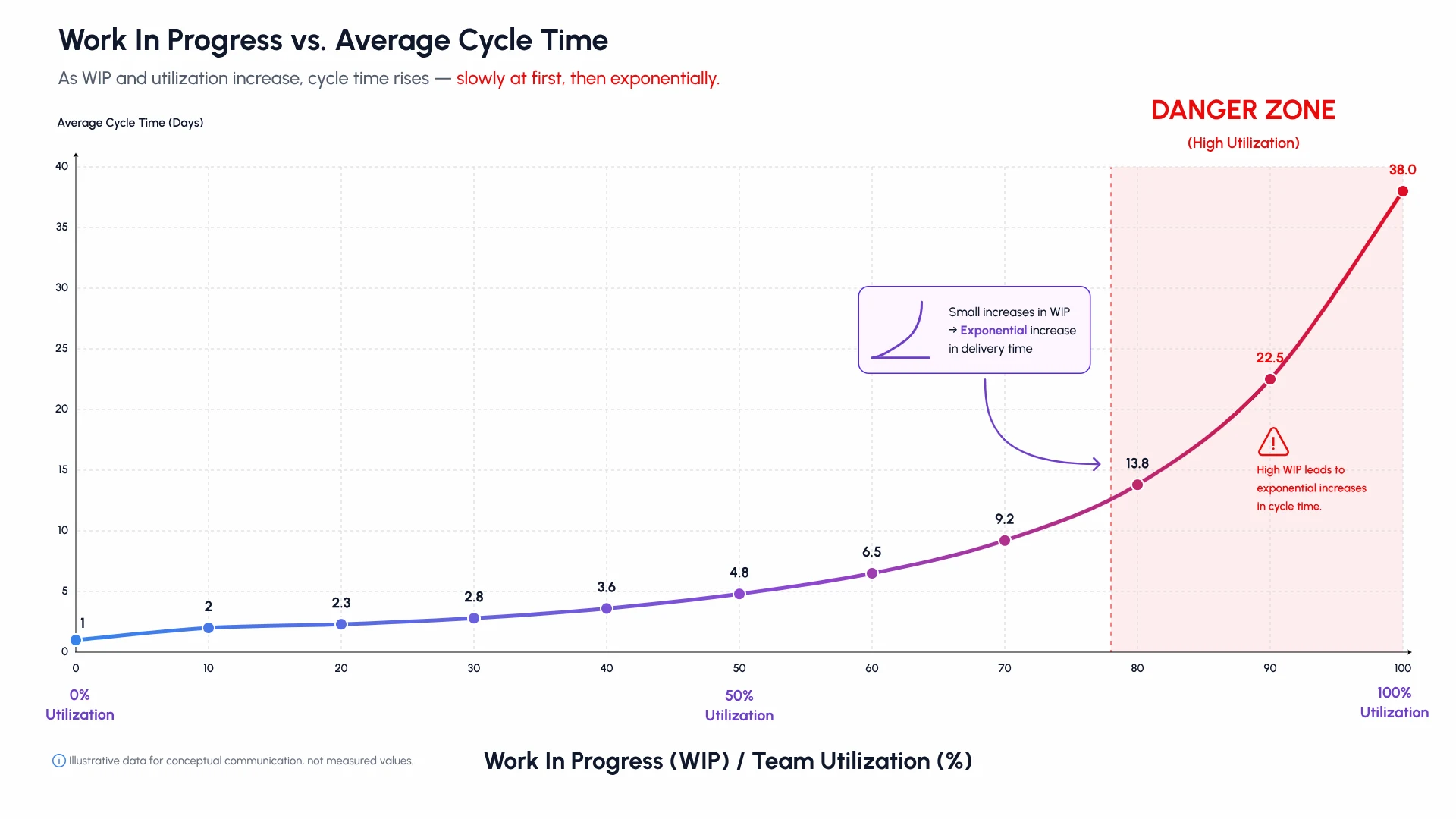
The more work in progress you allow, the more utilization creeps toward 100%, and the slower everything moves. Every additional task in flight adds to the queue every other task has to wait behind.
This is the same mechanism behind the queuing math you saw, just applied to your team’s actual task list instead of a call centre or a highway. It lines up with decades of research on how work actually flows through a system under load.
Controlling work in progress beats chasing utilization for four reasons.
1. Direct Visibility lets you see exactly how many tasks are in flight, instead of estimating hours after the fact.
2. Practical Control means limiting work in progress is something you can enforce today. Utilization targets are hard to manage in real time as they only tell you what already happened.
3. Psychological Reality means fewer active tasks cut the context switching cost you saw earlier, giving people room to actually finish something before starting the new thing.
4. Mathematical Advantage means capping work in progress keeps you below the point on the curve where wait time spikes, protecting delivery speed even when demand is high.
Once you understand why work in progress matters more than raw utilization, the next step is building a system around it.
None of this requires overloading anyone further. It is really about protecting delivery without overloading your team.

Start by mapping every stage work passes through, from requests to delivery, including the handoffs that are usually skipped in a quick sketch. You cannot control what you cannot see, and a clear work plan is the foundation everything else in this section builds.
Track how long tasks actually wait at each stage, not just how busy people look on a calendar. Queues, not full schedules, are where delays hide. They usually reveal themselves at the same one or two stages every time.
Restrict the number of tasks that can be active at each stage of your workflow. Treat this limit as a hard rule and not a suggestion. This one change protects delivery speed more than any utilization target ever will. This stops new work from entering a stage that is already backed up.
Reward finishing tasks over starting new ones even when a new request feels urgent at the moment. A team that finishes three tasks a week beats a team that starts ten and finishes one, every time. The reason? Half-finished work still occupies mental space and schedule slots without delivering anything.
Pro Tip
Before adding a new task to anyone’s plate, ask what they have to finish first. If the honest answer is nothing, you have just found your bottleneck.
Track cycle time and delivery dates after you set WIP limits, not just utilization percentages. The reason is that utilization percentages may look healthy even while queues quietly grow. If you are still racing to beat time constraints over every project, tighten your WIP limit further before you add headcount.
Doing all this manually across a growing team gets messy fast, which is exactly the gap the right software closes.
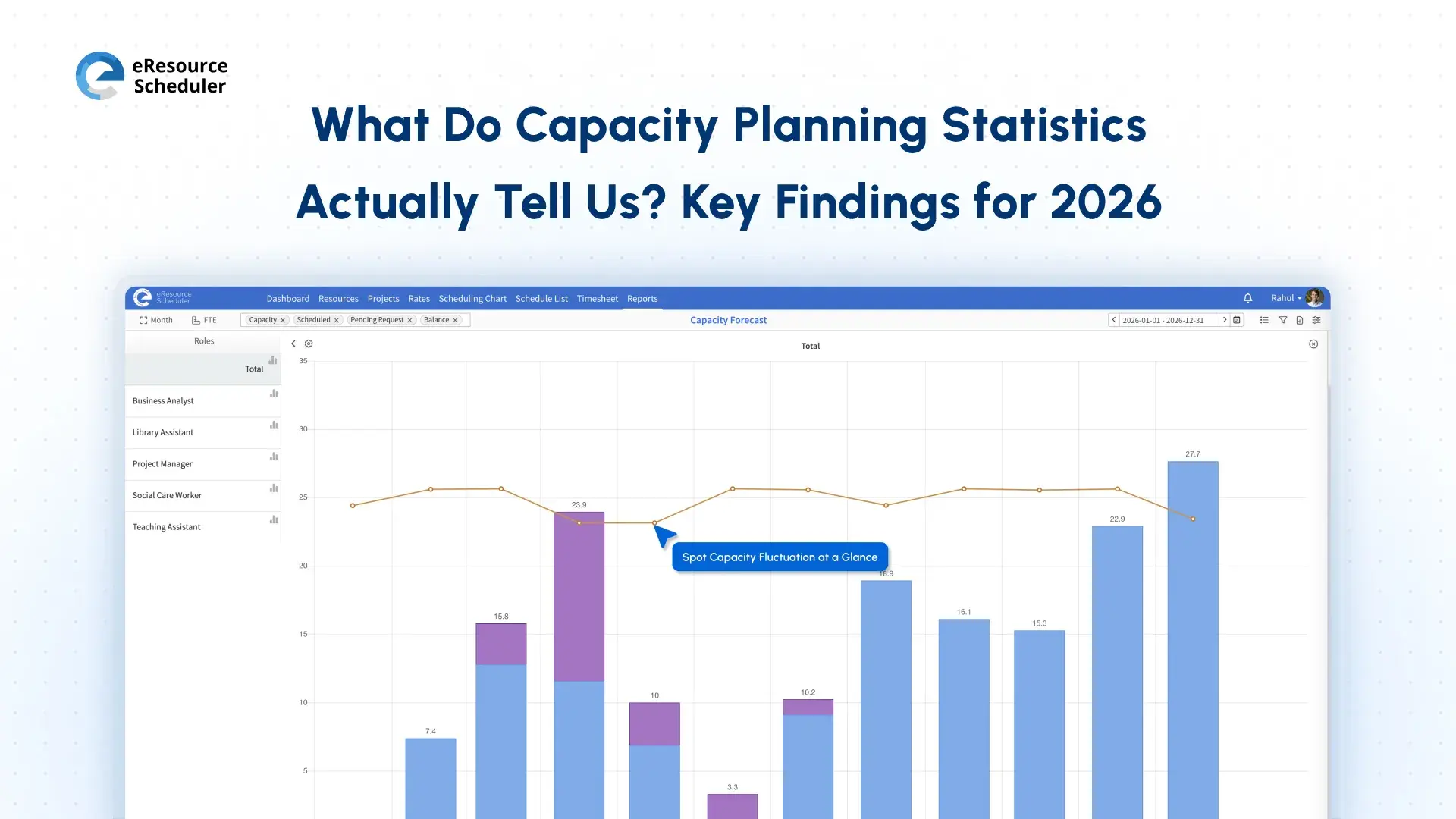
Spotting a work-in-progress problem on a whiteboard is one thing. Catching it before it turns into a missed deadline is another. A resource capacity planning tool exists to fill this gap, giving you a live view of who is carrying what so overloaded shows up as a number on a dashboard instead of a delivery date you find out about too late. This shift alone changes how a team plans its week, since decisions are made with real data rather than a gut feel about who ‘seems free’.
Most teams eventually run into the limits of tracking this in spreadsheets, where work-in-progress and queue data go stale the moment someone’s workload changes. This is where software built specifically around live scheduling data earns its place. eResource Scheduler ties capacity information to actual workflow stages as work moves. A bottleneck at one stage of a project shows up while there is still time to redistribute the load, rather than three weeks later when the delivery date is already at risk.

This kind of visibility matters most in environments where multiple deadlines compete for the same people. This has become the new normal for professional services and IT teams. For these teams especially, the shift turns utilization paradox from a recurring headache into a manageable, everyday metric. One you can see and adjust instead of one you only discover after a project has already slipped.
The utilization paradox is not a reason to slow down on purpose. It is also not an argument against ambitious targets. It is a reminder that a fully booked calendar and a fully functioning team are two different things. Mistaking one for the other is what quietly drains delivery speed, quality, and morale over time.
This shift changes what a ‘good week’ looks like on your team. Instead of celebrating a fully booked calendar, you start celebrating short queues and predictable delivery dates. These are the numbers that actually predict whether next month goes smoothly. It won't happen from one policy change. It happens the first time someone asks ‘what's finished?’ before asking ‘who's free?’
This question must become a habit instead of an exception.

Plan Smarter. Schedule Faster. For Free.
Join thousands already using eResource Scheduler to align teams, time, and tasks seamlessly.
 ALL FEATURES INCLUDED