The traditional, top-down office organizational structure, with its clear reporting lines and departmental silos, is slowly becoming a thing of the past. Today's dynamic business landscape, where there are hybrid and remote workers and more complex projects, demands a more flexible and collaborative approach. This is where matrix management comes in.
Join us as we explain what matrix management is and its intricacies. We'll delve into the different styles of matrix management, explore the potential benefits and drawbacks, and equip you with the tools to thrive in this multifaceted work environment. Whether you're a seasoned project manager or a newbie to the workforce, this guide will provide valuable insights into mastering the new and rapidly evolving work culture with the help of resource management software.
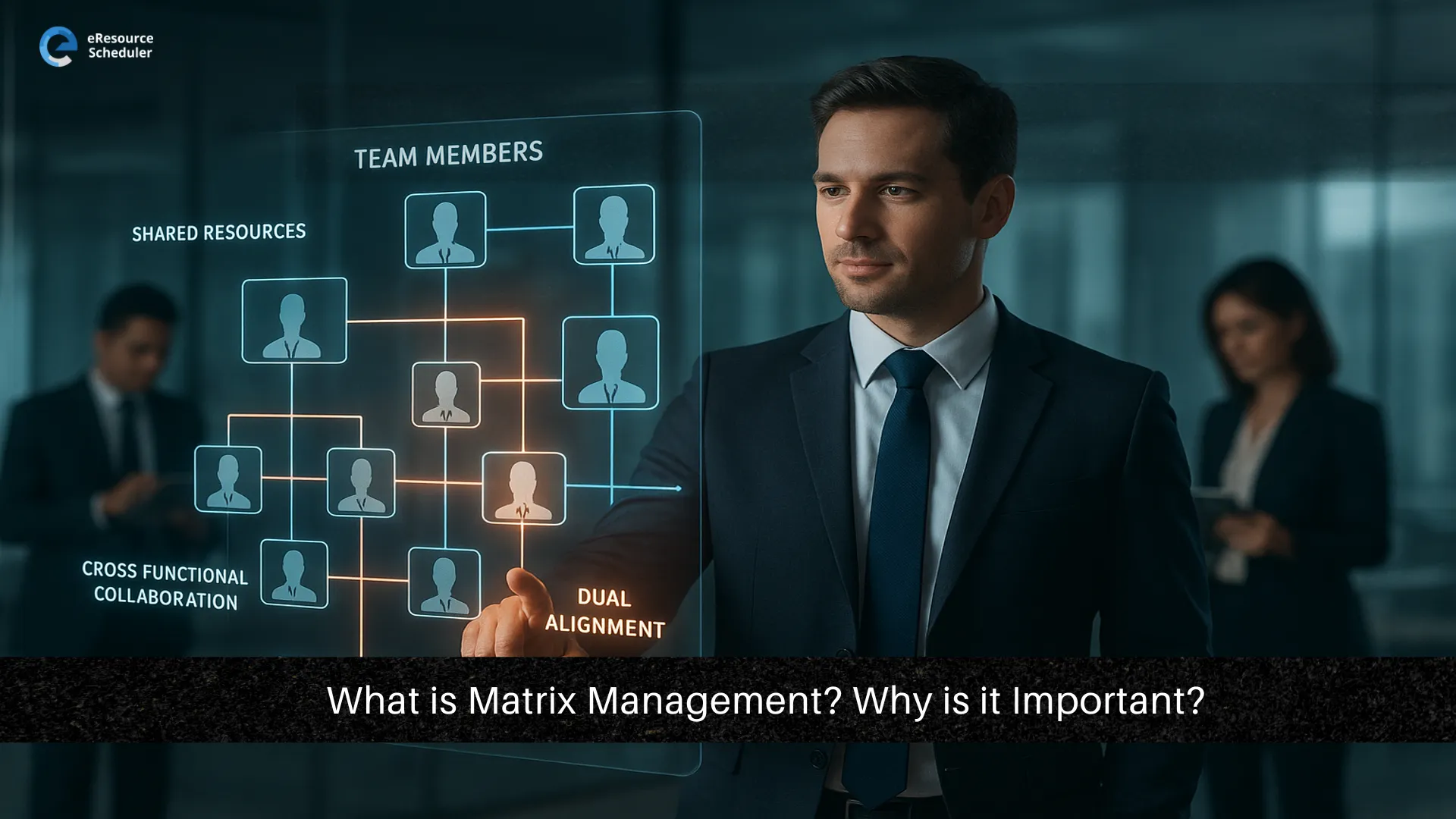
Matrix management is an organizational structure that allows people to report to multiple managers. An employee might have two or more reporting lines in a matrix organization. Reporting usually combines two organizational thought processes: project management and functional management. Harvard Business Review describes Matrix Management as not an organizational structure but a frame of mind.
Here’s one example of matrix management in an organization—an employee from the engineering department will report to the department head and the project lead, who is leading the development of new valves for the aerospace market. The employee has more than one line of reporting managers.
Another example of matrix management is that for a product development project, the leader would have an engineer, a salesperson, a finance person, and possibly even a customer service agent working together.
It’s important to highlight here that even in a matrix structure, the company realizes that project-based hierarchies are temporary (depending on a project-to-project basis) and last for a defined duration. The functional hierarchies and reporting remain constant.
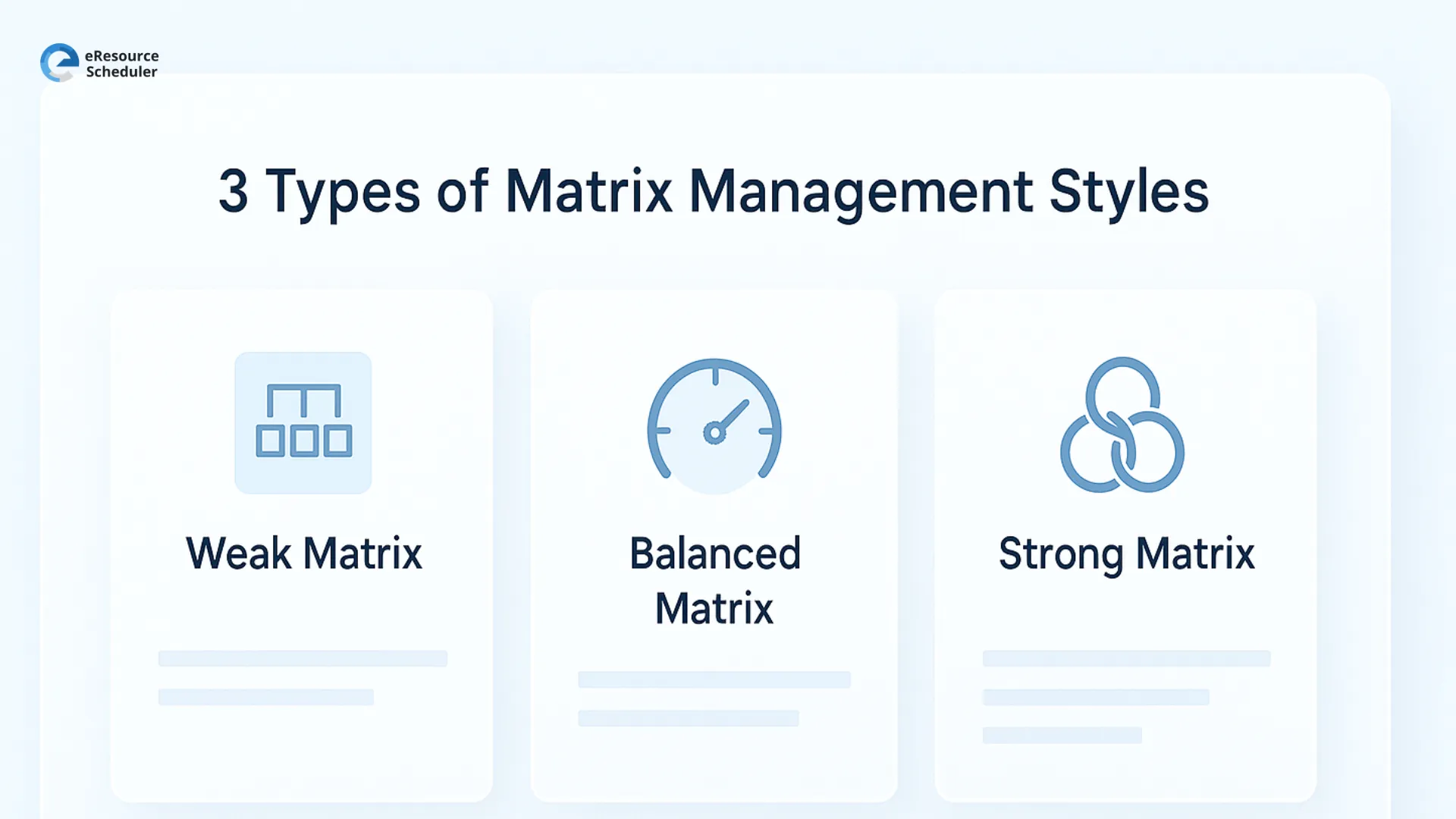
There are three types of matrix management styles: weak, balanced, and strong. Understanding the differences between the styles will help you determine which may benefit you and your company.
In this approach, the project manager has little control or authority over the resource. It borrows heavily from the traditional office hierarchy and structure. The departmental or functional manager has the majority of decision-making authority and power over the employee. There’s more potential for conflict in a weak matrix style because of the divided authority.
In a weak matrix, the main focus remains on fulfilling functional or departmental goals and tasks. Let’s go back to our example with the engineer, who has a departmental head and a project head. The engineer will complete the job the engineering manager assigned and then complete the project duties. This approach lends itself to project delays.
As you can guess from the name, functional and project managers have equal power distribution and control in this style. The department or functional manager will assign the employee to a project, while the manager will determine the important needs. Both managers will collaborate while making decisions about resources and project goals
In a strong matrix, project managers take the main stage. They have more authority and decision-making power over the employees who report to them. They have ownership of the project from start to finish. Project managers can identify the resources they need and assign the appropriate tasks to them. The functional or department manager has more of a secondary role
The strong matrix prioritizes completing project objectives over individual departmental goals. This can lead to a more streamlined and efficient project execution process. However, in this model, it’s crucial that the project manager has strong leadership and communication skills. This will reduce the chances of conflict with the line managers.
By understanding the structures within a matrix management system, one can address the dual reporting lines more properly. This will increase collaboration and the ability to achieve project success.
Let's delve into the key roles in this dynamic system:
However, they still play an important role in ensuring team members have the required skills and tools.
Let’s look at how a matrix management structure differs from traditional hierarchies and structures from a communication, reporting, decision-making, and adaptability standpoint.
The multiple lines of reporting allow for more collaboration and communication. Each employee also gets to learn from different managers and departments. There is more integration.
There is shared accountability in a matrix organization. As most employees have dual reporting relationships, they are accountable to both. The employee is accountable to the project manager and their line manager. This shared responsibility makes the employee value their work more, and they are also more open to collaborating.
In a traditional structure, the decision-making is usually top-down and primarily resides in the hands of the functional manager. Employees have limited influence and typically execute decisions made by upper management. Information also flows in the same manner from top to bottom. Employees are provided information on a need-to-know basis, and management often acts as gatekeepers.
In contrast, the decision-making power is decentralized in a matrix management setup. Project managers and leads, departmental managers, and even employees have varying levels of decision-making authority. Information flows vertically and horizontally. So information and knowledge are transferred between departments and also between managers and staff. This leads to quicker problem-solving and collaboration.
| Feature | Traditional Structure | Matrix Structure |
| Decision-making authority | Centralized at the top | Distributed across levels and teams |
| Information flow | Primarily vertical | Both horizontal and vertical |
| Potential for delays | High | Potentially lower |
| Agility and responsiveness | Lower; Slower response | Higher, Faster response times |
In a traditional company, skill transfer is limited between departments. For instance, an engineer will only progress within the engineering domain. He or she will never have the opportunity to cross over into sales or marketing. In a matrix structure, an employee gets more exposure to different domains. Exposure to diverse perspectives speeds up their learning curve and allows them to progress in a different function.
Matrix structures also tend to promote informal learning. This could be through mentorship, knowledge-sharing sessions, and on-the-job collaboration. Informal learning leads to more organic skill transfer. This means that the skills and knowledge learned usually stay with the employees, and they are able to apply them correctly.
Matrix organizations offer greater flexibility because of their shared resources and services model. This approach lets them build multiple cross-functional teams for projects. They can also quickly adjust resource allocation—ensuring the right person is there for time-sensitive tasks.
The flexibility also allows companies to respond quickly and proactively to changing markets and customer requirements. Matrix companies have faster responses to customer demands and project requirements.
Traditional organizational structures are more rigid. This often makes it challenging for them to adapt and respond to altering market conditions or project requirements.
What makes matrix management important and relevant in today’s times? Here are five benefits of adopting the matrix model in your organization:
In a matrix structure, more resources are shared; therefore, employees can apply their skills in diverse settings and projects. This reduces the redundancy for a particular skill set. For example, a niche resource can be pulled into Project X and Y based on their availability and workload. You won’t need to hire the same skill set for Project Y.
This scenario allows the project to maximize its bottom line while keeping the employee engaged in appropriate tasks. Matrix structure allows for a better fit between project needs and employee skill set. This avoids situations where resources are underutilized or sitting idle in their functional role. In this fluid structure, project managers can pull those specialists away and make effective use of them.
The matrix structure promotes the sharing of resources, materials, and knowledge. It fosters an environment that is both agile and adaptable. The ability to draw upon resources from various departments allows for greater flexibility in project staffing.
A project manager is not stuck when a resource is not available in his department. He knows he can pull the required resources from another team. This is especially helpful for organizations with constantly changing workloads and/or diverse project requirements.
The structure also creates a dynamic working environment where employees get exposed to different processes. This enhances their ability to adapt and makes them more responsive.
A matrix structure can increase employee engagement and job satisfaction in several ways. The model encourages ownership and increases a sense of purpose among employees. As employees report to multiple managers, they know the onus of the work is on them.
Furthermore, they realize their contributions play a significant role in the outcome of the project.Collaborating with various teams and colleagues develops their own problem-solving and communication skills as well.
This is personally rewarding and enhances their professional development. The exposure also opens up broader career opportunities for the employees. Employees feel more satisfied when they know they can pursue a role that suits their interests or when they can see multiple career growth options.
Finally, working with colleagues from different verticals exposes employees to new skills, ideas, and working styles. This can lead to increased learning and personal development, which can be stimulating and enhance job satisfaction.
The matrix management style also increases innovation and creativity in an organization. By bringing together individuals from different departments and breaking department silos, the matrix structure lends itself to a cross-pollination of ideas and knowledge sharing. This exposure to different perspectives sparks creative thinking and leads to innovative solutions to problems.
In a matrix organization, knowledge is shared. In a traditional structure, the knowledge generally stays trapped within one department or group. The free flow of ideas and perspectives allows the company to develop creative solutions to problems and serve the clients to the best of their abilities.
Having employees report to various managers also provides financial benefits to a company. Rather than having to hire resources specific to each project's requirements (which increases costs), the company can use a technical resource across multiple projects. There are fewer overhead or duplicate effort costs in a matrix organization.
It is not all fun and glory in a matrix organization. Some challenges or hurdles can make things messy and counterproductive. Below, we explain some disadvantages of adopting this style and what you can do to minimize their occurrence.
Sometimes, a lot of confusion and miscommunication stem from matrix management. Employees can experience confusion regarding roles, responsibilities, and expectations. For example, employees might not be sure of who they need to report to and when. This can lead to inefficiencies and decreased morale. Poorly designed reporting structures can muddy the waters and create chaos.
To prevent this from occurring, it’s crucial that every member knows whom they have to report to and when. This should be outlined at the beginning of every project. Using a resource management platform that highlights reporting lines and project status can reduce any chances of confusion.
With employees reporting to and informing multiple managers about issues, the decision-making process can become slower. This can be avoided if there are clear guidelines that establish what level of decision-making authority each person has. For instance, the employee can make the decisions for low-level issues, while the project manager is the final authority for issues that impact customer deadlines.
Having two managers who are giving feedback and reviews can create friction and conflict. Who should the employee listen to? Which tasks should be prioritized? Which project is more important? Having conflicting priorities and power dynamics can derail a project. Additionally, any resulting power struggles between two leaders can create a tense working environment. This can hurt productivity and output.
Open and frequent communication is the key to preventing such clashes. The project manager and department lead have to communicate and understand how tasks will be prioritized. They can set clear objectives that will make it easier for employees to perform without fear or conflict.
| Advantages of Matrix Management | Disadvantages of Matrix Management |
| Resources are utilized efficiently | Can create confusion |
| Costs are reduced | Promotes a power struggle |
| Employees are engaged and satisfied | Slows down decision-making |
| There is more innovation and creativity | Difficult to stay organized |
| The organization is more agile and responsive | Leads to conflicts in priorities |
Don’t be deterred by these disadvantages. It's important to remember that a well-designed and effectively implemented matrix structure can offset these obstacles and offer significant benefits.
Implementing a successful matrix management system in any company requires careful consideration and planning. Follow these steps to properly bring the matrix organizational structure to your business and make it work:
The first step is to get the leadership team to commit to this change. In traditional hierarchies, the leadership holds all the authority and decision-making power. In the matrix structure, they will spread that responsibility to others. To be able to do that, they have to prove that the matrix structure is beneficial.
Once the leadership embraces this structure, they need to actively promote it within the company. Why? Leadership sets the tone for everyone else. If they are actively participating in it, it will influence others. This buy-in will reduce resistance from employees and other stakeholders.
Provide training to the leadership team, which will help them understand and adapt to this new structure.
Know what you want to achieve through a matrix structure. Are you seeking to improve collaboration? Or are you looking to utilize resources more efficiently? Do you want to increase employee engagement ? SMART goals are vital to ensuring clarity in tasks and aligning people with them.
Examples of SMART goals are:
When the objective or end goal is clearly defined, specific, and measurable, there is little room for confusion. Everyone knows what they’re expected to do and what the result will be when they hit the bullseye. Remember to set SMART goals that match your company’s long-term strategy and culture.
As mentioned earlier, a matrix structure can sometimes create more confusion and conflict. This happens when the structure is poorly designed, and no reporting guidelines are given. To avoid this from occurring, it’s essential to clearly define the roles and responsibilities of each stakeholder. Also, outline what level of decision-making authority they have.
The company must also specify the balance between the departmental and project leads. Which style of matrix management (weak, balanced, or strong) will be used in the company? This way, resources and management will have a better understanding of their work scope, be more accountable, and be able to communicate efficiently. Employees will also know who they need to report to and when.
A matrix structure will not thrive if there’s no solid communication plan backing it. The communication channels should outline how information and knowledge will be shared. Create guidelines that dictate when physical or online meetings are required or when a subject matter can be discussed via email.
It’s equally important for department and project managers to have regular check-ins with their subordinates. Encourage management to have frequent check-ins through a method that suits them (email, face-to-face, virtual coffee meet, etc.). This will help them keep a pulse on how the employees are doing and if they need to step in.
Once a matrix system is set up, it needs to be constantly monitored and tweaked. Yes, this is an ongoing commitment.
Ways to track the effectiveness of this are through getting employee surveys and feedback, and tracking the number of conflicts. Setting S.M.A.R.T. goals also makes measuring success easier. Continuously refining the matrix system will yield greater results and benefits.
Some additional tips that can ensure the successful implementation of the matrix structure:
One way to overcome the shortcomings of a matrix structure is to invest in a project or resource management system. The software can help managers agree on resources, project deadlines, priorities, and more. Employees can also clearly see who they need to report to for each task.
Let’s look at a few more ways a resource management system can help you maximize the benefits of a matrix organizational structure.
A resource management system provides complete visibility of all the resources a company has, no matter where they are based. Department and project leaders get a complete insight into the resources that match their needs and their availability. For instance, a project manager might realize that they don’t need to hire an expensive consultant for their project because the person with the expertise is actually in the research and development (R&D) department.
The tool provides a single platform for project managers, functional managers, and team members to share real-time information, updates, and documents. This fosters clear and transparent communication. Features like discussion boards, automatic notifications, and document storage and sharing also facilitate team discussions and efficient information exchange. Additionally, employees can also see who is an expert in a field and reach out to them in case they need their assistance.
With a resource management tool at your disposal, managers can quickly identify the right resources, assign tasks to them, set deadlines, and track their progress from a single place. The information is captured in real-time, and they can focus on more pressing or strategic issues.
Furthermore, visual dashboards help track employee workload and utilization. The data markers also identify potential conflicts. For instance, if there is a great variance between the time allotted for a task versus the time taken, the manager instantly knows something is amiss. They can check in with the concerned employee and decide the next step of action.
A resource management software serves as a single, consolidated source of truth for any project-related information. It has all the project data. This includes task status, resource availability, and communication history. This tool removes the need for countless other trackers and software. You also don't need to shuffle through Spreadsheets or emails for data. This empowers managers to make informed and data-driven decisions.
The majority of resource allocation apps also generate insightful reports on project performance and key performance indicators (KPIs). Real-time reports on resource utilization and availability, capacity vs. demand, and project costs are vital to project success. This data can be used for informed decision-making and course correction.
Team members can use the tool to see what tasks are assigned to them. Employees also get an accurate understanding of their performance when they can see how they are progressing against the assigned tasks. For instance, if they constantly see that assigned tasks are taking them longer to complete, maybe it’s a sign for them to brush up on their skill set. This visibility brings a sense of ownership to their work.
As the world of work continues to evolve rapidly, companies need to break away from the traditional top-down structure. In today’s times, the matrix management structure has emerged as a prominent force shaping modern organizations. While it does have some minor challenges, the overarching benefits, like efficient resource utilization, increased agility and collaboration, and faster skill transfer, are undeniable.
Stop operating in silos and unleash the power of the matrix structure for your business. Adopting this structure will optimize your organization and prepare it to handle any challenge or conflict easily and effectively.
Use eRS to break down the walls, collaborate to the core, and increase the effectiveness of the matrix structure in your organization. Our all-in-one eResource scheduler will build transparency while minimizing confusion and conflict. It also has all the key metrics you would need to make well-informed decisions. Book your personalized demo today!
1. What is matrix management?
Matrix management is an organizational approach where employees report to both a functional manager and a project manager. It blends departmental expertise with project execution to improve collaboration, flexibility, and resource utilization across the business.
2. Why do modern organizations use matrix management?
Organizations adopt matrix management to handle complex projects, remote teams, and shifting priorities. It allows leaders to share specialized talent across initiatives, respond faster to change, and break down functional silos without losing operational control.
3. What are the main types of matrix management structures?
There are three types of matrix structures. Weak matrix where functional managers hold authority. A balanced matrix where authority is shared. Strong matrix where project managers lead execution. Each model impacts speed, accountability, and decision-making differently.
4. What are the biggest challenges of matrix management?
The most common challenges include role confusion, slower decisions, and priority conflicts between managers. These issues typically arise when reporting lines, authority levels, and communication norms are not clearly defined from the start.
5. How can resource management software support matrix management?
Resource management software improves visibility into workloads, availability, and reporting lines. It helps leaders align projects with capacity, reduce conflicts, and make faster data-driven decisions, which is critical for running an effective matrix organization at scale.


Plan Smarter. Schedule Faster. For Free.
Join thousands already using eResource Scheduler to align teams, time, and tasks seamlessly.
 ALL FEATURES INCLUDED