





 Learn more
Every business leader has lived through this moment. A big project lands. Everyone says yes. Three weeks later, the same five people are drowning while half the team sits idle waiting for handoffs that never come.
Nobody planned for this. Nobody planned for anything.
That is capacity planning failing in real time. It rarely gets blamed directly. Leadership blames sales for overpromising, or delivery for underperforming, when the actual failure happened weeks earlier, in a resource planning process nobody was watching closely enough.
This chapter breaks down what capacity planning actually is, why most organizations get it wrong, and what separates the businesses that scale smoothly from the ones that are perpetually firefighting.
Capacity planning is the process of matching what your organization can actually deliver against what it is being asked to deliver, now and in the future. At its core, it answers one question:
Do we have enough of the right resources, at the right time, to meet demand without burning people out or leaving them idle?
Those resources are not just headcount. They include:
Business capacity planning operates at a scale where individual visibility breaks down.
A team lead can eyeball five people's calendars and know who is free on Thursday. A COO overseeing 40 project teams across three continents cannot. At this scale, business capacity planning is less about any single person's calendar and more about patterns across the whole organization, patterns that only surface once the data is aggregated and reviewed systematically.
A simple way to separate the two:
| Scheduling | Capacity Planning | |
| Question it answers | Who is doing what today | Do we have enough people and skills for what is coming |
| Time horizon | Days | Weeks to years |
| Nature | Tactical | Strategic |
Confusing the two is the single most common mistake organizations make, and it shows up repeatedly throughout this guide.
It is worth sitting with that gap for a moment, because it is rarely a knowledge gap. Most managers know, intuitively, that the team is stretched or that a new engagement will strain things. What is usually missing is not awareness. It is a structured way to act on that awareness before it becomes a crisis.
This distinction matters because so much of business capacity planning fails simply from being misfiled under the wrong department.
Did You Know?The term "capacity planning" originated in manufacturing and IT infrastructure, where it referred to predicting server load or factory throughput. Service businesses borrowed the term decades later, applying the same logic to a much harder problem: predicting human availability, which does not scale the way machine capacity does.
Organizations that treat resource capacity planning as a living process, reviewed weekly or monthly, consistently report fewer delivery surprises. The ones that treat it as a static document tend to discover their capacity gaps the way most bad news arrives: too late to do anything graceful about it.
Quick example: a mid-sized consulting firm bids on three new client engagements in the same quarter. Sales evaluates each on its own merits, fit, margin, strategic value. None of those evaluations answers whether the firm can staff all three at once without pulling senior consultants off existing accounts.
That question belongs to capacity planning. If nobody asks it before the contracts are signed, the firm finds out around week three, when the first client starts wondering why their consultant seems distracted.
A capacity plan is not one document. It is a set of interlocking data points that, together, tell you whether your organization can absorb what is coming. Strip away the jargon and every resource capacity planning effort is built from five core components.
| Component | Core Question It Answers | Who Typically Owns It |
| Resource inventory | Who do we have available right now | Resource or operations managers |
| Skill and role mapping | Can our people actually do the work coming in | Team leads, HR |
| Demand pipeline | What is coming, and when | Sales, project or account leadership |
| Time horizon segmentation | Are we solving the right problem for the right window | Operations, PMO |
| Financial overlay | What does this capacity cost, or cost us if we get it wrong | Finance |
Who you have, what they can do, and how much time they realistically have available after accounting for leave, part-time arrangements, and non-billable obligations. Most resource capacity planning failures start here, with inventories that go stale the moment they are created.
Headcount alone tells you little. A team of 20 engineers means nothing if the upcoming project needs six specialists in a niche skill you only have two of.
Confirmed projects, likely projects, and the resource requirements each one carries. Without this, capacity planning becomes reactive by default.
What you need next week is a scheduling problem. What you need next quarter is a hiring and reallocation problem. What you need next year is a strategic workforce problem. A plan that does not segment by horizon tends to solve none of these well.
Idle capacity costs margin. Overextended capacity costs quality, retention, and eventually margin too. This is what turns a capacity plan into something the CFO actually cares about.
Pro TipIf your organization only tracks one of these five components well, make it the demand pipeline. Resource inventory problems are usually visible and get fixed reactively. A blind spot in demand is invisible until it becomes a crisis, because by the time you notice the gap, the lead time to close it has already passed.
No single department owns all five. That is by design, and it is also why capacity planning breaks down so often in practice.
Mature capacity planning treats these five components as a system, not a checklist.
Most organizations do not fail this stress test because the information does not exist. They fail because the information exists in five different places, owned by five different people, none of whom are looking at it together on a regular basis.
If there is one framework worth internalizing from this chapter, it is this one. Capacity planning does not happen at a single altitude. It happens across three distinct levels, each with its own time horizon, owner, and set of decisions.
Leadership decides whether the organization needs to grow headcount, restructure teams, invest in new skill areas, or expand into new service lines. Strategic capacity planning is less about today's project list and more about where the business is heading, informed heavily by market forecasts and long-range demand forecasting.
Department heads and resource managers translate strategic direction into concrete staffing decisions.
Tactical planning is the connective tissue between big-picture strategy and day-to-day execution.
The shortest horizon. This is where actual assignments happen: who is on which project this week, who has capacity for an urgent request, how workloads get rebalanced when someone calls in sick.
It is often confused with scheduling because the two overlap heavily, but operational capacity planning still asks a capacity question first: do we have the bandwidth, before asking who specifically does the work.
| Level | Time Horizon | Primary Owner | Typical Decisions |
| Strategic | 12 to 36 months | Executive leadership, finance | Hiring plans, restructuring, new service lines |
| Tactical | 1 to 6 months | Department heads, resource managers | Team allocation, cross-training, bench depth |
| Operational | Days to weeks | Project managers, team leads | Task assignment, workload rebalancing |
Strategic and tactical planning tend to get less structured attention, so the organization keeps solving problems at the operational level that should have been caught months earlier.
What that looks like in practice:
All three levels are solving the same underlying problem. They are just solving it at different points before it becomes unavoidable, and the earlier you catch it, the cheaper and less disruptive the fix tends to be for everyone involved.
The strongest capacity planning processes build explicit feedback between levels. If operational planners keep scrambling to cover the same skill gap, that pattern should surface at the tactical level as a cross-training priority. If it persists across quarters, it belongs in the strategic hiring conversation.
Teams that are excellent at day-to-day resource juggling often assume that skill translates upward. It does not. Strategic capacity planning requires different inputs entirely:
Organizations that only ever get good at operational firefighting rarely build the muscle for strategic capacity planning on their own. It usually has to be a deliberate leadership decision to start looking further out.
Capacity planning without demand forecasting is guesswork dressed up as a process.
Demand forecasting estimates future workload, whether that is client projects, product orders, service requests, or internal initiatives. Capacity planning takes that forecast and asks the follow-up question:
Given this expected demand, do we have what we need to meet it?
The relationship runs in both directions:
A sales team closing deals faster than delivery can staff them is not a win. It is a capacity planning failure wearing a growth costume.
Most organizations need both. The ones relying exclusively on one approach tend to get blindsided by exactly the kind of shift the other would have caught.
| Quantitative Forecasting | Qualitative Forecasting | |
| Built on | Historical data, statistical models | Expert judgment, market intuition |
| Works best for | Stable, repeatable demand patterns | New markets, unprecedented conditions |
| Weakness | Misses structural shifts | Harder to standardize or scale |
A firm expanding into a new service line has no historical demand data to lean on. Its capacity plan needs qualitative signals and comparable market data until enough real history accumulates.
Did You Know?A McKinsey survey of 130 CFOs found that around 40 percent said their forecasts were not particularly accurate and took far too much time to produce. Less than half of the companies surveyed used all the nonfinancial data already available to them when building those forecasts, which means the accuracy problem was often a visibility problem in disguise.
A few practical fixes close most of the gap:
Understanding capacity planning in theory is one thing. Watching it fail in practice is far more instructive. SPI Research's 18th Annual Professional Services Maturity Benchmark surveyed 403 firms across IT consulting, management consulting, software, accounting, and architecture and engineering.
The findings:
That gap between falling utilization and falling delivery is not a coincidence. It is what a capacity planning breakdown looks like at industry scale. The research points specifically to limited visibility into resource availability, project workload, and cost data as a driver of misaligned staffing and rising bench time. In plain terms: organizations cannot plan capacity they cannot see.
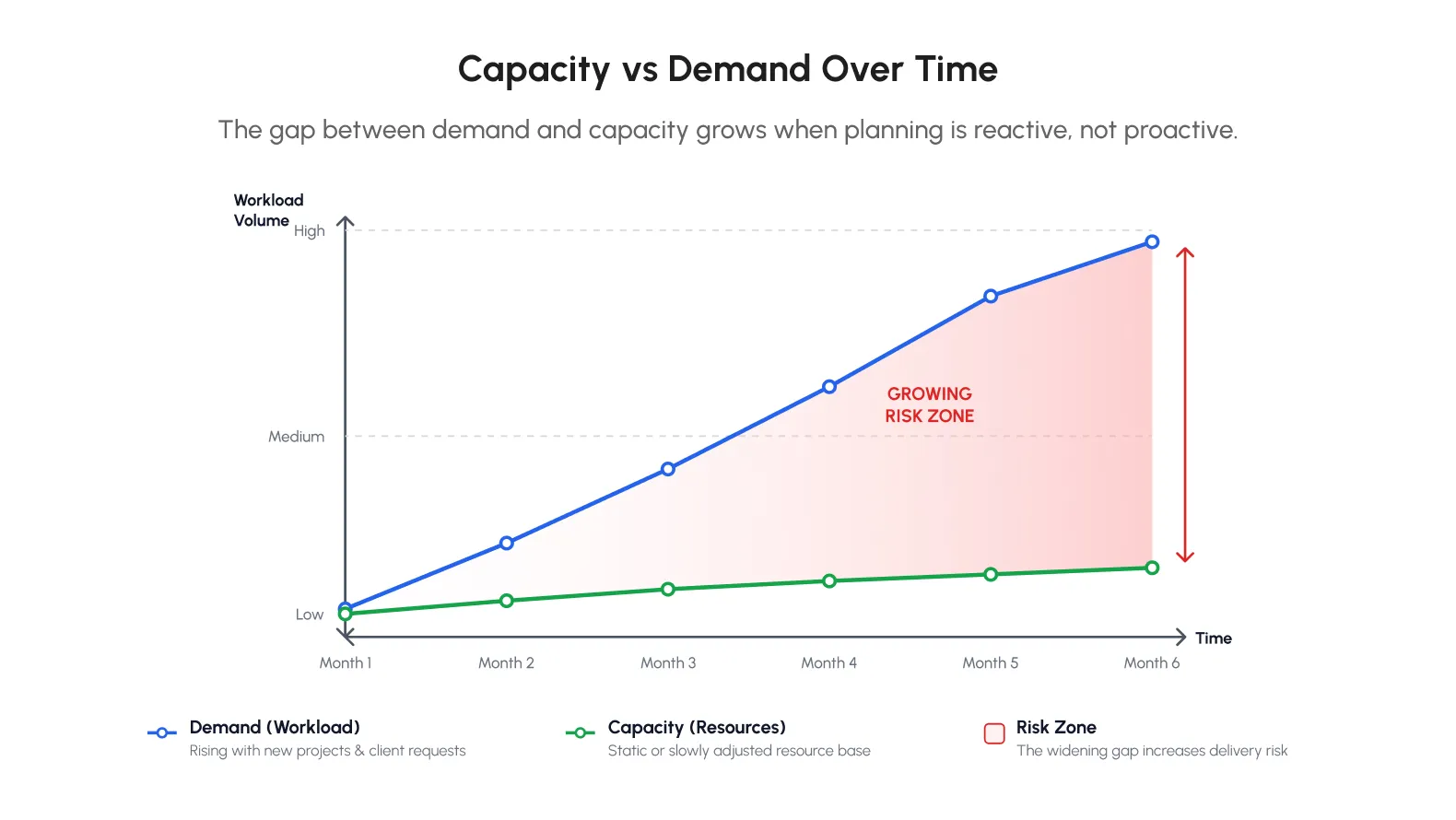
Manually updated spreadsheets go stale within days. Decisions get made on data that no longer reflects reality.
Sales knows the pipeline. Delivery knows current workload. Finance knows the budget. Rarely does anyone see all three at once.
Overallocation gets addressed only after someone complains or a deadline slips.
Forecasts and capacity plans live on different update cycles, guaranteeing a lag.
A plan built in January has usually diverged significantly from reality by Q2, yet many organizations do not revisit it until the next cycle.
These capacity planning challenges rarely announce themselves clearly. They show up as symptoms: rising overtime, slipping deadlines, unexplained attrition among top performers, margins eroding quietly even as revenue looks healthy. Most of these capacity planning challenges share a common root: someone had the information needed to catch the problem early, but it was sitting in a system, a spreadsheet, or a person's head that nobody else was checking.
Neither failure mode is dramatic on its own. Sustained over a few quarters, together they reshape an organization's culture and cost structure in ways far harder to reverse than the scheduling gap that started it.
The Warning Signs Worth Watching
Most capacity planning challenges show up as quiet symptoms long before they become visible crises. Watch for:
Any one of these on its own might be noise. Two or more showing up together, in the same quarter, is usually a capacity planning problem wearing a different costume.
Catching these signs early is almost always cheaper than fixing them late. A cross-training investment made proactively costs a few weeks of reduced billable time. The same gap discovered mid-crisis costs a missed deadline, an unhappy client, and often the resignation letter of the person who had been quietly absorbing the strain.
There is a meaningful gap between what capacity planning is supposed to look like and what it actually looks like inside most organizations.
| What Good Capacity Planning Looks Like | What Most Organizations Actually Do | |
| Update cadence | Weekly or continuous, reviewed against live data | Quarterly or annual, based on stale snapshots |
| Visibility | Single shared view across sales, delivery, finance | Fragmented across spreadsheets, emails, tribal knowledge |
| Forecasting integration | Demand and capacity reviewed together | Demand forecasted separately, capacity reacts afterward |
| Skill matching | Granular, role and skill level detail | Headcount treated as interchangeable |
| Ownership | Cross-functional, clear accountability | Owned informally, defaults to whoever escalates loudest |
| Response to overallocation | Proactive rebalancing before deadlines are at risk | Reactive firefighting after a deadline slips |
The businesses on the left are not necessarily larger or better resourced than those on the right. What separates them is maturity of process, not size of budget.
Case in Point: Pini Group
Pini Group, a multidisciplinary engineering and consulting firm with more than 500 employees across Europe, Asia, and Latin America, ran into a familiar version of this gap. Project managers coordinating tunnels, bridges, and urban development work across multiple countries had no real-time view of who was available where, leading to overbooked offices in some regions and underutilized staff in others.
Leadership could not anticipate upcoming demand well enough to staff proactively. After consolidating scheduling and capacity visibility onto a single platform, managers gained a live view of utilization patterns across teams and offices, allowing them to rebalance workloads before they became delivery risks rather than after.
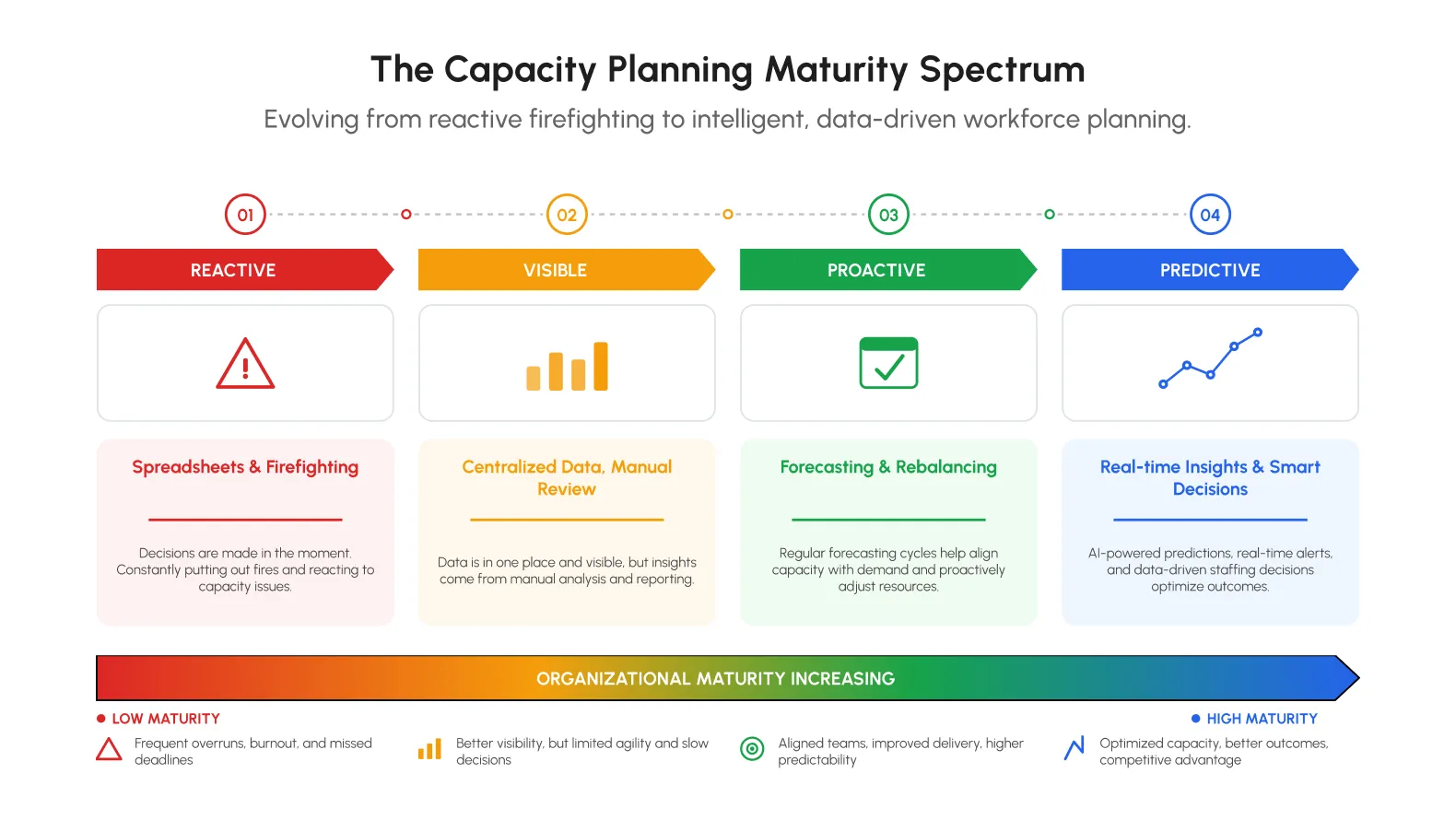
The most consistent difference between the two columns above is not effort. It is visibility. Organizations that solve for real-time, shared visibility move up the maturity spectrum quickly. Organizations that keep patching resource visibility problems with more meetings and more spreadsheets tend to stay reactive indefinitely.
A few honest markers, beyond the benchmarks above:
If most of these already describe your organization, you are closer to the predictive end of the maturity spectrum than most of your industry peers.
Most of the capacity planning breakdowns covered in this chapter trace back to one root cause: a lack of real-time, shared visibility into who is available, what they can do, and how demand is stacking up against that availability. eResource Scheduler is capacity management software built specifically to close that gap, rather than a general scheduling tool with capacity features layered on afterward.
Instead of relying on static spreadsheets that go stale within days, eRS gives managers a live view of capacity, filterable by skill, role, or team, whether the question is about next week or next quarter. Color-coded views show the full picture across projects at a glance, rather than requiring managers to check individual schedules one by one.
Overallocation does not have to wait for a deadline to surface it. The system flags overbooked resources directly on the scheduling chart, so adjustments can happen before a project timeline is at risk rather than after.
Capacity forecast reports track pending resource requests and the resulting capacity balance by role, giving leadership the same forward-looking visibility this chapter argued is essential for connecting demand forecasting to actual capacity decisions. Instead of discovering a resourcing gap once a project is already understaffed, teams can see it forming and respond while there is still runway to hire, train, or reallocate.
Real-world capacity planning has to account for the fact that people are not machines running at fixed output. eResource Scheduler lets organizations define planned leave, reduced hours, and non-working days at the individual, team, or location level, so capacity plans reflect what is actually available rather than a theoretical full-time equivalent nobody actually works.
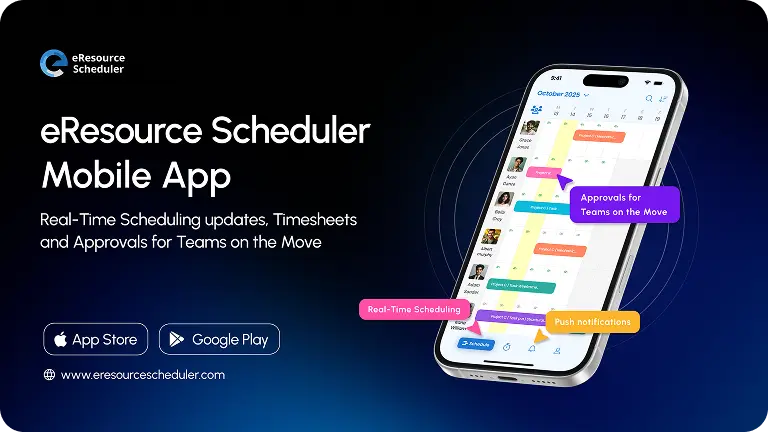
That visibility extends beyond the desktop. Managers reviewing capacity from the field or between meetings can check utilization and pending requests from the eRS mobile app. A resourcing gap spotted on a Tuesday afternoon and acted on the same day is a very different outcome than one left unresolved until Thursday's status meeting.
Good capacity management software should support all three levels of capacity planning covered earlier in this chapter, not just the operational layer most tools default to. This combination, live visibility, proactive overallocation alerts, forward-looking capacity reports, and realistic availability modeling, is exactly that.
Trusted by organizations including American Express, Honeywell, and 7-Eleven, and built on a SOC2-certified platform, eResource Scheduler is designed to support capacity planning as the strategic function this chapter has argued it needs to be, not just another scheduling grid.
Whether or not eRS ends up being the right fit, a few capabilities are worth treating as non-negotiable when evaluating capacity management software:
For organizations still managing capacity through spreadsheets and gut instinct, the gap between where they are and where the businesses in the good capacity planning column sit is rarely a talent problem. It is almost always a visibility problem, and it is the most fixable one on this entire list.
This is the most common misconception in this entire subject: capacity planning is not scheduling with extra steps. It is a business function with its own strategic weight.
Resource scheduling is operational and reactive by nature. It answers who does what, when. Capacity planning is strategic and forward-looking. It answers whether we should even be taking this on, and what needs to change if we are.
One informs staffing decisions for the week. The other informs hiring plans, service line expansion, pricing strategy, and where the business chooses to grow.
Organizations that elevate capacity planning to a genuine business function give it a seat at the same table as financial planning. It gets reviewed in leadership meetings, not just operations stand-ups, and it informs strategic capacity planning conversations about market expansion, not just next week's staffing grid.

 ALL FEATURES INCLUDED