Learn more
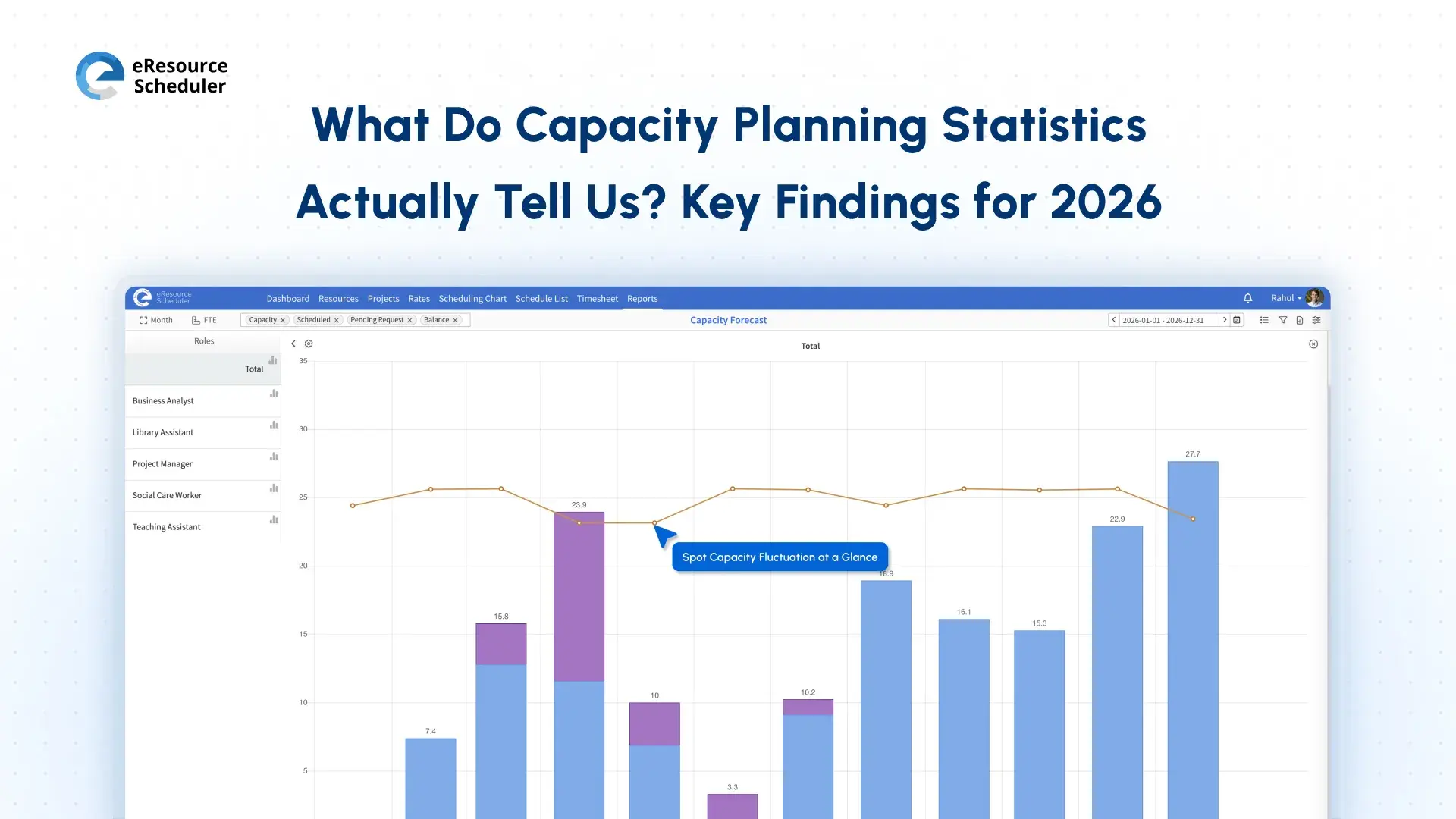
Most organizations treat capacity planning like a calendar exercise. Block some time, estimate headcount, hope for the best. The data from 2026 tells a very different story, and if you are serious about resource capacity planning, you need to hear it.
The numbers are not just surprising. They are a diagnostic. They tell you exactly where the gaps are, why teams keep firefighting, and what separates organizations that grow predictably from those that scramble constantly. Here is what the research actually says.

For years, capacity planning sat comfortably in the project management or HR function. Leaders would sign off on headcount budgets, resource managers would shuffle allocations in a spreadsheet, and everyone would move on. That model is collapsing.
Deloitte's 2026 Global Human Capital Trends survey, which gathered responses from more than 9,000 business and HR leaders across 89 countries, found that 7 in 10 business leaders now say their primary competitive strategy over the next three years is to be fast and nimble. The two capabilities leaders ranked as most critical to achieving this: accelerating how people and resources are orchestrated to do work, and increasing the workforce's ability to adapt at speed.
Read that again. Resource orchestration is now a top competitive priority and not an operational nicety.
Yet the same Deloitte research found that only 7% of leaders say they are actually making progress in helping their workforce continuously grow and adapt, despite 85% calling it critical. That is not a technology problem. That is a capacity modeling problem. Organizations cannot orchestrate what they cannot see, and they cannot adapt at speed without a real-time picture of who is doing what, at what load, with what skills available.
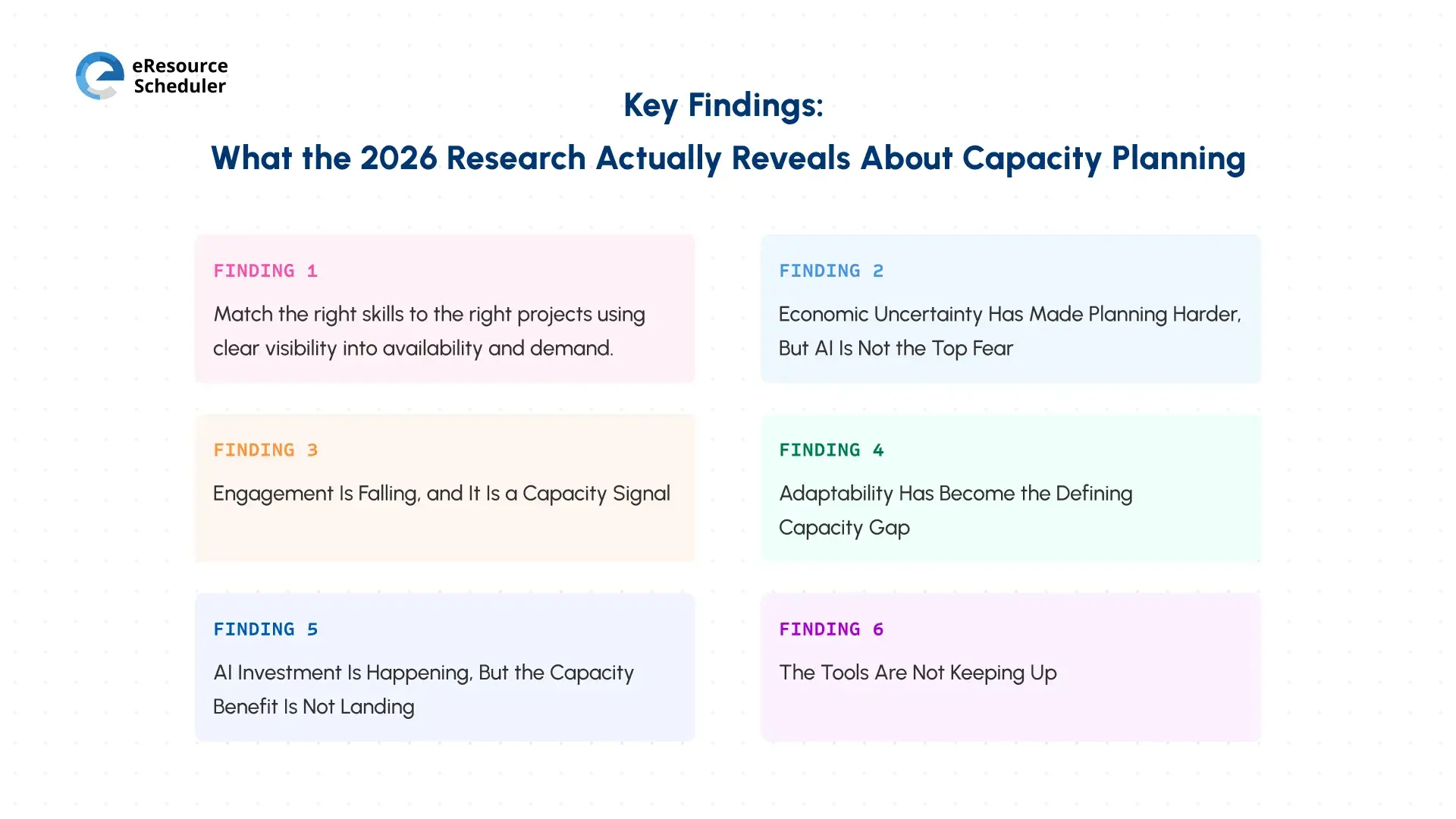
This is where the data gets specific and uncomfortable. Across three major research bodies covering thousands of HR leaders, managers, and employees globally, several patterns emerge with uncomfortable consistency.
OrgChart's State of Workforce Planning 2026, a survey of 409 HR leaders at US organizations with 200 or more employees, conducted in February 2026, surfaced a finding that should alarm any business leader: 47% of HR leaders say their workforce planning tools do not provide accurate workforce data.
Nearly half. Not a struggling minority. This means capacity planning reports built on these tools are built on a shaky foundation. Decisions about hiring, project staffing, and demand forecasting are being made on information that the very people using it do not trust.
When you cannot see your workforce clearly, you are not doing capacity planning. You are doing capacity guessing.
Ask most leaders what is making planning difficult in 2026, and the default answer is AI disruption. The data tells a more nuanced story. OrgChart's 2026 capacity planning report found that 46% of HR leaders say economic uncertainty is their biggest planning challenge, compared to just 36% who cite the unknown impact of AI on their workforce.
This matters for how organizations frame their capacity challenges. The primary difficulty is not knowing how to plan for AI transformation; it is the inability to forecast reliably in a volatile economic environment. Workforce capacity planning that can flex to economic scenarios, rather than locking into a single annual headcount plan, is what organizations need most right now.
Gallup's 2026 State of the Global Workplace report, which surveyed employees across more than 140 countries, found that employee engagement in the US and Canada sits at 31%, the highest in the world, and still means that 69% of the workforce is either not engaged or actively working against their organization.
Critically, Gallup found that manager engagement has dropped nine points globally since 2022. Globally, manager engagement has collapsed from 31% in 2022 to 22% in 2025, the sharpest decline of any workforce segment. This matters for capacity planning and workforce management because managers are the people making day-to-day allocation decisions.
Disengaged managers build disengaged teams. They under-report capacity constraints, fail to flag utilization problems early, and default to reactive firefighting over proactive planning. Workforce capacity planning done at the leadership level but executed by disengaged managers is not a plan. It is a document.
Here is the finding that ties everything together. Deloitte's research found that one-third of workers experienced up to 15 major organizational changes in the past year alone, and only 27% of respondents believe their organizations manage change effectively.
That volume of change is doing something specific to workforce capacity. It is making planned capacity obsolete faster. A staffing model built in January may bear no resemblance to operational reality by March. Skills assumed to be available get redeployed. Priorities shift. Projects pile up. The result is what employee capacity planning professionals see constantly: utilization data that looks healthy on paper while teams report feeling overwhelmed.
Deloitte's data makes the stakes explicit. 66% of C-suite leaders agree that traditional functional structures must change to enable the kind of agility competitive strategy now demands, yet only 7% say they are making meaningful progress toward that change. Workforce capacity planning that is tethered to those old structures will keep producing the same gaps.
Gallup's research also surfaced a finding that reframes the entire AI-and-productivity conversation. Despite an estimated $40 billion in enterprise AI investment globally, 95% of organizations have seen zero measurable impact on profits from that investment.
For employee capacity planning, this has a direct implication. Many organizations have assumed AI tools would automatically expand effective workforce capacity and end up doing more work with the same headcount. However, without redesigning how work is structured and measured, adding AI tools adds complexity without adding clarity.
Deloitte's data reinforces this: only 6% of leaders report meaningful progress in designing human-AI interactions in ways that actually unlock value. You cannot plan for capacity you cannot measure, and you cannot measure what you have not deliberately designed.
The capacity management challenge is not just a data problem. It is a tool problem that is making the data problem worse. OrgChart's research on State of Workforce Planning 2026found that 90% of HR leaders face active challenges with their current workforce planning tools, ranging from poor data consolidation and inaccurate information to excessive manual work required to keep plans current.
That figure deserves emphasis. Nine in ten. In a function where the output is supposed to be strategic foresight, nearly every HR leader surveyed is fighting their own tooling just to get a static picture of their workforce.
The most common complaints: tools that cannot easily consolidate data from multiple sources, that require manual updates to org charts and headcount plans, and that do not connect workforce structure to cost modeling. When workforce capacity planning lives in disconnected spreadsheets and outdated charts, the capacity management challenge is structural, not a skills or effort issue.
Myth Vs. Reality
Myth: A spreadsheet is good enough for capacity planning if your team is small.
Reality: Team size is not what breaks spreadsheet-based capacity planning. The moment you are managing more than one project lifecycle simultaneously with shared resources, a spreadsheet stops being a planning tool and starts being a conflict log you update after problems happen.
According to Gartner, only 15% of organizations actually conduct strategic workforce planning. Most teams have a planning process on paper. In practice, it rarely goes beyond headcount.
Resource leaders say their workforce planning process is limited to headcount planning, and they find it hard to demonstrate the ROI of anything more sophisticated. When capacity modeling is reduced to counting seats, you lose the ability to forecast demand, anticipate skill shortages, or make confident hiring decisions.
This is the trap. You plan for numbers. Work arrives as complexity.
The data not only diagnose problems but also describe what organizations actually get right.
Rather than running capacity reviews quarterly or annually, high-performing teams maintain real-time visibility into utilization, demand, and skills availability. The capacity planning report is never a snapshot; it is a continuous feed.
Knowing you have a team of 12 is not a capacity planning workforce management plan. Knowing which of those 12 have the specific skills required for the next three months of demand and where the gaps are is what actual employee capacity planning looks like.
Pro Tip
Build Your Capacity View Around the Project Pipeline, Not the Calendar
Most resource managers default to planning capacity month by month. Instead, map your view to the project pipeline: what is confirmed, what is in proposal, what is likely. Capacity decisions made against a live pipeline are three steps ahead of decisions made against a calendar.
With 46% of HR leaders citing economic uncertainty as their top planning challenge, the organizations that plan in scenarios (best case, likely case, stress case) are far better positioned than those locking into a single forecast.
Given what Gallup's data tells us about manager disengagement, organizations that build capacity reporting into manager workflows rather than leaving it to self-report get more accurate data and earlier warning of problems.
Most organizations treat workforce planning like an annual ritual. Set the headcount budget in Q4, lock in the resource plan, and revisit it when something breaks. The problem is that business reality does not wait for your planning cycle to catch up. The question is not whether to plan more frequently. It is whether your planning infrastructure can actually support it.
You cannot be agile with a planning cadence built for a slower era.
The 2026 capacity planning workforce management statistics paint a clear picture. The capacity management challenge facing most organizations is not a shortage of people or even a shortage of ambition. It is a shortage of visibility, a mismatch between planning tools and planning needs, and a structural inability to adapt capacity plans at the speed the business requires.
The organizations that take these findings seriously are not doing anything exotic. They are investing in the right workforce capacity planning infrastructure; tools that give real-time visibility into utilization and demand, that connect skills data to resource scheduling, and that let teams model multiple capacity scenarios before problems become crises.
The gap between those organizations and the ones still running capacity planning in a spreadsheet is compounding every quarter.

Plan Smarter. Schedule Faster. For Free.
Join thousands already using eResource Scheduler to align teams, time, and tasks seamlessly.
 ALL FEATURES INCLUDED