Your Denver office just turned down a culvert replacement because no one local could run the hydraulic model, while two engineers in Tucson are billing only half their available hours. Cross-office resource sharing closes this gap. It treats engineers in every location as one pool, so projects can borrow the right person from a sister office for set hours, with the home office approving the move and both offices seeing it.
Firms often call this a loan. The engineer works on another office’s project for agreed hours and dates but stays on the home office’s team and payroll. For regional directors and resource managers, it turns idle hours in one office into delivered work in another.
In practice, getting one office to lend an engineer to another is rarely simple. Every manager is protecting their own billable hours, deadlines, and best people, and each has a good reason to.
Offices hold on to staff because the way most firms measure and run branches makes lending risky or invisible.
The lending office often keeps the engineer’s salary on its books while the fees go to another office’s project. Unless a credit flows back, its revenue and margin dip in the same month. Leaders whose bonuses ride on these numbers learn that saying yes costs them.
Many offices track their people in their own spreadsheets or other disconnected tools. A project manager cannot see that a sister office has a licensed engineer with the right modeling experience sitting half booked. So the default becomes overtime, a contractor, or a declined bid, often before anyone thinks to ask another office.

Permit reviews drag, clients add design alternatives, and RFIs sit unanswered for weeks. A loan scoped to the 60% submittal can easily run through 90%. Without a firm end date, it reads as open-ended risk to a home office with its own deadlines.
PE licenses are issued state by state, and licensure by comity can take weeks or months. Responsible charge rules require the sealing engineer to direct and supervise the work, which some firms read as a reason to keep project teams in one office.
Many loans happen through a phone call between two managers who trust each other. Nothing gets written down, so any problem becomes a dispute between offices. It’s a classic resource management anti-pattern, and it collapses when either manager leaves.
Each habit protects one office, but the cost lands where no office leader is measured.
Each office’s caution is reasonable individually, but together it creates costs no single office owns. Here is where they surface:
What Most Firms Miss
None of these costs appear in a single office’s report, because each office’s P&L looks healthy on
its own. The loss only shows at the firm level, when one office’s declined pursuits and overtime sit
next to another office’s unused paid hours.
Appeals to generosity won’t move the numbers managers are paid on, but visible loans with clear rules will.
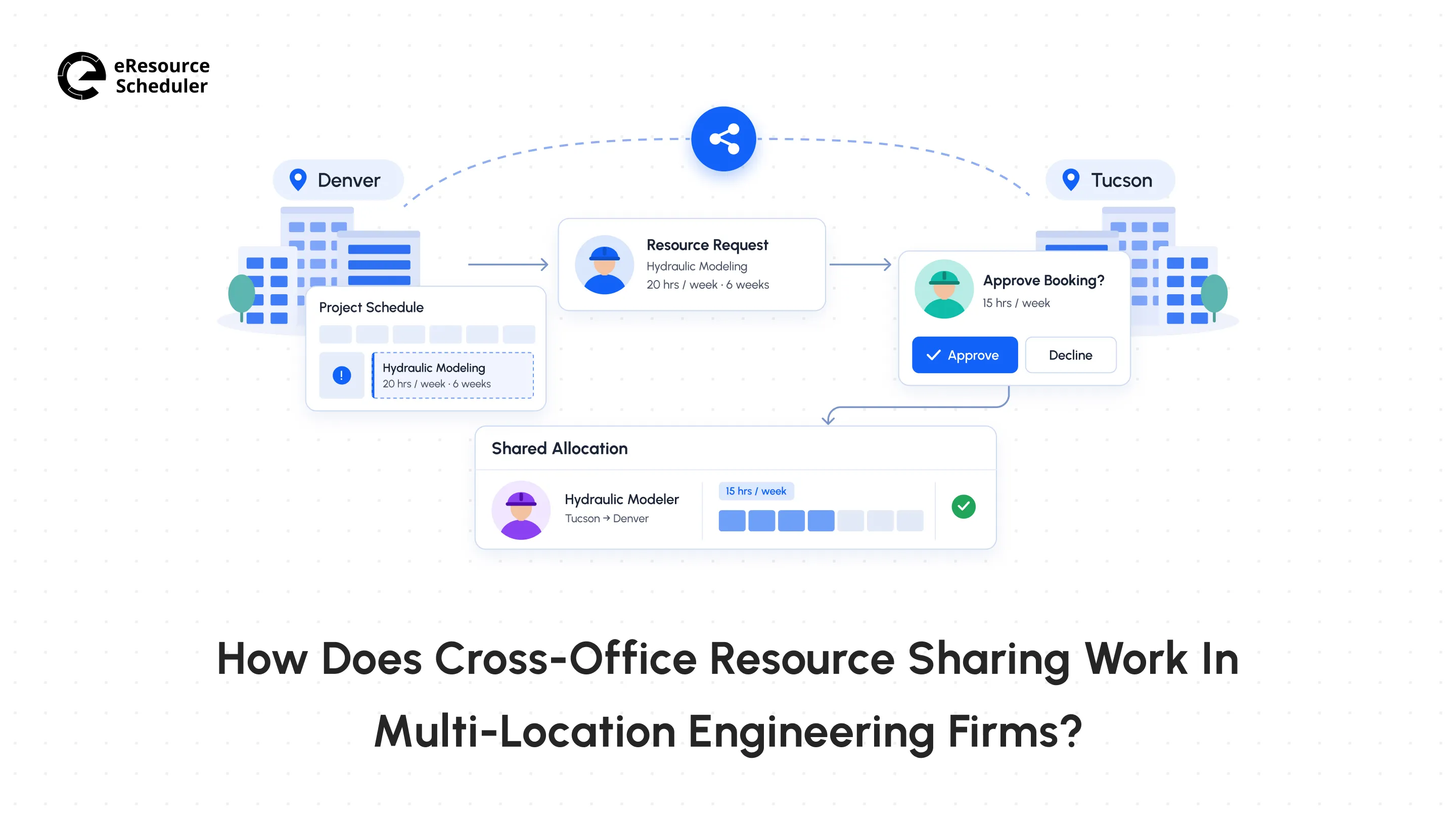
Sharing needs three pieces: a firm-wide view of skills and availability, a request-and-approve step between offices, and permissions that keep each office in control of its people. Ultimately, anyone can see who might help, but only the home office says yes.
Firms that share staff well tend to run all three in resource scheduling software, replacing the per-office spreadsheets or other disconnected tools that kept these engineers out of sight.
Here is one loan at an engineering firm* with offices in Denver and Tucson:
1. Monday Morning: Denver wins a culvert replacement, and the project’s staffing need shows up as an unfilled gap on its schedule. The gap calls for hydraulic modeling and 20 hours a week for six weeks.
2. Monday Afternoon: The project manager raises a request against the gap, listing the skill and the hours rather than a name. Matches come back ranked by fit, led by a Tucson modeler booked at half capacity who is not licensed in Colorado.
3. Tuesday: The request waits in the Tucson resource manager’s queue, marked unprocessed until he acts. Unlike a hallway ask, a queued resource request gives him time to check the engineer’s timeline, where a local deadline in week 3 is about to need five more hours a week.
4. Wednesday: He books 15 hours a week rather than 20, protecting the deadline, and the request flips to processed. Denver sees the booking right away, while permission settings decide who can change it.
5. Week 1: Arizona skips daylight saving, so Tucson runs an hour behind Denver for most of the year. Each office sees bookings in its own local time, and Denver’s engineer of record reviews the model in a daily overlap window, keeping the work under her direction and supervision, as responsible charge requires. The same loan from a Boston office would leave Denver about six shared working hours a day, so wider gaps suit work that can move without same-hour back-and-forth.
6. Weeks 1 to 6: The engineer submits weekly timesheets against the Denver project, and Denver’s PM approves them, since she can confirm the work got done. Planned and actual hours sit side by side, so a slip shows up in week 2 rather than at invoicing.

7. Week 6: The booking ends on the date set back on Wednesday, and the engineer’s hours return to Tucson’s availability without a single email. Tucson’s next project, booked against that date weeks earlier, starts on time.
*The firm’s name is not shared to protect its privacy.
Many firms skip the Wednesday decision, but this step determines whether the loan will hold. Research on multi-location engineering projects found that schedule updates must reflect inputs from all offices, and that every office needs to buy into the schedule at all stages of the project. Denver gets 30 fewer hours than it asked for, so a junior engineer at home takes on the data prep and report figures, leaving the modeling itself to Tucson and keeping the six-week end date. In return, it gets a plan Tucson will actually keep.
The same study names information that is not available in time as one reason schedules slip. The weekly timesheet approvals in step 6 keep this information moving between offices. If actual hours start running ahead of plan, Tucson’s manager and Denver’s PM see it in the same week and can adjust the booking before the end date is at risk.
A clean loan is the easy case. The harder case is two offices reaching for the same engineer in the same week.
You prevent double-booking by letting only the home office book its own engineers, so two offices cannot claim the same person on their own. The clash that does happen is quieter: a loan overlapping work the home office already has lined up for the engineer, or two requests for the same person landing in the same queue.
The fix has two parts: a flag that surfaces the clash right away, and a rule agreed in advance for who settles it. In resource management software, an overload flag appears on the engineer’s schedule as soon as overlapping bookings push them past their available hours, so the conflict shows up before either project counts on the time.
In simple terms, the software spots the problem early, and your rules decide what happens next. Here is how this plays out across the life of a loan:
| Situation | How It Is Recorded | Who Acts | What Both Offices See |
| Approved Loan | Booking on the shared schedule | Home office resource manager (RM) | Same dates and hours on both schedules |
| Loan Overlaps Home Office Work | Overload flag on the engineer’s schedule | Home office RM | The overlap on the engineer’s timeline |
| Two Requests for the Same Engineer | Both requests in the home office queue, marked unprocessed | Home office RM, with the regional director as tiebreaker | Each request’s status until one is processed |
| Planned Leave During the Loan | Leave marked as an exception | Home office RM | Greyed-out dates the receiving PM can plan around |
| Home Office Needs the Engineer Back Early | Booking split or shortened | Home office RM, after recall notice | The revised end date, with a notification |
| Receiving Office Needs More Weeks | Booking extended once approved | Requesting PM asks, home office RM approves | The new end date on both schedules |
| Work Finishes Early | Remaining booking released | Requesting PM flags it, home office RM releases it | Freed hours back in the home office’s availability |
A visible record settles clashes loan by loan, but someone still has to watch the firm-wide pattern.
Leadership should track how capacity moves between offices alongside the performance of each office. Office reports are built to judge branches, so they reward the very hoarding this blog started with. A firm-wide view asks a different question: are your engineers working where the firm needs them most?
Resource management tools like eResource Scheduler can bring every office’s bookings, requests, and utilization into one view, so multi-office resource management runs on numbers that regional directors and office leaders both trust.
Utilization = (Billable Hours ÷ Available Hours) × 100
In simple terms, utilization is the share of paid time spent on client work. Say Tucson has 12 engineers with 480 available hours a week and logs 336 billable hours (70%). Denver has 10 engineers with 400 available hours and logs 380 billable hours (95%).
Combined, this is 716 of 880 hours (81%), which looks healthy. Split by office, Denver is running hot while Tucson has 144 non-billable hours a week. This parallel view is global resource visibility, and it is your earliest warning before overallocation turns into weekend work.
Track who lends, who borrows, how many hours move each month, and how often loans overrun. An office that borrows every quarter may need permanent headcount, while one that never lends may be hiding capacity behind its targets.
Managers can follow active loans on the go through the eRS mobile app, with push notifications when a booking changes. This makes it less likely that a recall or extension will catch anyone off guard.
Utilization shows where your engineers stand today. Capacity planning looks ahead, comparing the work in your pipeline with the hours each office will have, discipline by discipline. This is the point where borrowing staff between offices becomes a plan rather than a scramble.
Say Denver’s pipeline holds two bridge rehabs starting in April that need about 600 structural hours over the quarter, while its own structural team has 350 to spare. Tucson’s forecast shows 300 open structural hours in the same window. The 250-hour gap shows up three months early, so the loan can be requested and approved before either office feels the pinch.
A forecast also shows which state licenses your pipeline will need, early enough to start a comity application before the work arrives.
Many of the costliest calls in this playbook get made in the meeting room. A go/no-go decision on a pursuit often comes down to one question: do we have the people? When answering it means waiting for someone to pull a report, the pursuit usually gets passed over, and the declined work never shows up anywhere.
With eResource Scheduler connected through Model Context Protocol (MCP) to the AI assistant your team already uses, such as Claude, ChatGPT, or Microsoft Copilot, a director can ask which office has a structural lead free from May through July and get the answer before the vote. The assistant works within the permissions each person already has in eRS, so office leaders still decide who sees their team’s details.

All of this depends on something no report or assistant can produce: office leaders willing to lend.
You get office leaders on board by removing their reasons to say no before the first request arrives. A memo from leadership cannot do that alone, since any branch leader can still call an engineer too busy to lend. The steps below address the objections this blog opened with: the hit to their numbers, the open-ended timeline, and loans that run on handshakes. Then use a small pilot to prove the setup works.
1. Credit the lending office: Firms handle this in one of three ways, each asking more of leadership than the last:
Credit-back is the easiest place to start. A firm that outgrows it usually knows what model it needs next.
2. Set a standard recall notice: Agree on how much warning the home office gives before pulling someone back, such as two weeks, so the receiving PM has time to hand off the work. Decide up front who can approve a shorter notice when a client emergency hits at home (such as the regional director).
3. Settle cost rates: Credit only protects the lender’s numbers if both offices agree on the rate behind it. A cost rate keeps the lending office whole without padding it, and a billing rate rewards the lender but squeezes the receiving project's margin. A firm-wide rate suits firms already moving toward a single profit center.
4. Pilot with two sister offices: Pick the pair with the widest utilization gap, ideally in the same or neighboring time zones so review schedules are not one more thing to sort out. Choose one discipline both offices use, and put every loan through the request queue, even between managers who trust each other. Run it for a quarter and fix what breaks before adding offices.
Here is what credit-back does to Tucson’s numbers during the six-week loan, assuming a $150 hourly billing rate:
| During the Six-Week Loan | Without Credit | With Credit |
| Salary for the 90 Lent Hours | Paid by Tucson | Paid by Tucson |
| Fees Credited to Tucson | $0 | $13,500 |
| How the Hours Look in Tucson’s Numbers | Cost with no revenue | Cost matched by revenue |
Lending costs Tucson nothing extra, since the engineer is paid either way. Credit decides whether these hours reach the quarterly review as a drain or as revenue. Add notice and a clear rate, and there are few reasons left to say no.
Hoarding grows out of office-level P&Ls, blind spots, and handshake loans, so cross-office resource sharing sticks only when the rules and tools change together.
When your pilot quarter ends, judge it on the costs it was meant to cut. Check whether the utilization gap between the two offices narrowed, whether fewer pursuits ended in ‘no-go’ for lack of staff, whether subconsultant spend dropped, and whether loans ended on their agreed dates. If these numbers move, the next pair of offices will ask to join.



Plan Smarter. Schedule Faster. For Free.
Join thousands already using eResource Scheduler to align teams, time, and tasks seamlessly.
 ALL FEATURES INCLUDED