





 Learn more
Most organizations don't struggle to plan work. They struggle to plan who will actually do the work. Projects are scoped, timelines are agreed on, and priorities are set, but capacity often remains an assumption rather than a data point. That gap shows up later as missed deadlines, overbooked teams, and constant reshuffling.
This pattern repeats so consistently across industries that it has almost become an accepted cost of doing business. A roadmap gets approved in a planning meeting where everyone nods along to a timeline, and only weeks later does it become clear that the people meant to deliver on it were already committed elsewhere. Nobody set out to overcommit the team. The plan simply assumed capacity that was never actually confirmed.
In the middle of all of this, one question often sits in the background:
Are the required resources actually available?
Resource management exists exactly to answer this. It brings structure to how organizations align people, skills, and availability with the work that needs to be delivered using proven resource management techniques.
This chapter breaks down what resource management actually means, how it works in practice, and where it fits in modern organizations.
Resource management is the practice of planning, allocating, and optimizing people, skills, and capacity across work demand. From an academic perspective, resource management refers to the allocation and optimization of resources to achieve defined objectives.
Resource management ensures that:
In most business environments, the focus is not on physical assets. It is on people. That includes:
Each of these groups behaves differently when it comes to availability. A full-time employee's capacity is usually visible on a single calendar. A freelancer's capacity might be split across three other clients that the organization has no view into at all. Treating all four groups as one undifferentiated pool of "people" is often where resourcing assumptions start to break down, since the actual constraints on each group's time look nothing alike.
The goal is simple but critical, and resource management answers one question consistently.
Who is available and what should they work on next? For modern teams, the resource management definition becomes more practical:
Resource management is the system that connects work demand with workforce capacity in a structured and visible way. It also ensures that work gets delivered without overloading teams or leaving capacity unused.
Why resource management is important becomes obvious the moment a leader tries to scale past a handful of people. At a small enough size, everyone can keep the full picture in their head. A founder or a team lead simply knows who is free and who is buried. That informal system breaks the moment a second team, a second project, or a second location enters the picture.
Past that point, resource management stops being a nice-to-have process and becomes the only reliable way to keep decisions grounded in what the workforce can actually support, rather than what a plan hopes it can support.
Run a 10-minute visibility audit. Ask three managers, "Who on your team is free next week?" If you get three different answers, or any of them need to check five places before responding, that's not a staffing issue. That's a resource management gap.
Resources are not limited to people, but in most modern organizations, every type of resource eventually ties back to how people and time are allocated.
Here are the most common resource types, with resource management examples to see how they show up in real work environments.
Human resources include the people required to execute work. This covers full-time employees, part-time staff, freelancers, contractors, and subject matter experts. They are the most critical and complex resource because skills, experience, and availability vary significantly.
Examples:
Technical resources refer to specialized skills or systems required to deliver technical work. This includes developers, engineers, IT infrastructure, and software capabilities. These resources are often limited and highly dependent on expertise.
Examples:
Creative resources include designers, writers, video editors, and campaign specialists responsible for content and brand execution. Their work is often iterative and time-sensitive, making workload balance critical.
Examples:
Engineering resources focus specifically on product and development teams responsible for building and maintaining systems or applications. These resources are typically structured around sprints, backlogs, and long-term roadmaps.
Examples:
Operational resources support day-to-day business functions, especially in environments with repeatable processes or shift-based work. These resources require consistency and efficiency in allocation.
Examples:
Financial resources refer to the budget available to support projects, teams, and initiatives. While not directly assigned like people, budget constraints influence how resources are allocated. This is where the gap between planning and execution tends to show up first.
The 2025 FP&A Trends Survey found that only 11 percent of organizations have fully aligned strategic, financial, and operational planning, which means for the rest, budget decisions and resourcing decisions are often made in separate conversations entirely.
Examples:
Time is the most finite and universally constrained resource across all organizations. Every allocation decision ultimately consumes both billable and non-billable hours.
Examples:
This is also the resource type that exposes the limits of good intentions. A manager can have the best people, a solid plan, and full buy-in from leadership, and still watch a timeline slip if time itself was never tracked with any real precision.
Of the seven resource types covered here, time is the only one that cannot be borrowed, stored, or recovered once it has passed, which is exactly why it deserves the same level of planning rigor as headcount and budget.
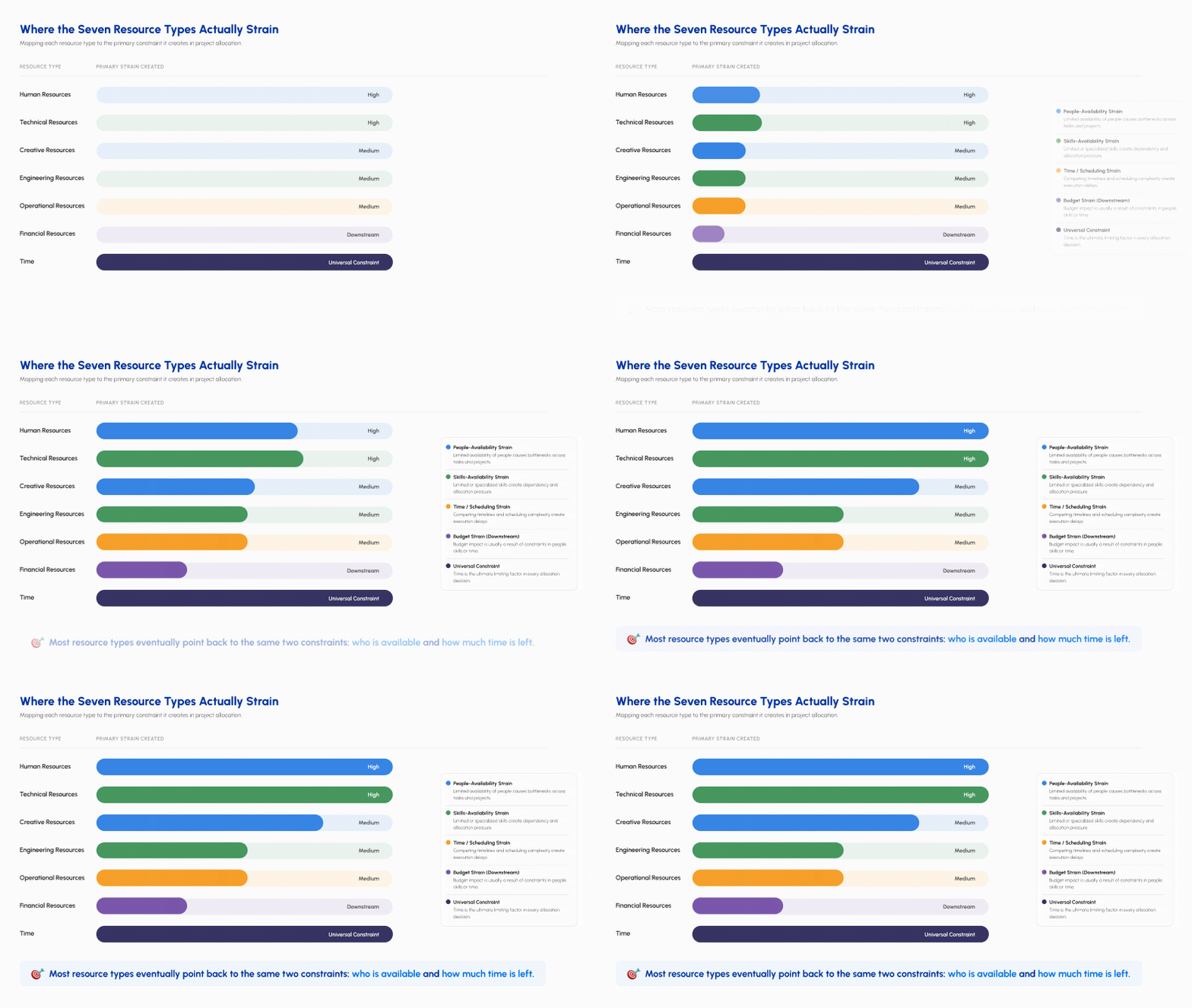
What this means in practice is that while organizations manage multiple resource types, one reality holds.
In an article titled, The critical role of strategic workforce planning in the age of AI, McKinsey & Company (2025) notes that workforce allocation and time prioritization have become central to organizational performance, reinforcing that people and their time sit at the core of execution.
McKinsey's research also found that S&P 500 companies that excel at maximizing return on talent generate roughly 300 percent more revenue per employee than the median firm, which is a hard number behind a soft idea: how well an organization manages its people is not a side metric; it is tied directly to revenue outcomes. Everything else supports how effectively that core resource is used.
This is one of the most common points of confusion. While both resource management and project management are closely related, they serve different purposes, often supported by project and resource management software.
| Project Management | Resource Management |
| Focuses on tasks, timelines, and deliverables | Focuses on people, capacity, and allocation |
| Answers what needs to be done | Answers who will do the work |
| Tracks progress and milestones | Tracks availability and utilization |
| Measures project completion | Measures workforce efficiency |
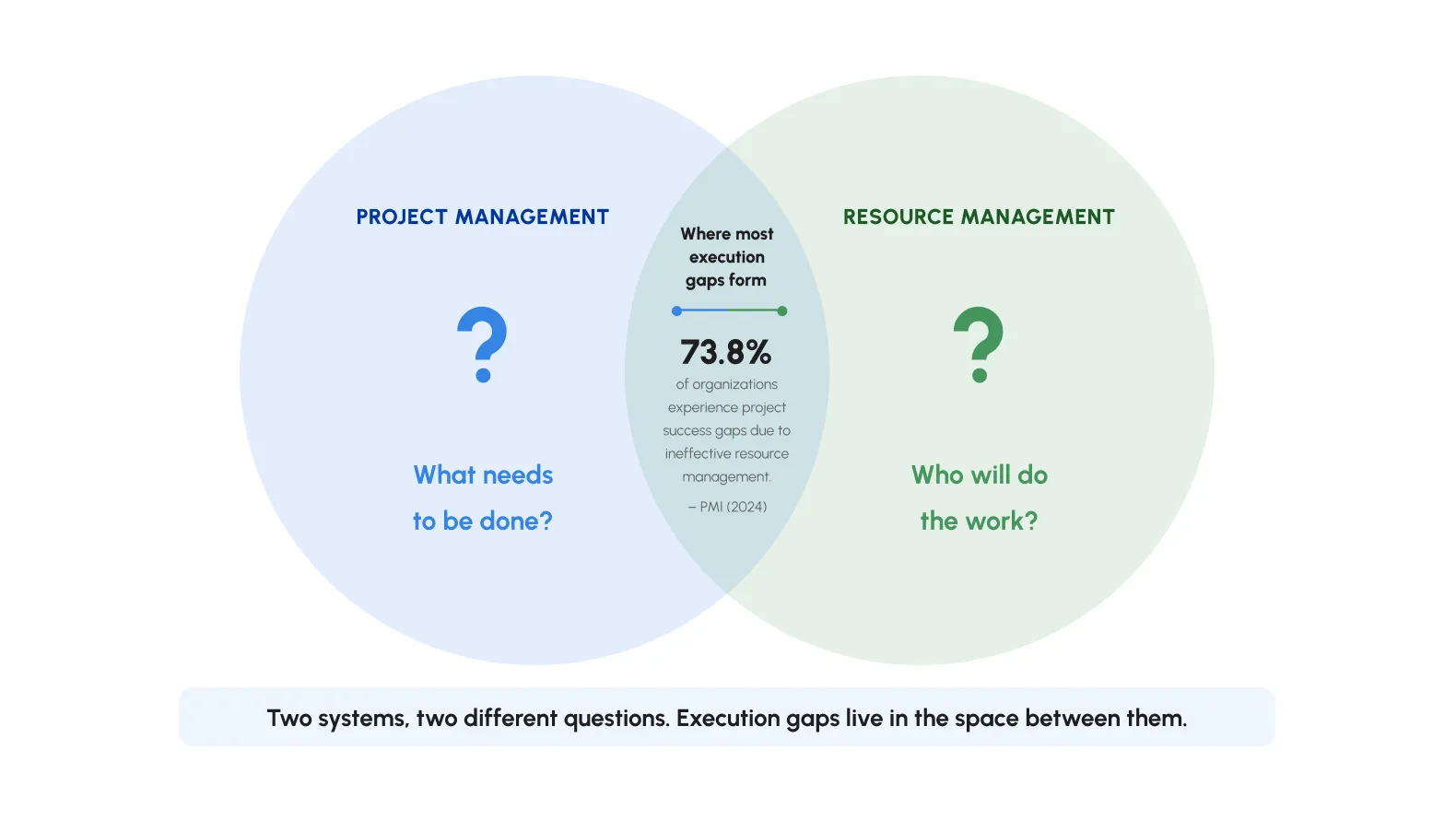
Many organizations rely heavily on project planning tools but lack visibility into resource capacity and schedules. This creates a disconnect primarily because projects may look feasible on paper but fail during execution due to resource constraints. The confusion tends to come from how most organizations are structured.
Project management usually sits inside a PMO or a delivery function, watching tasks move across a timeline. Resource management, when it exists as its own discipline at all, sits closer to operations or workforce planning, watching people move across multiple timelines at once.
The two functions are looking at the same work from different vantage points, and when neither has full visibility into the other, plans get approved that the available workforce was never actually capable of supporting.
This is also why a project can be reported as "on track" right up until the week it isn't. A project management view only shows whether tasks are progressing against a schedule. It does not show whether the people behind those tasks are already overcommitted somewhere else, quietly running at the edge of their capacity until something gives.
The two disciplines need each other to function well. A resourcing decision made without a project's timeline in view is just as risky as a project plan made without resourcing in view. The organizations that get this right tend to treat the two as a single conversation rather than two separate departments, occasionally checking in with each other.
According to PMI's Pulse of the Profession research, the average project performance rate across organizations sits at 73.8 percent, meaning roughly one in four projects fails to fully meet its business goals, and a meaningful share of that gap traces back to planning and resource alignment issues rather than the work itself.
Resource management complements project management by ensuring that plans are grounded in reality, reinforcing why resource management is important for execution success.
Understanding the key elements of resource management is what separates planning from execution. The key elements of resource management define how work actually gets delivered. Even the best resource management software depends on getting these basics right.
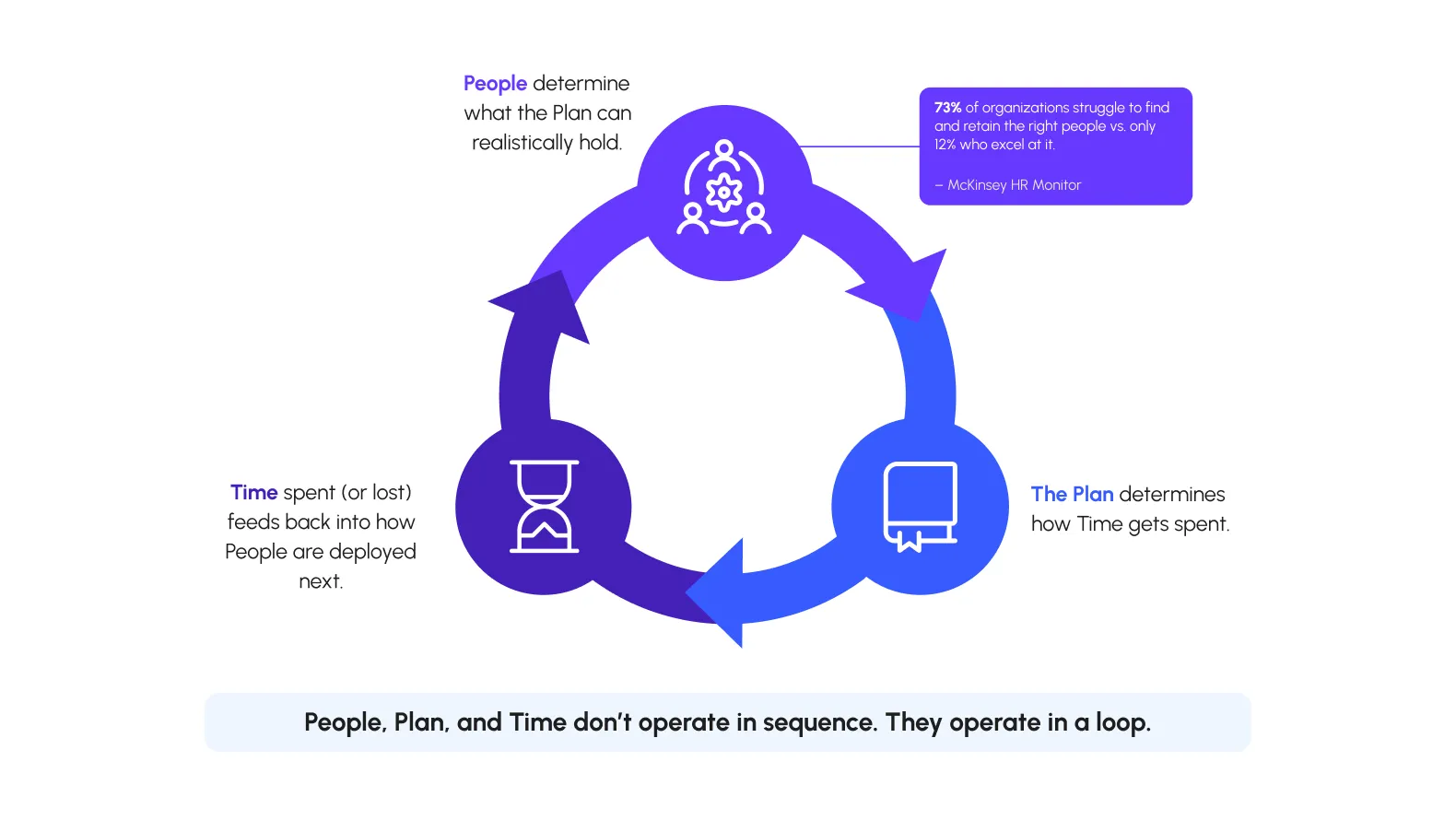
Everything flows through three anchors. We call it the 3T Method: the People, the Plan, and the Time.
People are ultimately responsible for project success. Leadership, emotional intelligence, and communication are not soft extras; they are what turn a plan into work that actually gets done. Combining people skills with project management tools is what separates a manager who inspires a team from one who simply assigns tasks to it.
McKinsey's HR Monitor 2025 found that 73 percent of organizations conduct short-term operational workforce planning, but only 12 percent of organizations in the US do strategic workforce planning that looks three or more years ahead. That gap is the People anchor failing quietly.
In practice, the People anchor comes down to three questions a leader should be able to answer at any point:
That gap between the first question and the other two is usually where attrition and missed deadlines quietly originate, often well before anyone connects the two.
This is also where resource management diverges most clearly from simple staffing. Staffing asks whether a seat is filled. The People anchor asks whether the person in that seat is the right fit for what the work actually requires, and whether they have the bandwidth to do it well rather than just technically complete it.
All projects require a plan, regardless of their size. Before starting, you assemble the project's components and organize them into a plan. Large projects need lists of lists. Small projects might need nothing more than a single task list. Either way, the work is the same: dissect everything, think about what would be required, and prepare for those resource requirements.
A plan that ignores resource reality is really just a wish list with deadlines attached. The difference between a project plan and a resourced plan comes down to one extra layer of honesty:
Skipping that layer is how a perfectly reasonable-looking roadmap turns into a quarter full of slipped dates.
This is also where the Plan anchor connects directly back to the People anchor. A plan built without visibility into actual capacity isn't a resourcing plan. It's a guess dressed up as a schedule, and the gap between the two only becomes visible once execution starts and the guess runs out of room.
Everyone has heard the adage "time is money." Ignoring utilization is the simplest way to lose control of a project. It's hard to predict exactly how long each step of a plan will take, and even experienced project managers see variance between estimates and reality.
As each step finishes, the same check applies: are you ahead, behind, or on course? Of those three outcomes, two involve more work for you.
What changes the outcome is not the estimate itself, but how quickly the variance gets noticed:
That lag, between when a time problem happens and when someone actually notices it, is one of the highest hidden costs in resource management. It rarely shows up as a single dramatic miss. It shows up as a string of small delays that nobody catches early enough to fix cheaply.
It's easy to talk about visibility, capacity, and control in theory. The real test shows up when operations don't pause. Take 7-Eleven. Training isn't a calendar event but a constant flow.
Zoom in for a second, and you have a string of tasks waiting for you:
Now multiply that across locations. Across roles. Across weeks that never really "reset." What looks like scheduling on paper quickly turns into a moving system of dependencies.
If answering one staffing question takes checking more than one tool, that's your signal to centralize. Track how many places someone has to look to confirm a single resource is available. Two is manageable. Three or more means you're coordinating through luck.
Before structured resource management with eResource Scheduler, that system had no center of gravity, and work looked something like this:
Ultimately, nothing was technically "broken," but nothing was truly connected either. Answers existed. Just not in the same place. Not at the same time. That's where inefficiency compounds, not from lack of effort, but from lack of visibility.
The fix was never about replacing the people doing the coordinating. It was about giving them one place to look instead of four. Once training schedules, trainer availability, and certification status lived in the same system, the same coordination that used to take a string of phone calls and a small leap of faith took a glance at a shared calendar. The work didn't get easier. The guesswork around it disappeared.
Those who understand the basis of resource management often swear by one truth: when resource management happens within a system of record, decisions stop depending on effort and start depending on clarity.
Modern resource management systems replace fragmented coordination with structured visibility and control. Instead of relying on scattered spreadsheets and ad hoc communication, planning becomes centralized, consistent, and decision-driven.
This shift is enabled through capabilities that directly improve planning quality:
These are not feature add-ons. They directly remove the need for manual coordination. The biggest difference is not operational. It is behavioral. When planning stops being reactive, teams move from asking "Who is available right now?" to "Who is the right fit given capacity, skills, and priorities?"
This shift is typically enabled by a dedicated resource management tool designed for visibility and control.
Not every system that calls itself resource management software actually delivers on visibility. The label gets used loosely, so it helps to know which capabilities separate a genuinely useful tool from a digital version of the same spreadsheet problem.
A few things worth checking before adopting any resource management tool:
These criteria matter more than feature count. A tool with fifty features that nobody trusts is worth less than a tool with five features that everyone actually uses to make decisions.
A rough threshold worth watching: once a team crosses 15 to 20 people or juggles more than 3 to 4 concurrent projects, spreadsheet-based tracking starts breaking down. If updates are more than a day old by the time anyone acts on them, you've already outgrown the spreadsheet; the calendar invite just hasn't gone out yet.
Most organizations don't lack talent. They lack clarity on how that talent is actually being used. Research on advanced planning maturity reinforces this: organizations that connect real-time signals to decision models execute faster and more accurately, while the vast majority, operating with the planning silos described earlier in this chapter, are left reacting instead of deciding.
Work demand keeps increasing while visibility remains fragmented. Teams are assigned work based on assumptions rather than real capacity. The same people get overbooked, others remain underutilized, and timelines begin to slip despite strong planning.
This is not a delivery issue. It is a visibility issue.
It shows up in a familiar pattern. A project is approved because, on paper, the team has capacity. A few weeks in, that same team is also absorbing unplanned work from another initiative nobody flagged during planning. Nothing about the original approval was wrong. The information it was based on was simply incomplete the moment it was made, and stayed incomplete until something visibly broke.
The cost of this is rarely a single dramatic failure. It is closer to a slow leak. A missed deadline here, an unplanned hire there, a high performer who quietly leaves because they were stretched across too many priorities for too long. Each of these looks like an isolated problem when it happens. Taken together, they are usually symptoms of the same root cause: nobody had a single, trustworthy view of what the organization's people could actually take on.
Resource management solves this by aligning work demand with actual, available capacity before execution begins, turning planning from guesswork into informed decision-making using structured resource management techniques.
Spreadsheets work until scale introduces complexity. As teams grow, plans become harder to maintain, updates fall behind, and coordination turns into a manual effort.
The shift rarely happens all at once. It usually starts small, one team outgrows its tracking sheet, then spreads as more teams hit the same wall at different times. By the time leadership notices the pattern, the organization is often running several disconnected versions of the same basic problem:
This is where resource management software like eResource Scheduler becomes necessary. It centralizes planning, provides real-time visibility into availability, and enables teams to allocate resources with greater accuracy and confidence, much like the best resource management software solutions in the market.
The shift is less about replacing a tool and more about replacing a habit:
Instead of reacting to a conflict once it has already happened, teams catch it while there is still time to do something about it.
Many organizations today are also shifting toward integrated project and resource management software to eliminate silos between planning and execution. This matters because the two disciplines were never meant to run separately. A project plan without resource visibility is, at best, a confident guess. Project and resource management software closes that gap by keeping both views connected inside one system, so a change in one is immediately visible in the other.
Resource management starts with a simple shift. From planning work in isolation to planning with clear visibility into capacity. Once that visibility exists, decision-making sharpens. Allocations become intentional. Execution runs with far less friction.
None of this requires a complete reinvention of how a team works. It starts with a smaller, more honest question: if someone asked who is free this week, how long would it take to get a real answer, and would that answer be the same no matter who in the organization was asked? For most teams still running on spreadsheets and inbox threads, the honest answer is that it would take longer than it should, and the answer itself would depend on who you asked.
This is where purpose-built platforms like eResource Scheduler begin to change the equation, turning visibility into a consistent planning advantage rather than a one-off effort.
This chapter established what resource management is, why it matters, and the elements that hold it together. The next step is understanding why it has become a strategic priority for modern organizations, not just a back-office function that keeps the lights on.
Up Next: In the next chapter, we explore why organizations are moving toward modern resource management and what is driving the shift from fragmented planning to structured, system-led approaches.

 ALL FEATURES INCLUDED