Your best developer is booked across four projects this week, and somehow none of them are moving fast enough. Sounds familiar? If you have ever managed people, timelines, or budgets, you have probably hit this exact wall. Too many deadlines, one very tired resource manager, and a spreadsheet that stopped making sense three tabs ago.
When schedules jam up like this, two fixes get mentioned in almost the same breath: resource leveling and resource smoothing. They sound like twins, and plenty of project leads use the two terms interchangeably, which is exactly where things start to go sideways. One technique protects your deadline. The other protects your teams’ workload. Reach for the wrong one, and your scheduling fix can create a bigger mess than the bottleneck you started with.
Getting this right matters more than most teams realize, and it ties back to resource management practices PMOs rely on when they build resourcing plans that actually hold up under pressure. In this blog, we will walk you through what each technique does, when to use it, and how to tell which one will genuinely clear your bottleneck rather than just shifting it to someone else.
Before we go further, here is the short version.
| Aspect | Resource Leveling | Resource Smoothing |
| Main Priority | Keeping resources within capacity | Hitting the fixed deadline |
| Effect on Timeline | Can push the end date out | Stays fixed |
| Effect on Critical Path | Can shift it | Leaves it untouched |
| Best Suited For | Overallocated or understaffed teams | Projects with float and firm deadlines |
| Typical Trigger | Team is overallocated | Deadline is fixed, but some float exists |
| Risk if Misapplied | Deadline slips unexpectedly | Team stays overworked, conflict goes unresolved |
Now, let’s break down what is actually happening behind each of these rows.
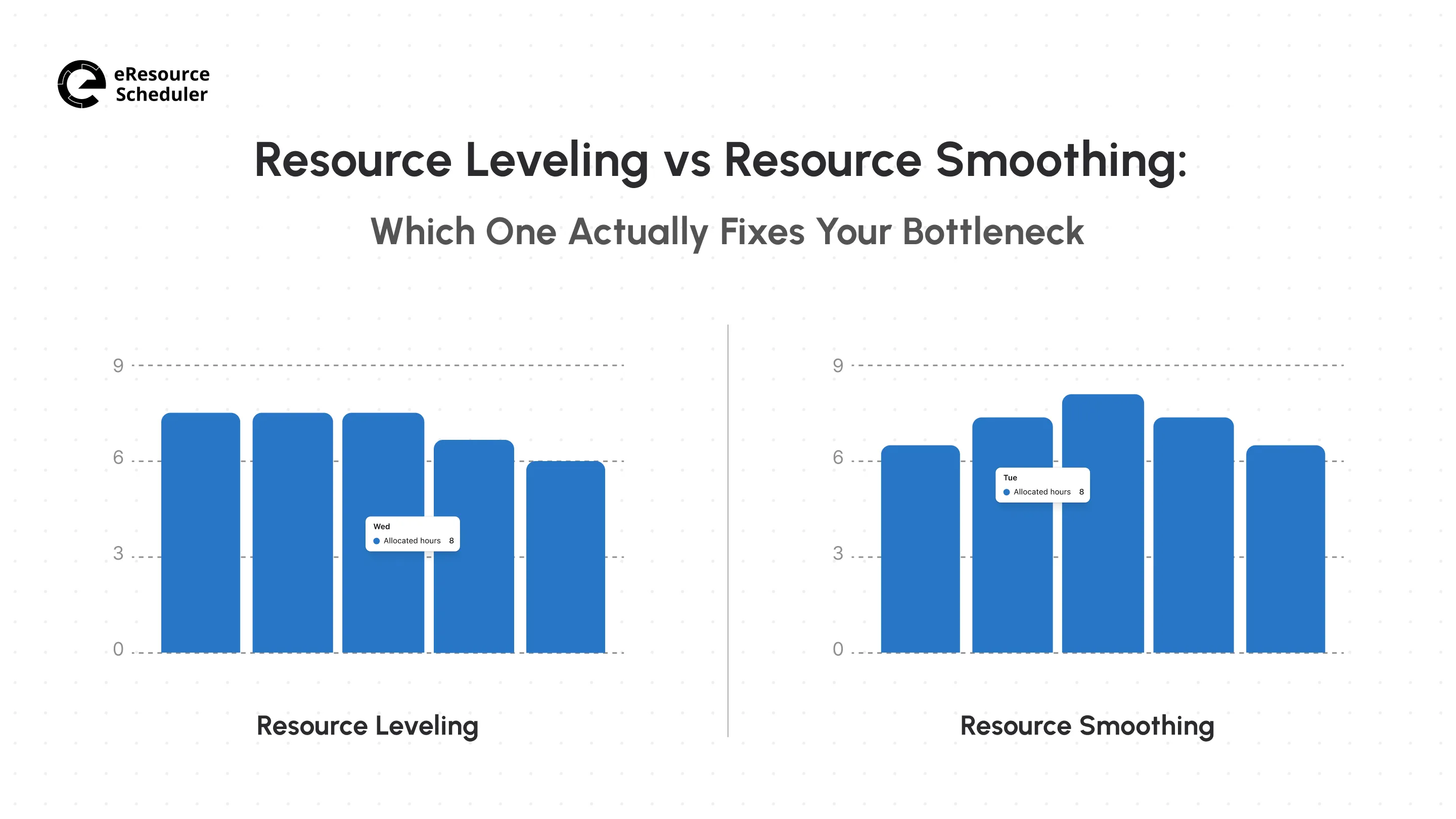
Let’s start with the basics, then get into when this actually makes sense. Resource Leveling means adjusting the task start and end dates so nobody on your team ends up double-booked. If your project timeline has to stretch to keep people from being overworked, leveling accepts that trade-off. The deadline bends so the workload does not break.
This technique earns its keep when your team is small, your people cannot be cloned, and the deadline has at least some buffer. If you run a lean team where one person covers three specialties, leveling stops you from running this person into the ground to hit an arbitrary date.
Say two of your engineers are needed for the same work, but only one project has the room to slip. Leveling would push the less urgent task a few days out rather than forcing both engineers to work double-time. Knowing what you can safely delay usually comes down to understanding your critical path, which is where mapping out task dependencies really pays off. Once you know which tasks have breathing room, deciding what to move becomes a lot less stressful.
Did You Know?
Resource leveling actually has roots in construction and manufacturing scheduling, where
reassigning skilled labor without hiring a whole new crew was the entire point. The same logic works
just as well whether your ‘crew’ is a dev squad, a design team, or a group of
consultants juggling three client accounts.
The upside is straightforward. Fewer burned-out employees, more realistic workloads, and a schedule that reflects what your team can actually deliver. The downside is just as real. Your project can run longer than originally promised, and that is a hard conversation to have with a client or sponsor expecting a fixed date. This is especially true when the slip only becomes visible after the fact, rather than being caught early through resource management software designed for this kind of tracking.

Leveling solves one kind of problem well, but it is not the only tool in the box. This is where the second technique comes in, pulling in the opposite direction.
Now flip the lens and look at the other side of this coin. Resource Smoothing keeps your deadline exactly where it is and instead adjusts how resources are used within the existing slack in your schedule. Instead of moving the finish line, you shuffle work around inside the time you already have.
This is your go-to move when the deadline is genuinely fixed (think regulatory filings, product launches tied to a marketing campaign, or contractual delivery dates). If missing the date is off the table but you still have some flexibility in how tasks are sequenced, smoothing lets you use this flexibility without touching the finish line.
Think of a product launch date that cannot move because of a scheduled ad campaign. If one designer is slightly overloaded in week two, smoothing might shift a non-critical task into week three, where there is spare capacity, without pushing the launch itself. Nobody outside the project even notices the adjustment happened.
The clear win here is deadline certainty. Stakeholders get the date they were promised. The trade-off is this smoothing only works when your schedule has float to spare. If every task is already tight against the critical path, there is no room left to smooth anything, and you are back to square one.
Both techniques solve real problems, just not the same one. Seeing them side by side makes the choice a lot clearer.
Before we go further, here’s how the two actually stack up against each other.
| Similarities | Differences |
| Both exist to solve the same root problem: too much demand chasing limited capacity | Leveling protects the team’s workload; smoothing protects the deadline |
| Both require real-time visibility into who’s working on what | Leveling can extend the project timeline; smoothing keeps the deadline fixed |
| Both work within your existing schedule instead of relying on adding headcount | Leveling can shift the critical path; smoothing leaves it untouched |
| Both are proactive scheduling techniques, not emergency fixes applied after a deadline is already at risk | Leveling uses float only when a task needs to move; smoothing depends entirely on how much float is available |
| Both assume the project plan and task dependencies are already mapped out before you start adjusting anything | Leveling can affect multiple resources across the project; smoothing typically targets the specific resource that’s overloaded |
| Both are usually run using the same scheduling data, whether that’s a tool or a shared resourcing view | Leveling is often applied once, upfront; smoothing tends to happen in smaller, ongoing adjustments throughout the project |
| Both aim to avoid the more disruptive alternative: overtime, rushed reassignments, or last-minute scope cuts | Leveling can ripple into other projects if the same people are shared across them; smoothing usually stays contained within one project’s own float |
Knowing the theory is one thing. Spotting which problem you are actually dealing with in a live project is where most teams get stuck.
Before you can pick the right fix, you need to know what you are actually fixing, so let’s start with what a bottleneck looks like from the inside.
Project resource conflicts usually show up in behavior before anyone names them as a scheduling problem. Someone starts saying yes to everything and delivering slower on all of it. Status meetings turn into finger-pointing about who dropped a task, when the real issue is ‘three people were quietly counting on the same person’s time’. With tighter tracking as work moves forward, most of this surfaces weeks earlier as a manageable heads-up.
The behavior is a symptom, though. The interesting question is what keeps producing it project after project.
Almost every recurring bottleneck traces back to one of three habits:
None of these are one-off mistakes. They are anti-patterns worth unlearning. This is why they keep resurfacing even after you have fixed the schedule in front of you. Fix the pattern, and the next overloaded week never gets a chance to build.
Once you can name what is actually driving the jam, the leveling-versus-smoothing decision stops being a coin flip and starts being a straightforward read of your constraints.
It comes down to one question: Is the deadline negotiable or is it carved in stone? Everything else follows from this answer.
Knowing which technique fits is half the job. The other half is actually catching the conflict, the float, and the overload in time to choose. This is exactly where a manual, spreadsheet-driven process tends to fall apart.
Knowing the theory is one thing. Seeing it play out is another.
A PMO lead at a mid-size architecture firm was running three renovation projects at once. All shared the same licensed structural engineer for sign-offs. Nobody realized he was booked for site reviews on opposite sides of the city the same Thursday until the client asked why no one had shown up. The team scrambled, pushed one review to the following week, and spent the next client call explaining a delay that had nothing to do with the construction work.
Run this same scenario through proper resource capacity planning, and the story changes completely. The double-booking gets flagged the moment both site reviews are scheduled, not the morning a client calls asking where everyone is. The team sees the conflict three weeks out rather than finding out the hard way, and there is room to shift one review to a different day.
This kind of visibility rarely happens by accident. It usually comes from a resource management office whose entire job is owning resource data across projects, rather than leaving each project lead to track shared specialists like the structural engineer. When the ownership exists, the double booking in the architecture firm example above would have been visible the moment both site reviews were scheduled, not the morning a client called asking where everyone was.
Software is what makes this ownership practical at scale. Instead of each project lead holding a partial, slightly outdated picture of who else has claimed the same specialist, one shared view shows every booking as it happens. This is the entire difference between catching a conflict with three weeks of runway left and finding out only when a client does. eResource Scheduler is one example of a software designed around this principle, giving project leads and resource managers the live view the architecture firm was missing.
Resource leveling and resource smoothing are not competing strategies; they are two different tools that solve two different problems. Leveling protects your people when the deadline can flex. Smoothing protects your deadline when your team still has room to maneuver.
What the Data Says?
Wellingtone’s 2026 State of Project Management
Report found that only 36% of organizations mostly or always complete their
projects on time. This gap usually is not a planning failure so much as a visibility failure. Teams
do not see the conflict early enough to choose the right fix before it turns into a missed date.
Go back to the overbooked developer from the start of this blog. The fix was never about picking a fancier scheduling method; it was about knowing early enough whether the project had room to slip or whether the team had room to breathe. This is the real skill here, not memorizing definitions, but catching the bottleneck while you still have a choice to make.
Whether you are running a formal project management office or just the closest thing your team has to one, build this habit into how you plan work, and the bottlenecks stop being emergencies. They just become one more thing you already know how to handle.
1. Can you use resource leveling and resource smoothing on the same project?
Yes, and most real projects use both at different points. You might smooth a minor overlap early on when there’s still float to spare, then lean into leveling later if the workload gets tight enough that protecting your deadline stops being realistic. Treat them as two settings on the same dial, not a one-time choice you make at the start of a project.
2. How do you explain a leveling-caused delay to a client without losing their confidence?
Lead with the reason, not the apology. Clients generally accept a pushed date better when you show them it was a deliberate call to protect quality or avoid burning out the person doing the work, rather than something that caught you off guard. Naming the trade-off upfront, ‘we moved this three days to keep the same reviewer on it,’ reads as control, not as a miss.
3. Is resource leveling only useful for large teams, or does it work for small teams too?
It arguably matters more on small teams. Larger teams often have some redundancy, a second person who can cover if someone’s overbooked. Small teams rarely have that cushion, so a single overlap hits harder and faster. If you’re running a lean team, leveling isn’t a nice-to-have; it’s often the only thing standing between a manageable week and a burned-out one.
4. What’s the difference between resource smoothing and just asking the team to work overtime?
Smoothing rearranges existing float inside the schedule you already have. Overtime adds hours instead of reallocating them, which solves the immediate crunch but doesn’t touch the underlying scheduling problem, and it tends to resurface the same conflict on the next project. Smoothing is a planning fix. Overtime is a workaround that borrows against your team’s patience.
5. How often should you check for resource conflicts during a project instead of just once at the start?
Once at kickoff is not enough; scope shifts, people get pulled onto other work, and new projects get greenlit mid-stream. A weekly or biweekly check against current bookings catches most conflicts while you still have float to smooth around them. Waiting until a deadline is close usually means you’ve lost the option to smooth and are stuck leveling under pressure instead.


Plan Smarter. Schedule Faster. For Free.
Join thousands already using eResource Scheduler to align teams, time, and tasks seamlessly.
 ALL FEATURES INCLUDED