Learn more
A new project lands on a Friday afternoon. You spend your weekend rearranging your best people like puzzle pieces, desperately hoping nobody notices two of them are already double-booked. You already know the feeling. This scramble happens when nobody in the building actually knows what capacity planning solves until it is too late to fix quietly.
Most agencies do not lack talent or tools. They lack a working answer to one question: how much can this team actually absorb before something breaks? This blog answers the question, broken into strategy, math, and eleven habits worth stealing.
Every agency runs on a mix of three capacity planning approaches. The table below shows where each one earns its keep and where it quietly costs you.
| Factor | Lead Strategy | Lag Strategy | Match Strategy |
| Hiring Ahead of Demand | Adds capacity before demand arrives | Reactive by design, no advance hiring | Adds capacity as demand is confirmed |
| Risk Tolerance | Higher risk, higher readiness | Lower risk, slower response | Balanced risk and response |
| Best Fit | Agencies with predictable pipelines | Agencies with tight budgets | Agencies with fluctuating client mix |
| Main Downside | Idle capacity if demand slips | Missed deadlines, overtime spikes | Requires constant recalibration |
| Signal that Triggers Action | Sales forecast confidence | Actual signed workload | Deal reaches late-stage negotiation |
| Impact on Team | Can cause idle-time frustration | Can cause burnout from overtime | Moderate, eases if recalibration is frequent |
| Budget Impact | Carries payroll cost before revenue arrives | Protects cash flow, delays cost | Aligns cost closer to revenue timing |
| Client Visibility | Rarely visible to the client | Visible the moment deadlines slip | Occasionally visible during scope shifts |
Most agencies do not pick one of these on purpose. They default into a lag strategy, hiring only after the fire starts, and wonder why margins never stabilize.
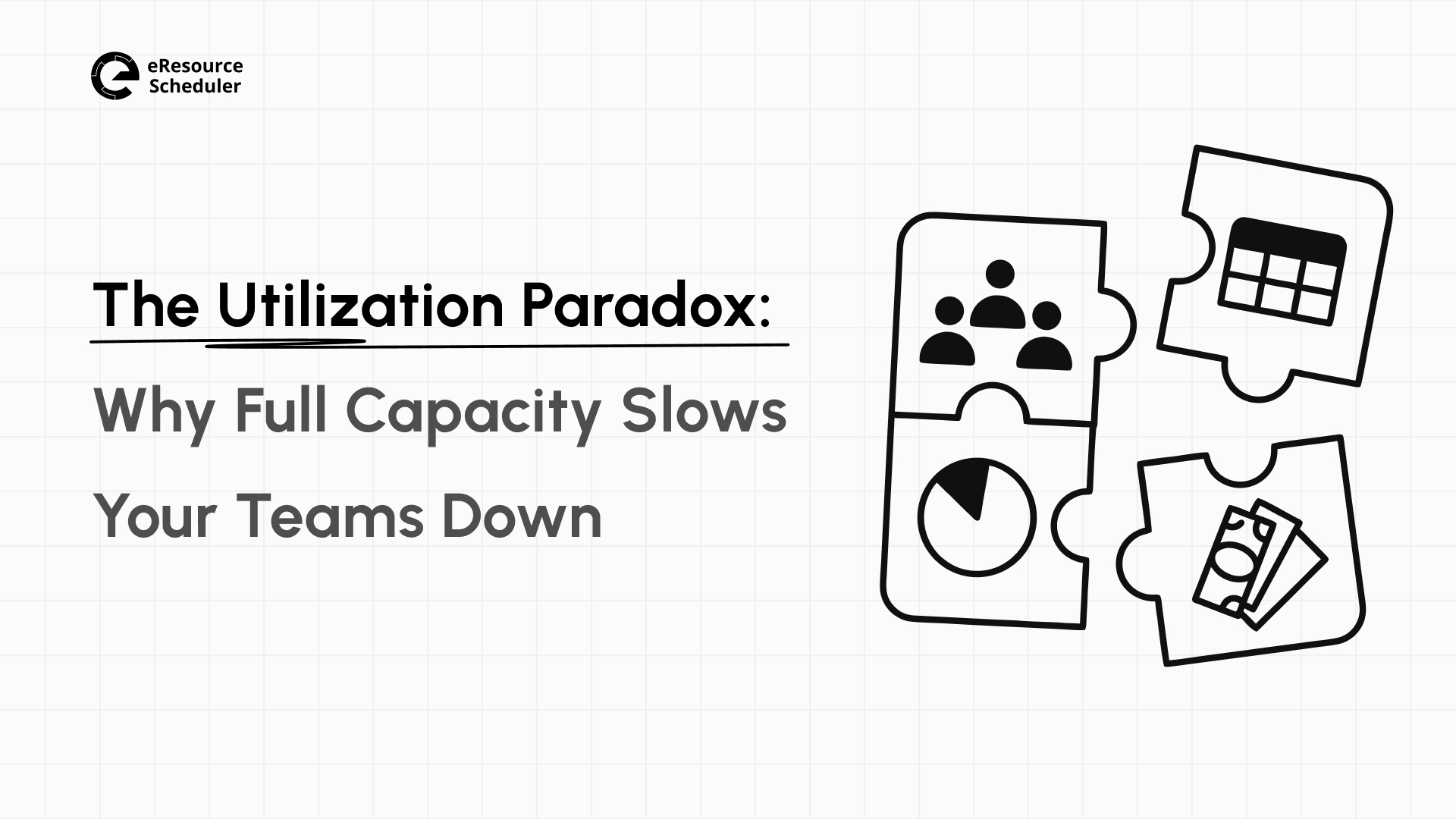
Utilization and margin are not the same. Giving them the same treatment is why most agencies lose money (without noticing). Utilization tells you how busy your team is. Margin tells you what actually survives after the business is billed, discounted, and delivered.
Where the gap usually opens up:
1. Scope that was never quoted: A team sits at 85% utilization and still bleeds margin if a chunk of these hours are invested in work that slipped past the original project scope unnoticed.
2. Delays that compound: Every slipped handoff or late project start stretches the bench a little further, and this cost rarely shows up until a finance review. Well after it has already happened three times over.
3. Wrong person, right calendar: The person who lands on a project is often whoever is free, not whoever is the right fit at the right rate. A senior doing junior-level work quietly erodes margin even when the client paid exactly what was quoted.

4. The bench nobody tracks: Every hour someone sits between projects because the next one was not staffed early enough is an hour you are paying for without billing it. It is rarely tracked because it is uncomfortable, but it is often the first sign of the utilization paradox.
Knowing your real net capacity weeks in advance is what lets you close these gaps before they turn into a quiet loss, instead of finding them after the fact.
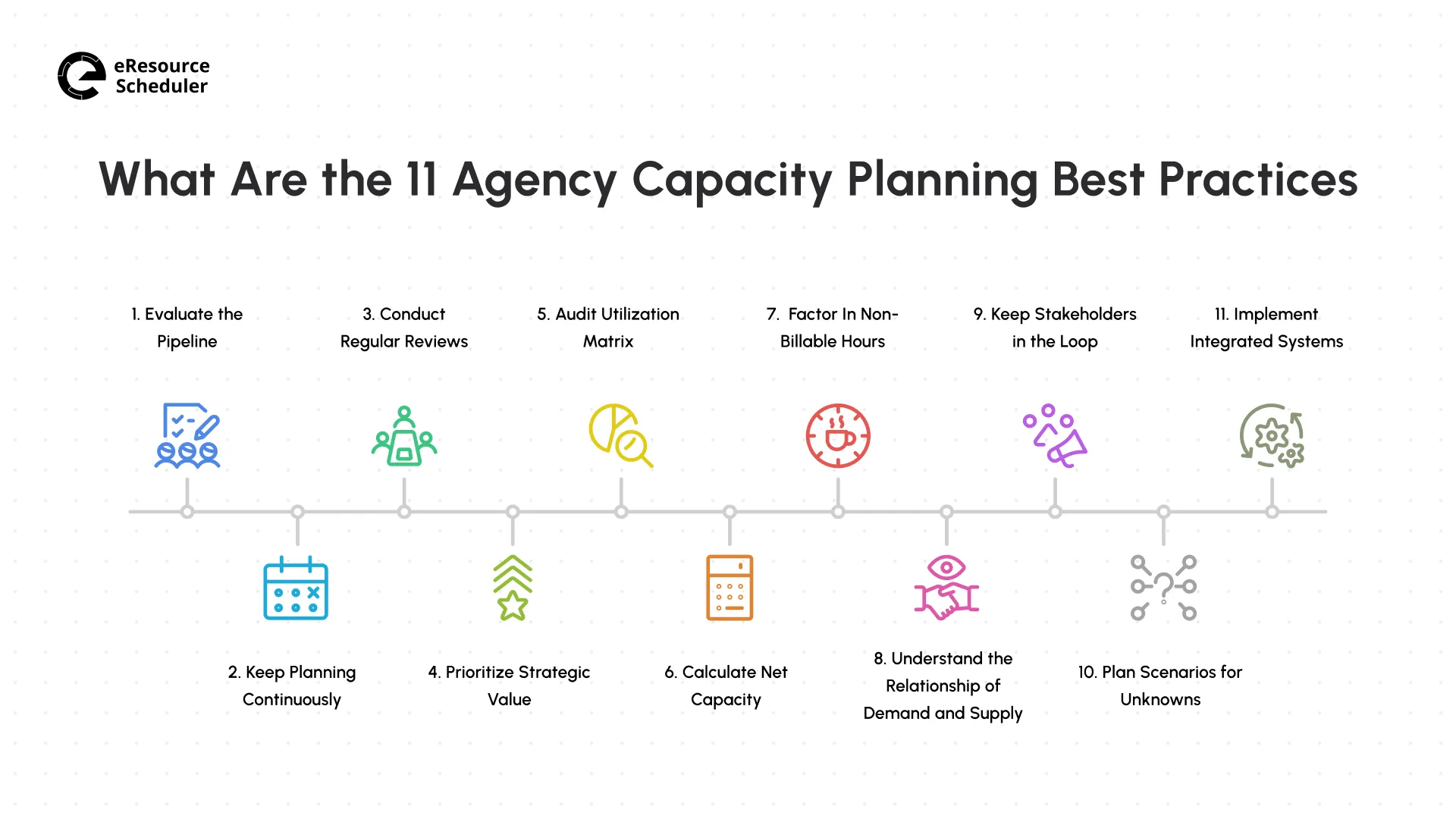
These eleven practices don't carry equal weight, and this list is ordered for a reason. The first habit decides how much of the rest you'll actually need. Get it wrong, and the other ten are just damage control.
Most agencies plan against signed contracts and get blindsided every single time. Deals in late-stage negotiation deserve a seat in your capacity math too, even at 50% probability weighting. This is necessary because ‘we’ll figure it out when it closes’ is how you end up outsourcing at premium rates on a Tuesday. A properly maintained project pipeline turns this panic into a forecast you can actually plan around.
A capacity plan built in January and revisited in April is already historical fiction. Client scopes creep, people quit, and someone takes unplanned leave. Design a five-minute ritual for Mondays where plans are modified for whatever changed that week; not a quarterly event where they are rebuilt from scratch. The point isn't to plan more. It's to plan in smaller, more frequent doses so nothing has time to drift far enough to become a crisis.
Planning and reviewing are different muscles, and agencies that do only one end up either optimistic or paralyzed. Planning says what should happen this week. A review checks what actually happened against the plan. The gap between these two numbers is the most honest performance metric your agency has that nobody is tracking.
A big-name client at break-even margin can be worth more than a smaller job with better margins, if it opens doors or gives you a case study you will use for years. Staffing your best people based on invoice size alone sounds fair, but it is the wrong call. Structured prioritization forces the harder question: Which project actually moves the agency forward?
Headcount lies to you. Ten available hours mean nothing if the person who owns them cannot do the work assigned to them. Cross-check who is booked against what they are actually qualified for, and you’ll usually find your ‘capacity shortage’ was a skill mismatch wearing a headcount costume.
Gross hours are what payroll pays for. Net hours are what is left once you strip out meetings, admin, sick days, and the internal fire drills nobody puts on a timesheet. Agencies that plan against gross numbers are planning against a number that was never real, and getting utilization calculated correctly is the first step toward fixing it.
The One Habit Everyone Skips (Yes, You Too)
Never plan against 100% of
net capacity. Hold back 10-15% for scope creep or the client call that might run long. Agencies that
build buffers miss fewer deadlines than agencies that plan every hour to the minute
and call it precision.
A designer marked ‘100% booked’, who spends six of the assigned hours in meetings, is not at capacity for client work. They are at capacity for status meetings. Ignore this distinction, and the busiest-looking week on paper becomes the week burnout actually starts. Track non-billable time with the same discipline you track billable hours, and your net capacity number finally reflects what people can actually take on.
Demand moves in client time. Supply moves in hiring time. These two clocks run at the same speed, and the gap between them is where agencies either lose the deal or lose the team. Mapping capability against upcoming demand is the only way to see this gap coming rather than living inside it.
Sales promising a project timeline that the delivery team never agreed to is not a communication problem. It is a data problem outright. If your account manager and your capacity lead are looking at two different numbers, someone downstream will inherit this gap as a crisis. Give both sides access to the same live view, and the timelines sales start matching what delivery can actually hit.
Most capacity plans only account for a version of next month where nothing goes wrong. This perfect version of vision never actually happens. A key hire gives notice. A client doubles scope overnight. Two rush jobs land in the same week. The plan you have built has no answer for any of it. The agencies that handle this well are not the ones with better luck; they are the ones who already know what gets reshuffled first when it happens.
Your Move. What Would You Actually Do?
Read this and decide before you scroll past it.
Your agency is running at 92% utilization. On Monday, your biggest client asks for a rush
deliverable due Friday. Two of your three senior designers are already booked solid over other
client work for the entire week. What would you do?
A) Say no to the rush request outright.
B) Pull the designers off their current work and let the other deadlines slip.
C) Check your buffer capacity, redistribute lower-priority tasks, and loop the
client in on trade-offs before committing.
If you picked options A or B, you are not alone. But you are also solving
today’s fire by lighting a new one for the next view. If you picked option C,
this instinct is exactly what buffers and regular reviews are for: giving you room to move before a
deadline forces your hand.
Spreadsheets survive exactly until two people need to edit them at the same time. After a certain point, someone is definitely working off a stale version and making decisions on numbers that were true yesterday. Resource management software with a single source of truth for utilization, timesheets, and project timelines makes the ten habits on this list feasible (not aspirations).
Even disciplined agencies trip on the same handful of failure points. Most failures are not about missing a best practice. They are about conditions the practices alone do not fix.
| Challenge | Why It Happens | Early Warning Signs |
| Lumpy, Seasonal Demand | Client budgets and industries don’t spread work evenly. | Teams alternate between overtime months and quiet months. |
| Cascading Project Delays | One late deliverable pushes back everyone scheduled after it. | One missed deadline compounds as three missed deadlines. |
| Client-Side Bottlenecks | Work stalls on approvals, feedback, or non-agency assets. | Hours get logged as ’waiting’ more often than ‘in progress’. |
| No Benchmark for New Services | Estimating hours for unfamiliar work relies on guesswork. | New offerings consistently run over their quoted hours. |
| Planning Owner with No Authority | The person who tracks capacity flags overbooking but can’t stop it. | Overbooked weeks get approved anyway because a client asked. |
These conditions do not get fixed by adopting a habit from the list above. Fix them by knowing which one is actually hitting your agency, since the response to a client-side bottleneck looks nothing like the response to an authority problem.
Here is the part most agency owners skip: None of the eleven best practices from above require new hires, new budget, or a six-month rollout plan. They require someone choosing that guesswork is not good enough. The agencies that get resource capacity planning right didn’t start with a perfect system; they started by picking the leak that was costing them the most. Be it the case of an inflated gross capacity or a sales team promising delivery timelines that were never agreed to.
This is the part worth remembering when it feels like too much to fix at once. You do not need all eleven this week. Pick one, fix it properly, and let it hold before you move to the next. A buffer actually maintained is worth more than a perfect plan nobody follows.
Start today (even in a small way) with whichever habit is closest to breaking. Once the discipline is there, software like eResource Scheduler can help keep the numbers accurate as your team and client grow. But the habit itself has to come from your side because tools only protect a process that is already working.
1. Who should own capacity planning inside an agency, one person or a shared responsibility?
Capacity planning needs a single owner who is accountable for the number, usually a capacity lead or operations manager. The account managers and team leads who see scope changes first can still provide input. Ownership without input is guesswork, and input without ownership turns into finger-pointing when a deadline slips.
2. How does capacity planning change for an agency that bills project-based versus retainer-based?
Retainer work gives you a predictable baseline so buffers can run leaner and reviews can happen less often. Project-based work is lumpier because deals close on the client's timeline, not yours, which means you need a wider buffer and a shorter planning cycle. Agencies running both usually plan retainer capacity first, then layer project work into whatever's left.
3. What is a realistic timeline for an agency to see results after fixing its capacity planning process?
Most agencies see the scramble reduce within four to six weeks, once net capacity numbers are accurate and reviews actually happen weekly. Margin impact shows up a full billing cycle later, as fewer hours go untracked and fewer projects need last-minute freelancer help. The earliest win is usually fewer surprise conversations with clients about missed timelines.
4. Does capacity planning look different for creative teams compared to strategy or account teams?
Creative work is harder to estimate because revision cycles vary so much from client to client, so creative capacity plans need wider buffers than strategy or account work. Strategy and account teams follow more predictable hour patterns since their deliverables depend less on subjective feedback loops. Holding creative teams to the same tight buffer as account teams usually backfires within a month.
5. What is the biggest sign that an agency's capacity planning process has stopped working?
Consistently over-promising delivery that doesn't survive contact with the actual team is the clearest tell. If sales and delivery keep disagreeing about what's possible, the process broke before the disagreement did. Another sign is when the same two or three people get pulled into every rush request while the rest of the team stays comfortably booked.

Plan Smarter. Schedule Faster. For Free.
Join thousands already using eResource Scheduler to align teams, time, and tasks seamlessly.
 ALL FEATURES INCLUDED