






 Learn more

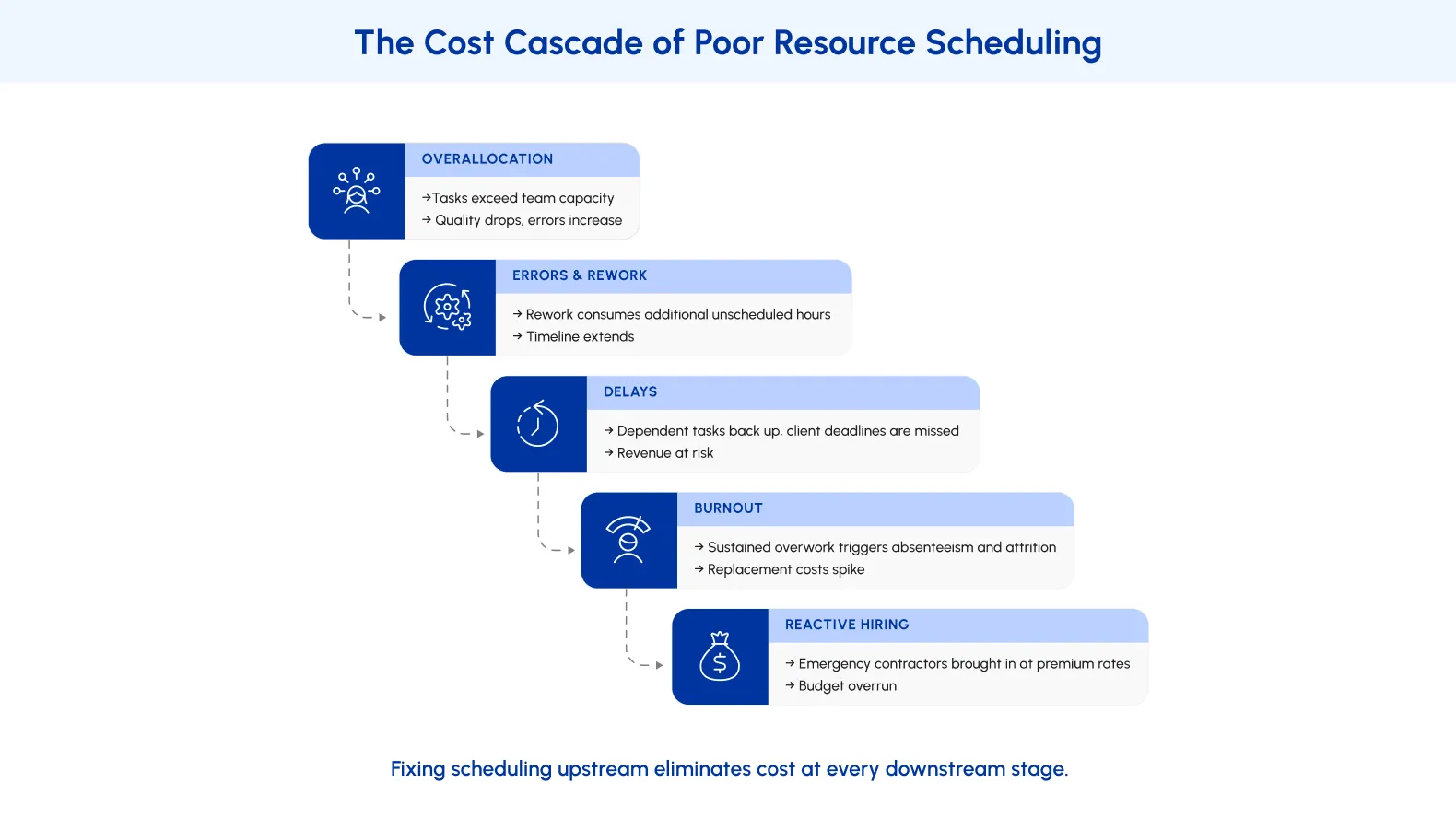
For every $1 billion invested in the United States, approximately $122 million is wasted due to poor project performance. That is not a rounding error. That is a structural failure, and most of it traces back to one fixable problem: organizations are putting the wrong people on the wrong work at the wrong time.
Resource scheduling is the discipline that fixes this. Not partially. Completely.
Yet most organizations treat it as an administrative afterthought, something a project manager figures out in a spreadsheet before a kickoff meeting. That is a $122 million mistake dressed in a calendar view.
By the end of this chapter, you will understand what resource scheduling actually is (beyond the textbook definition), why it is the single highest-leverage operational lever available to a project-driven organization, and what separates companies that execute it well from those that remain permanently reactive.
Resource scheduling is the process of assigning the right people, equipment, and materials to the right tasks at the right time across every active project in your portfolio.
Sounds simple enough on paper, right? But it's brutally difficult in practice.
Definition of resource schedulingResource scheduling determines when each task begins and ends based on the availability, capacity, and capability of the resources required to complete it.
Scheduling is not just about filling slots on a Gantt chart. It is about optimizing the flow of work through an organization so that projects finish on time, teams do not burn out, and clients do not get a sub-standard version of what they paid for.
Think of it this way. A hospital scheduling surgeons to operating theatres, an engineering firm assigning structural analysts to a bridge tender, a software consultancy staffing a product sprint, all of these are key resource scheduling problems. The domain changes, but the discipline rarely does.
Here is the data that should make every senior leader sit up straight.
A recent academic review of 99 public-building projects spanning 2008 to 2024 found that approximately 78% ran over on schedule and 58% ran over on budget. Nearly half experienced both simultaneously. The same pattern holds in IT: budget overruns average 75%, schedule delays average 46%, and value delivery falls short of initial projections by 39%.
Those are not project management statistics. They are resource scheduling statistics. Projects run late because the people, machines, and materials needed for a task are not available when that task needs to begin.
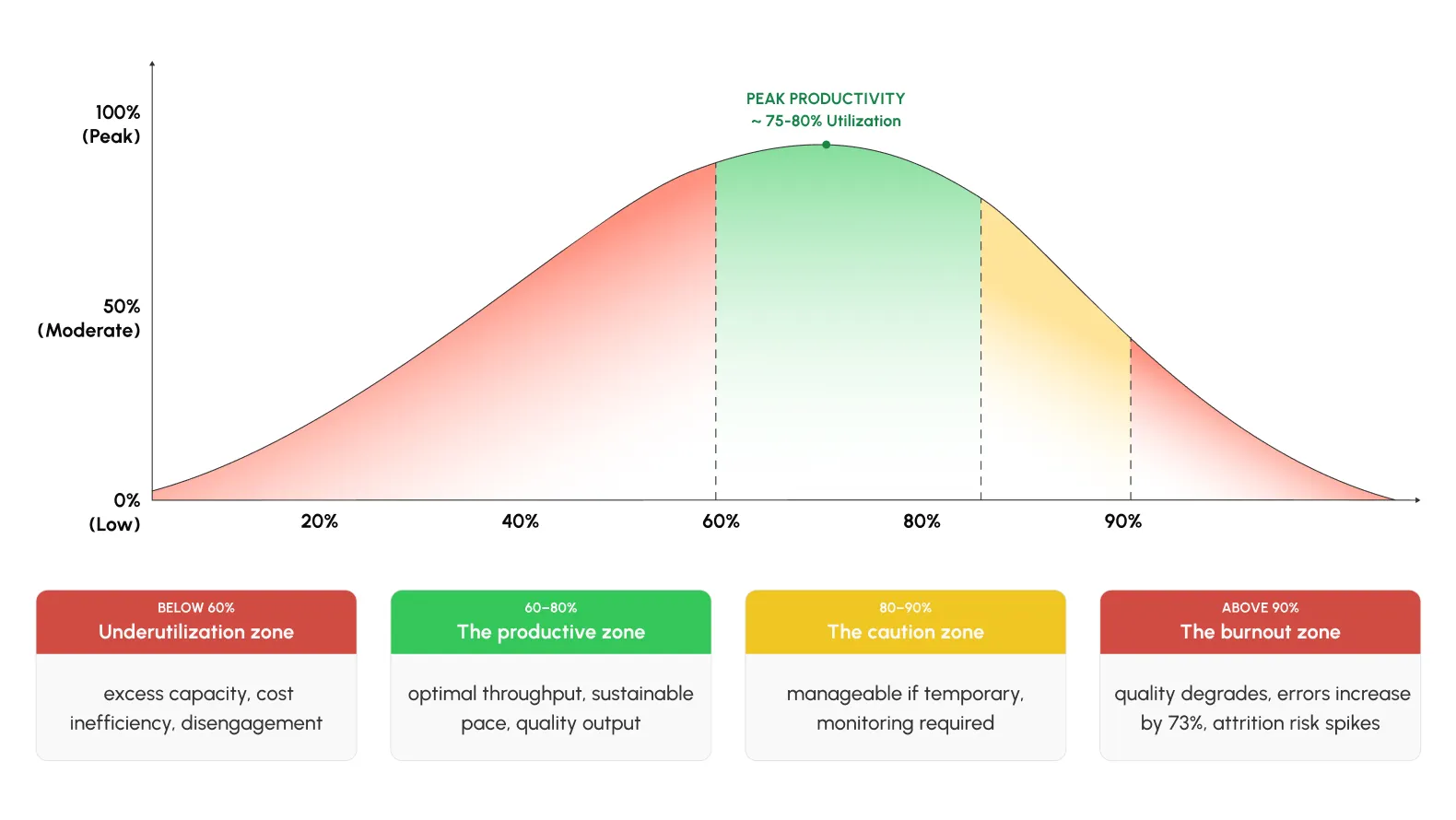
This figure from research alone should end the conversation about whether it is acceptable to run teams at 100% capacity. Overallocation does not just burn people out; it actively degrades the quality of work being delivered. You pay for it in rework, client escalations, and attrition.
This is well below the 75% threshold that most professional services benchmarks define as financially healthy. That is according to Deltek's 2024 Clarity Study. Nearly one in three billable hours that could be generating revenue is either sitting idle or assigned to non-revenue work. Poor scheduling is directly costing organizations margin.
According to a 2024 computational model published in the American Journal of Preventive Medicine. For a 1,000-person organization, the annual toll averages around $5 million. Gallup research shows that employees experiencing burnout are 63% more likely to take sick leave and 2.6 times as likely to leave their job entirely.
Put these together, and the picture is clear. Bad resource scheduling is not a project manager's problem. It is a profit and loss problem.
When you get resource scheduling right, you are simultaneously controlling four organizational outcomes that leaders care about deeply. Here are the four key elements essential for effective resource scheduling.
How much work gets completed per unit of time? Effective scheduling eliminates the dead air between tasks, the waiting, the context switching, the "I thought you were handling that" moments that quietly consume 20% of productive time across most organizations. This is one of the key elements of resource scheduling that directly impacts delivery speed.
Tasks completed by the right person, at an appropriate capacity, with enough time to do the work properly. This is where skills-based scheduling earns its keep. Putting a junior analyst on a senior-level deliverable because they happen to be available is a scheduling failure, not a staffing solution. Matching work to capability remains one of the key elements of resource scheduling that protects output quality.
Resource costs are the single largest line item in most project budgets. Scheduling affects whether you are deploying high-cost senior resources on tasks that do not require their expertise, whether you are paying for idle time, and whether you are scrambling to bring in contractors at a premium because you did not see a capacity crunch coming. Cost control is one of the key elements of resource scheduling that leadership tracks closely.
This one is underweighted in most operational discussions. How you schedule people is how you signal what you value. Organizations that chronically overallocate create attrition pipelines. According to the American Journal of Preventive Medicine study, burnout costs for a single manager average $10,824 per year. For an executive, $20,683. The talent you are losing is the most expensive to replace. Protecting people is one of the key elements of resource scheduling that sustains long-term performance.
Resource scheduling does not happen in a vacuum. Three variables shape every scheduling decision, and understanding their interaction is what separates reactive scheduling from proactive, optimized scheduling.
Every project is a set of demands: tasks to complete, in a specific order, by a specific date, to a specific standard. Requirements determine which resources are needed (skills, tools, certifications), how many, and for how long. They also establish the task dependencies that constrain when any given resource can begin work.
A project with poorly defined requirements is un-schedulable. You cannot assign resources to a deliverable you cannot describe. This is why requirement mapping is not a project management formality.
Myth: "Resource scheduling is what project managers do. It's not a strategic concern."
Reality: Resource scheduling determines organizational throughput, revenue capacity, delivery quality, and talent retention simultaneously. That is a board-level set of outcomes being decided in a PM tool. When senior leaders delegate scheduling entirely without establishing governance, priority frameworks, or utilization guardrails, they lose control of all four outcomes at once. The most successful project-driven organizations treat resource scheduling as a core operational strategy, not a coordination task.
Availability is more complex than it looks. True resource availability is not the number of hours in a work week. It is that number minus public holidays, approved leave, training days, administrative overhead, and existing project commitments. For most full-time employees, true available capacity for project work sits somewhere between 32 and 34 hours per week, not 40.
Scheduling against 40 hours when real capacity is 32 is how 100% utilization becomes 125% utilization before the week starts.
Myth: "If everyone is at 100% utilization, we're running efficiently."
Reality: 100% utilization is a warning sign, not a KPI. When every resource is fully committed at all times, the organization has zero capacity to absorb variability and every project has variability. One sick day, one scope change, one delayed client approval, and the cascade begins. Leading operations research consistently recommends maintaining utilization around 80% to preserve the organizational slack needed to handle disruption without cascading delays. The 20% buffer is not wasted time. It is the capacity that makes the other 80% reliable.
The right resource is not just whoever happens to be free. It is the person with the right skills, at the right level, at a cost that makes sense for the type of work. Scheduling on availability alone, without factoring in skill fit, produces work that either fails quality standards or requires expensive senior oversight to salvage.
Skills-based matching is not a nice-to-have feature for enterprise scheduling software. It is the mechanism through which scheduling decisions become revenue decisions.
Myth: "We already have a resource plan, so we're covered."
Reality: Planning and scheduling are not the same function. A resource plan tells you that you need three senior engineers next quarter. Scheduling tells you which engineer does which task on which project on which day and resolves the conflict when all three are needed simultaneously on two different projects. Organizations that plan without scheduling end up with plans that look good in a deck and collapse in execution.
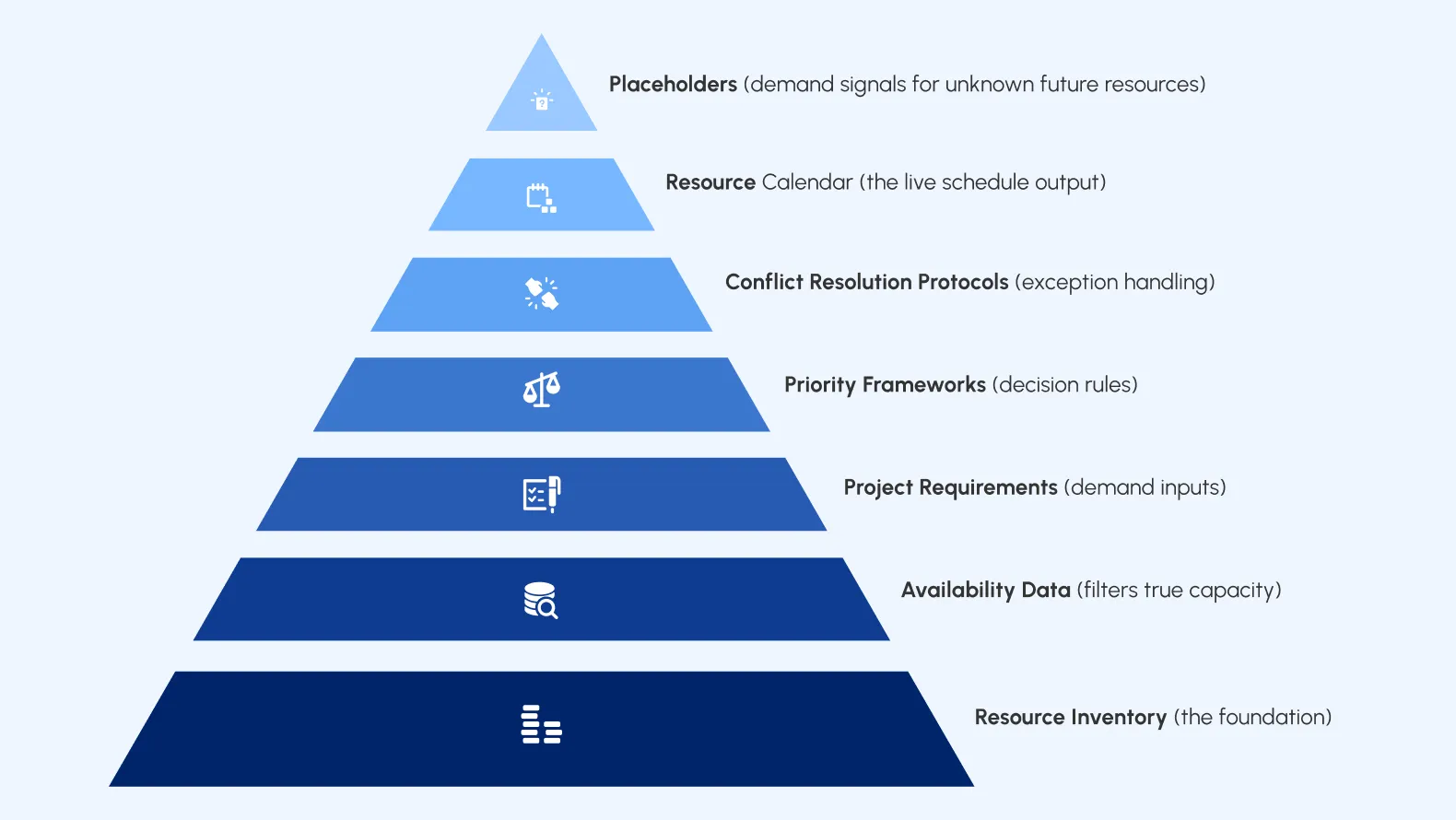
Before you can build an effective resource schedule, you need to know what one actually consists of. A complete resource schedule is not a calendar with names on it. It has seven components.
A centralized database of every available asset, like people, contractors, equipment, facilities, tagged with attributes including skills, certifications, costs, time zones, and standard capacity. This is the single source of truth that all scheduling decisions draw from.
A real-time record of each resource's working hours, approved leave, public holidays, and existing commitments. This is where true capacity lives, and not in a notional 40-hour week.
A documented breakdown of what each project phase needs: skills required, hours estimated, deadline, and dependencies. Requirements mapping converts a project brief into a schedulable set of demands.
When two projects need the same scarce resource simultaneously, something has to give. Priority frameworks determine which project gets the resource and which waits. Without this, every conflict becomes a political negotiation.
Documented rules for what happens when demand exceeds supply: who gets notified, what options are considered (overtime, contractor augmentation, scope reduction, deadline extension), and who has authority to decide.
A visual representation of each resource's schedule, like what they are working on, when, and for how long, updated in real time as assignments change.
When a project is being planned, and the specific assignee is not yet known, placeholders allow the demand to be captured by role and skill level, so capacity gaps surface early rather than on the day the work needs to start.
Here is how effective organizations build and maintain a resource schedule, not as a one-time setup exercise, but as an ongoing operational process.
Map every active and upcoming project into a task list. Each task needs an estimated duration, a defined output, and a deadline. If a task cannot be clearly defined, it cannot be reliably scheduled. This step forces clarity before commitment.
For each task, document the constraints: hard deadlines, regulatory requirements, skill prerequisites, equipment dependencies, and geographic considerations. Constraints are not obstacles to scheduling but the parameters that make scheduling meaningful. A schedule that ignores constraints is a fictional document.
Translate the task list into a resource demand map. How many senior developers, how many QA engineers, how many hours of specialized equipment time are required, and during which weeks? This is where resource demand becomes visible as a concrete number rather than a vague feeling that the team is "pretty busy."
Compare demand against true available capacity. This step will almost always surface gaps. Some will be addressable through schedule adjustment. Others will require hiring, contractor augmentation, or honest conversations with clients about timelines. The organizations that do this step consistently are the ones that surface capacity problems in week one, not week eight.
Assign resources to tasks based on skills, availability, cost, and priority. Publish the schedule as a live document, not a static snapshot. Build monitoring into the cadence: weekly reviews of actual vs. planned utilization, real-time alerts for overallocation, and structured check-ins to identify scope changes before they cascade.
Pro Tip : The 80% Rule That Changes Everything
One of the most counterintuitive findings in resource management is also one of the most consistently validated: you should never schedule a resource for more than 80% of their available time. The 20% buffer is not slack. It is the operational margin that makes 80% reliable.
At 100% scheduled utilization, you are assuming a zero-friction work environment. That environment does not exist.
Build schedules to 80%. Deliver at 100%. That is the discipline.
A 200-person infrastructure firm was running approximately 30 concurrent projects at any given time, managed by 12 project managers, each operating their own spreadsheet-based resource tracker.
The symptoms were familiar: senior engineers routinely assigned to three projects simultaneously, constant firefighting around deadlines, an average project delivery delay of 23%, and a billing utilization rate sitting at 67%, well below the industry benchmark.
The firm had no unified view of resource demand across projects. When a new project was won, the assumption was that capacity existed because no individual PM could see the full picture.
After implementing a centralized resource scheduling software with a shared resource inventory, a live capacity dashboard, and a project prioritization framework, the firm's outcomes shifted significantly within two quarters:
The change was not about working harder. It was about seeing clearly and making informed allocation decisions instead of reactive ones.
Most of the literature on resource scheduling is written as if resources belong to a single project at a time. In reality, most team members in professional services, engineering, consulting, and technology organizations are shared resources contributing to multiple projects in parallel.
This creates what practitioners call the shared resource conflict: two project managers both need the same senior analyst for the same two-week window, and there is only one of her. Resolving shared resource conflicts without a structured system produces one of three bad outcomes:
A functioning resource scheduling system makes the conflict visible before any of these outcomes occur and applies a priority framework to resolve it objectively, without politics, at the earliest possible moment.
A resource schedule that works operationally but damages the people it schedules is not a success. It is a slow-motion attrition program.
Human resource scheduling, the specific discipline of managing people as the primary resource, requires attention to factors that equipment and facilities scheduling does not: career development, skill-building, workload equity, personal preferences, and sustainable pace.
The business case is not soft. Effective human resource scheduling treats utilization as a lever with two failure modes: too low (wasted capacity, underperformance) and too high (burnout, attrition, quality degradation). The objective is to operate in the productive zone between those extremes for every person, across every project, continuously.
There is no one-size-fits-all method for resource scheduling. The right approach depends on the nature of your work, the variability of your demand, and the maturity of your scheduling infrastructure.
The dominant approach is when deadlines are fixed and non-negotiable, such as regulatory submissions, event launches, and product release dates. Work backward from the deadline. Assign resources to meet the date. When conflicts arise, the options are to add resources or approve overtime, not to push the date.
This works well when the deadline genuinely cannot be moved. It requires honest capacity assessment, because optimism in time-based scheduling is the enemy.
For complex, technical, or high-stakes work, expertise drives the schedule. You wait for the right expert rather than grabbing whoever is free. This is common in R&D, specialized engineering, legal, and senior advisory work.
The risk here is bottlenecking around scarce senior resources. Skills-based scheduling requires proactive development of second-string capability so that critical skills are not single-threaded.
For teams managing a steady stream of similar work, like support desks, maintenance operations, and professional services delivery at scale, capacity-driven allocation distributes work evenly across available resources to prevent bottlenecks and maintain consistent throughput.
The objective is not to optimize individual assignments but to optimize system flow. Think of it as managing a pipeline, not placing bets.
One of the highest-value activities in resource scheduling is scenario modeling, building alternative schedule versions before a disruption forces you to improvise.
What happens to the Q3 delivery if your lead architect takes three weeks of medical leave? What does the portfolio look like if Client A accelerates their timeline by six weeks? What if you win that proposal that is still in negotiation?
Organizations that run these scenarios in advance do not scramble when disruption hits. They activate a pre-modeled response. The differences in reaction time and decision-making quality under pressure are significant.
Most scheduling software supports scenario planning. Most organizations do not use it until after the first major crisis makes the value obvious. Do not wait for the crisis.
Resource scheduling is the operational system that determines whether the right people are doing the right work at the right time across every project in your portfolio. Get it right, and you control throughput, quality, cost, and people outcomes simultaneously. Get it wrong, and you absorb the consequences in delays, rework, burnout, and margin erosion.
The most important mindset shift for leaders: resource scheduling is not a coordination task delegated to project managers. It is a strategic function that requires governance, tooling, and executive-level attention. The organizations that treat it that way deliver projects more reliably, retain their best people longer, and operate at a measurably lower cost per project.
 ALL FEATURES INCLUDED