Learn more

Staffing and scheduling are generally used in the same sentence, but for managers and leaders in the US organizations, they serve different purposes. For example, The Vampire Diaries and The Originals. Both fall under the same umbrella of supernatural. While the two shows do cross over multiple times, one focuses on the Salvatore Brothers in Mystic Falls, and the other focuses on the Mickelson family in New Orleans.
As workforce dynamics continue to shift, understanding how staffing and scheduling work, and where they overlap, has become a necessity to maintain productivity, compliance, and team morale.
Early clarity makes it easier to connect the planning stage with the execution stage. Many organizations nowadays rely on resource scheduling software like eResource Scheduler to ensure that their plans don’t remain trapped in spreadsheets while everyday operations move at the speed of a bullet train.
Staffing is making decisions regarding who you need, when you need them, and why, before work ever hits a calendar. In the U.S. context, staffing decisions are heavily determined by business forecasts, labor availability, and regulatory requirements.
At its core, staffing supports human resource planning. It looks at the future, often months or even years in advance, and answers questions like:
This is where workforce planning in the United States becomes particularly nuanced.
Factors such as regional labor shortages, rising wage expectations, and evolving compliance rules all mold staffing strategies. A retail chain expanding into new states, for example, must take into consideration local labor laws before making any hiring commitments.
Staffing has a butterfly effect. Its decisions ripple far beyond HR. If you are hiring too aggressively, labor costs inflate, while understaffing can stall your growth and frustrate customers. Leaders are intently tying staffing to broader goals like workforce efficiency and business continuity.
Effective staffing supports:
Many organizations link staffing plans with operational workforce planning to ensure future talent needs match realistic workloads rather than optimistic projections.
Where staffing is the script, scheduling is the shoot. Scheduling takes staffing decisions and turns them into action. If staffing answers “who do we have,” scheduling answers “who works when.”
Scheduling focuses on:
In contrast to staffing, scheduling is highly tactical and often changes daily or weekly. In U.S.-based teams, scheduling must also respect overtime rules, rest requirements, and state-level labor regulations.
This is where the difference between Staffing vs Scheduling becomes clear.
Staffing
builds the workforce. Scheduling activates it.
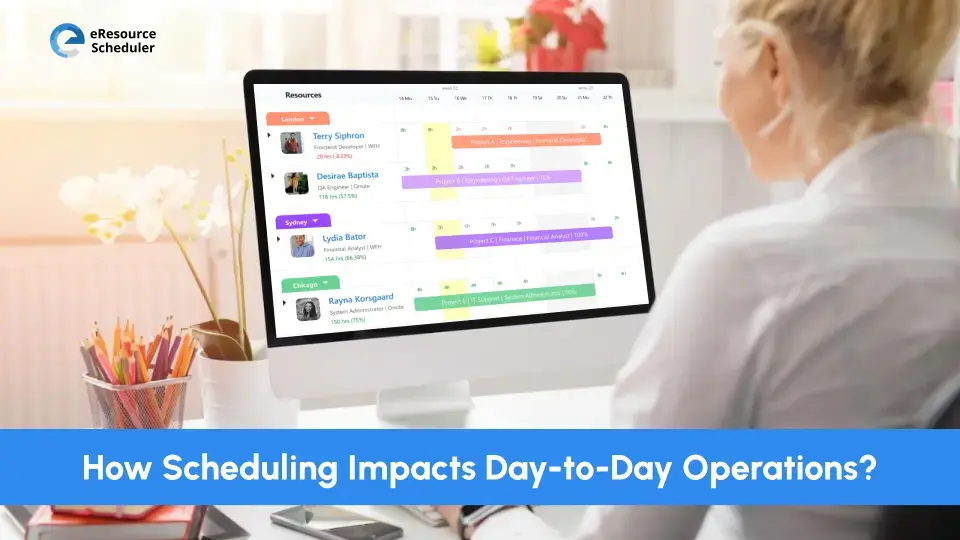
Poor scheduling often materializes as missed deadlines, idle resources, or frustrated employees. Strong scheduling, on the other hand, improves workforce efficiency by matching capacity to demand in real time.
Managers often rely on tools like the best resource scheduling software to cut the manual effort and improve visibility. When schedules are transparent, teams tend to adapt faster, and leaders spend less time resolving conflicts.
Scheduling also plays a major role in employee experience. Predictable shifts and even workload distribution can help retain talent in competitive U.S. labor markets.
While distinct, staffing and scheduling are deeply entwined. Staffing sets the structure of a house; scheduling works within it. When staffing plans are unrealistic, scheduling becomes a constant struggle.
This overlap is especially visible in resource allocation in US organizations. Leaders must balance:
Organizations that use integrated planning approaches often shift to platforms like eResource Scheduler to link their long-term staffing plans with short-term scheduling needs, minimizing guesswork and rework.
Disorder usually sprouts from siloed planning. HR teams focus on hiring targets, while operations teams focus on immediate delivery. Without shared data, both sides optimize locally but fail globally.
Common challenges include:
These gaps often lead to eleventh-hour hiring or excessive overtime, both heavy on pocket outcomes in the U.S. regulatory environment.
Scheduling is often the fastest lever leaders can pull to improve workforce efficiency. Small adjustments, redistributing workloads, or smoothing peak hours, can deliver monumental gains.
Effective scheduling helps organizations:
When supported by a staff scheduling software, managers gain visibility into availability and utilization, making these adjustments faster and more accurate.
One of the most common points of friction is hiring planning vs shift management. Hiring decisions may assume model conditions, while shift management deals with reality: absences, delays, and sudden spikes in demand.
Bridging this ever-growing gap requires tighter feedback loops. Scheduling data should confirm future hiring, and staffing plans should set realistic boundaries for schedules. Over time, this alignment reduces surprise elements and stabilizes operations.
Technology cannot replace judgment, but it can support better decisions. Platforms designed for workforce visibility can help leaders test assumptions and spot gaps early.
For example, organizations exploring resource scheduling software often find that visibility alone uncovers inefficiencies they didn’t realize existed.
The key is using technology as an enabler, not a crutch.

Improving alignment between staffing and scheduling doesn’t require a full transformation overnight. Phased steps often deliver meaningful results.
Leaders can begin by:
Over time, these practices create a shared language between planning and execution.
As service becomes more dynamic, the fine line between planning and execution continues to blur. Leaders who understand the difference between staffing and scheduling, and how they reinforce each other, are better equipped to adapt.
In the modern working environment, success isn’t about choosing one over the other. It’s about ensuring both move in sync, supported by record statistics and practical tools.
Explore a FREE TRIAL of eResource Scheduler to see how smarter planning and visibility can support better workforce decisions.
1. What is the main difference between staffing and scheduling?
Staffing focuses on long-term workforce needs, while scheduling manages short-term work assignments.
2. Why is staffing more complex in the United States?
U.S. staffing must take into consideration diverse labor laws, regional markets, and compliance requirements, which make it more complex.
3. How does scheduling affect employee satisfaction?
Predictable and fair schedules improve employee morale, reduce burnout, and support retention.
4. When should staffing plans be revisited?
Staffing plans should be reviewed regularly, especially when demand patterns or business goals change.
5. Can small teams benefit from formal scheduling practices?
Yes. Even small teams gain clarity and efficiency from structured scheduling.


Plan Smarter. Schedule Faster. For Free.
Join thousands already using eResource Scheduler to align teams, time, and tasks seamlessly.
 ALL FEATURES INCLUDED