Your team just lost a senior project lead mid-sprint. Someone calls in sick on the day of your biggest client presentation. Two engineers are juggling three projects at once, and nobody flagged the conflict. Sounds familiar?
This is what poor workforce management looks like up close. It is a slow accumulation of small breakdowns that drain your team’s time, squeeze project margins, and make on-time delivery feel like luck.
The right workforce management software changes this. When you can see who is available, where demand is building, and where the gaps are forming, you stop firefighting and start planning. Whether you run an engineering firm, a consulting agency, or a growing tech company, a dedicated workforce management solution gives you this visibility.
We reviewed 7 of the most widely used workforce management tools in 2026. Here is what we found.
Before you start evaluating tools, know what you actually need. Here are the key capabilities to check before you sign anything.
1. Cost-Effectiveness: The license fee is only part of what you will pay. Onboarding, training, and add-ons stack up fast. Platforms that charge separately for reporting or mobile access will cost more than the contract suggests, so get the full number before you start comparing.
2. Customization: Every team is structured differently. Your platform should bend to that structure, not the other way around. If configuring resource types, access rights, and scheduling rules requires a support ticket, keep looking.
3. Process Automation: If someone is still manually copying data between systems six months after go-live, the tool has not done its job. Shift assignments, approval chains, timesheet generation, and alerts should run rules you set once.
4. Third-Party Integrations: Your workforce management tool needs to talk to your payroll system, project tools, and HR platform. From time zones to currencies, seamless integrations are what make global resource planning work.
5. Data Security: You are putting employee records, pay data, and project financials into this system. Confirm that role-based access controls, data encryption, and multi-factor authentication are standard before signing, not an optional upgrade. GDPR or SOC 2 compliance should be on the checklist depending on where you operate.
6. Ease of Use: Two weeks of training to check a schedule is two weeks of productivity gone. Core features should be intuitive enough for a hire to figure out on a day without a walkthrough.
7. Mobile App: Field staff and remote workers cannot be tied to a desktop. They need to check schedules, request leave, and clock in from wherever they are. A weak mobile experience is a dealbreaker for any team that is not desk-based.
8. Forecasting and Budgeting: A tool that only shows you the present is half a tool. You want demand forecasting and capacity planning reports that connect your labor spend to project performance, so decisions come with runway, not just hindsight.
9. Performance Management: Knowing who is scheduled tells you very little about whether the work is actually getting done. Features that track output, track underutilization, and tie individual efforts to project outcomes give a far more honest read on performance.
10. Time and Attendance Tracking: Payroll errors and billing disputes usually trace back to sloppy time data. Planned vs actual timesheets cut the manual touch-points where mistakes tend to happen.
11. Live Scheduling: When scheduling happens live, changes show up immediately for the whole team. Managers no longer have to dig through emails and spot capacity to reassign people.
12. Remote Management: Hybrid setups bring in complexity that spreadsheets cannot handle. Time zone support, cross-location visibility, and remote time tracking should be built into the core product, not sold as add-ons.
Now that you know what to look for, here is how the top 7 tools actually stack up.
| Tool | Best For | Starting Price (Annually) |
| eResource Scheduler | Resource scheduling, capacity visibility, timesheet tracking, and management reports | $5/resource/month |
| UKG | Shift-heavy industries needing demand-based scheduling and compliance | Custom |
| ChartHop | HR teams needing visual headcount planning and org structure management | $5/employee/month |
| Saviom | Enterprises managing large, skills-diverse workforces across projects | Custom |
| Paylocity | Mid-market teams wanting payroll, HR, and time and labor tightly connected | Custom |
| Connecteam | Deskless and frontline teams needing mobile-first scheduling and communication | $29/user/month |
| nTask | Small to mid-sized teams needing affordable task and time management | $3/month |
If your team is constantly dealing with double-booked resources, last-minute gaps, or frequently asking who is actually available right now, eResource Scheduler was designed to fix exactly this.
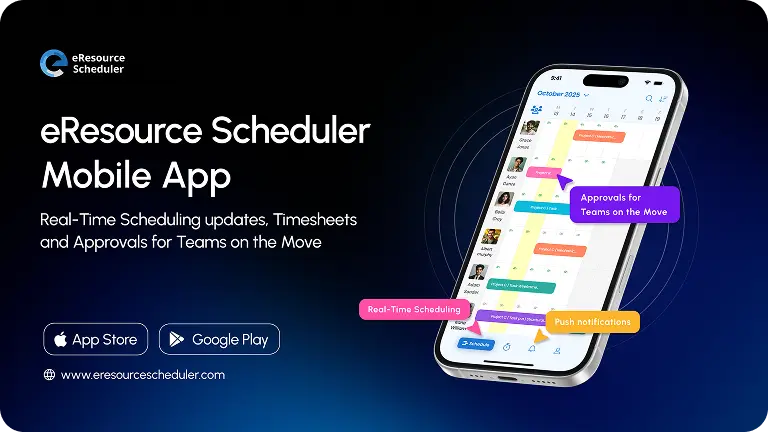
eResource Scheduler is resource management and scheduling software for project-driven organizations that takes a resource-first approach. It gives you real-time visibility into who is working on what, where your capacity gaps are, and how planned hours compare with actual time spent across the workforce, equipment, and facilities, all from a single interface. The eRS Mobile App keeps project managers and resource coordinators connected to that visibility on the go, so schedule changes and availability updates do not wait until someone is back at their desk.
Most teams come to eResource Scheduler after spending too long managing resources in Excel. Instead of chasing availability data across multiple files, you get a single source of truth that updates in real time. Project managers see conflicts before they happen. Leadership gets financial visibility without waiting for end-of-month reports.
Most workforce management tools are built around one anchor problem: payroll, shift coverage, org structure, or task tracking. eResource Scheduler is designed around a different one, the cost of not knowing. Not knowing who is free next month, or that your only senior architect just got double-booked, or that one team is running at 120% utilization while another sits at 60%.
This focus makes it a better fit for some teams than others. If you manage project-based work, bill clients by resource, or operate across multiple departments with overlapping demand, the visibility this software provides tends to pay for itself quickly. If your primary challenge is hourly shift coverage or payroll compliance, other tools on this list would be a better fit.
Feature count is not the right lens. The real question is whether the tool closes the specific gap that is costing your team time and money. Harder to answer than a checklist, but far more useful.
This tool is a workforce management platform built for industries where scheduling complexity is non-negotiable: Healthcare, retail, manufacturing, hospitality, and logistics.
It is built around operational visibility. It is the tool HR leaders reach for when they need to model headcount, understand team structure, and tie people's decisions to budget, all from one place.
It is a resource management tool for organizations managing simultaneous projects. It is well regarded in professional services, engineering, and consulting.
It is a payroll-first platform with a broad HR suite. Its time and labor tools are designed to close the gap between hours captured and payroll processed.
It is a mobile-first workforce management platform for deskless and frontline teams. It brings scheduling, time tracking, communication, and HR tools into a single app.
It is a project and task management platform for small to mid-sized teams. It is a lighter-weight option than most enterprise workforce management tools.
Knowing what each tool does well is useful. Knowing which one fits your specific situation is better. Here is how to figure that out.
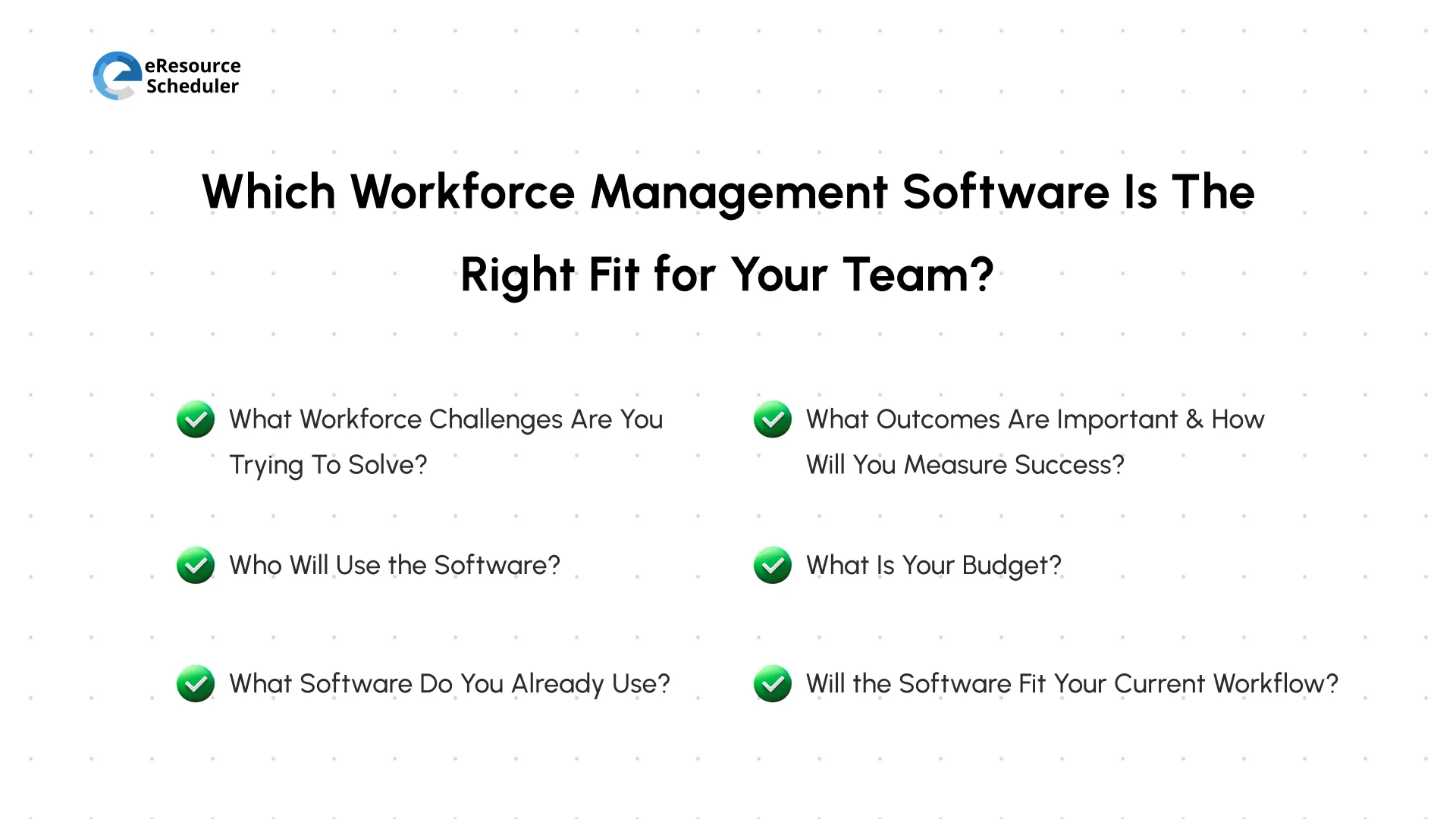
Before you book a demo, spend 20-30 minutes answering these six questions honestly. They will narrow your shortlist faster than any feature matrix.
Start with the pain, not the product. A capacity planning problem points to the eResource Scheduler. A shift coverage problem in health or manufacturing points to UKG. A payroll integration problem points to Paylocity. Different tools solve different problems.

Define what better looks like before you buy. A 20% reduction in scheduling conflicts? Cutting time on manual timesheets? Resource utilization above 90%? Tie your evaluation to measurable outcomes. Reviewing workforce management best practices first will help you set realistic benchmarks.
Think beyond the person making the buying decisions. Consider project managers, resource managers, individual contributors, HR administrators, and finance teams. A tool that delights your financial team but frustrates your team leads will have low adoption regardless of its feature list. Include end users in your evaluation.
Look at the all-in numbers. License, implementation, training, data migration, and integration costs. Some tools look affordable per seat but require expensive third-party connectors to actually work for your use case. Get a total cost of ownership estimate before you compare options.
Your workforce management platform needs to coexist with your current tech stack. A great standalone tool that creates data silos is often worse than a decent tool that connects everything. Check integration lists carefully and test the actual connections before you commit.
The best workforce management solution is one your team will actually use. Visualize the way your resource planning program is currently optimizing workflows. Then evaluate whether a new tool maps to that structure or requires you to start from scratch.
Answering these questions might feel like extra work. Skipping them is what leads to buying the wrong tool and spending months trying to make it fit.
According to the research from Mordor Intelligence, the global workforce management software is valued at USD 9.76 billion in 2026 and is projected to reach USD 12.04 billion by 2031. This growth reflects real demand. But investment without alignment is just expensive guesswork.
The teams that get real ROI from workforce management software are the ones that started with a clear problem, defined success upfront, involved actual end users in the evaluation, and chose a tool that fits how they work. The six questions above are not just checkbox exercises. They are the difference between buying and solving a problem.
Every tool in this list solves a problem. What separates a good software decision from an expensive mistake is the clarity they bring to the evaluation. The teams that see the fastest ROI are not always the ones that picked the most sophisticated platform. They are the ones who knew exactly what problem they were solving, chose to address that problem directly, and gave their team enough time and support to actually adopt it.
Workforce management is not a technology problem. It is a visibility problem. The right software just gives you the visibility you have been working without.


Plan Smarter. Schedule Faster. For Free.
Join thousands already using eResource Scheduler to align teams, time, and tasks seamlessly.
 ALL FEATURES INCLUDED