Learn more

In 2026, US organizations are facing ongoing challenges to proceed rapidly without burning out employees or underutilizing their resources. This raises a question for leaders: Which resource management tasks indeed assign people and resources to work?
Before getting to the solution, let's take a step back and review the basics of understanding resource management. The reason: The operation can not take place in isolation. It is the result of a structured planning process favoured by resource management software like eResource Scheduler.
The resource management task deploys during the deployment or assignment phase, where planned capacity is systematically dedicated to effective work. This is a point where your strategies are converted into execution.
In everyday terms, it is the function in charge of assigning teams and resources to work depending on availability, skills, and priorities. Until this measure comes into effect, resources live only on paper.
The task is referred to as resource deployment or staff deployment, a notion broadly used across US organizations and public-sector frameworks. This is where schedules are finalized, responsibilities confirmed, and people activated to deliver.
Activation is where the majority of resource strategies either succeed or fall apart silently.
In the modern work environments, managers face:
Without explicit personnel and resource activation, teams undergo confusion, overbooking, or idle capacity. Leaders may assume resources are engaged, but execution tells a different story altogether.
A centralized approach helps fill this ever-growing gap by making sure that activation decisions are visible, auditable, and aligned with actual capacity, not assumptions.
Within the broader US resource management framework, activation falls within planning and supervision. Whether in an enterprise environment or structured public-sector models, the logic remains constant:
This flow reflects how enterprise teams operate. Many organizations accommodate this logic into a resource management framework, reinforced by software that introduces visibility across departments and projects.
For instance, organizations that use structured resource scheduling often couple activation with capacity planning to reduce eleventh-hour firefighting. It is where platforms like eResource Scheduler naturally adjust into modern execution models.

Activation does not start with allotting names to tasks. It starts much earlier.
Managers typically activate resources by:
Once the list is followed, teams no longer remain ‘tentatively planned’. They are officially deployed.
This process is intimately tied to staff deployment practices employed across US enterprises, where the aim is to balance resource utilization without trading off flexibility. Multiple teams formalize this step using workflows discussed in effective resource management.
In most US-based organizations, resource activation responsibilities are shared. So the question remains: Who owns the decision?
Activation becomes fractured if there is no coordination. This is why organizations are increasingly depending on centralized views for capacity and schedules rather than spreadsheets or email-based approvals. This change promotes a more consistent enterprise resource management framework across teams.
Timing plays a crucial role in resource activation. It matters more than the teams realise.
| When Activation Happens Too Early | When Activation Happens Too Late |
| Priorities shift | Deadlines are missed |
| Teams are over- or under-booked | Teams struggle |
| Rework volume increases | Overtime becomes the new normal |
The perfect plan of action is to activate resources once the demand is recognised and capacity is approved. Many leaders rely on resource management reports to pinpoint the right moment rather than their instincts.
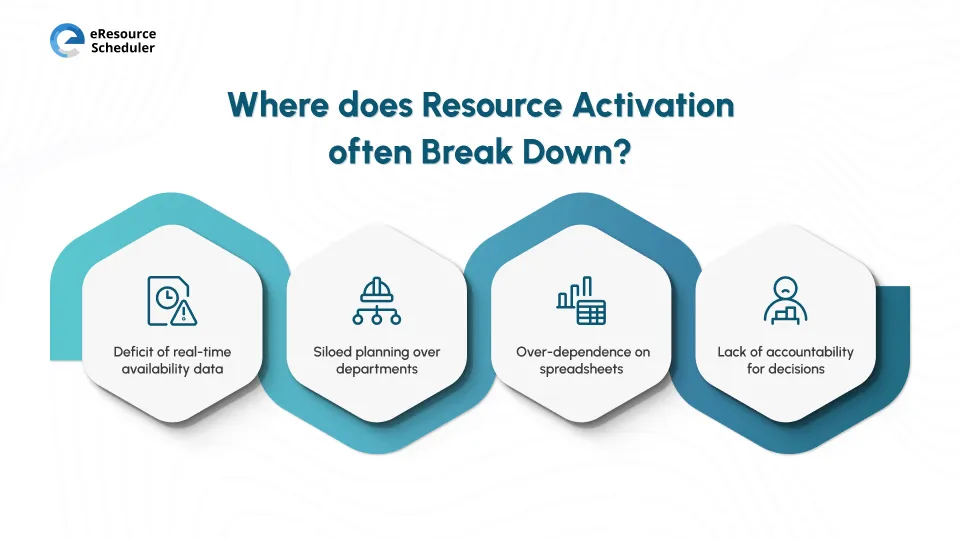
Even experienced organizations grapple with activation. Some common breakdowns include:
These challenges emphasize the importance of a centralized resource management approach. When activation decisions are on the table, teams move quickly with fewer surprises.
Many organizations tackle this by integrating resource scheduling systems like eResource Scheduler. It enables managers to perceive who is available at what time and for which type of task.
Modern resource scheduling and management platforms don’t overpower decision-making; they encourage it. They help leaders:
This process creates a never-ending cycle of planning, deployment, and optimization. Teams that adapt to this model generally find that activation becomes a repeatable process instead of a recurring crisis.
The resource management task deploys intrinsic value when it activates employees and resources at the correct time, for the right work, with complete visibility. In US organizations that navigate continuous change, activation no longer remains an administrative step; it then blooms into a leadership decision that can impact delivery, morale, and outcomes.
If you are reconsidering your team's floorplan from planning to execution, it is prime time to schedule a demo with eResource Scheduler and witness how clearer activation supports smarter decisions.
1. What resource management task activates personnel and resources?
The deployment or assignment task activates personnel and resources by formally committing them to approved work. This step confirms the availability, aligns the skills with demand, and signals the shift from planning to active execution across teams.
2. Is resource activation the same as resource allocation?
No. Allocation outlines where resources can be used based on forecasts and priorities, while activation confirms they are being used. Activation is the point where plans become operational commitments.
3. Why is resource activation critical for managers?
Resource activation helps managers avoid overbooking, reduce the idle capacity, and eliminate eleventh-hour rescheduling. It ensures teams are aligned, workloads are realistic, and execution begins with clarity.
4. How does the U.S. resource management framework define activation?
Within the U.S. resource management framework, activation falls between planning and monitoring. It represents the formal transition from strategy to execution, where personnel and resources are placed into active service.
5. Can software help with activating personnel and resources?
Yes. Resource management software such as eResource Scheduler helps managers validate real-time availability, assign teams confidently, and track utilization after activation. This reduces guesswork and supports more consistent execution decisions.

Plan Smarter. Schedule Faster. For Free.
Join thousands already using eResource Scheduler to align teams, time, and tasks seamlessly.
 ALL FEATURES INCLUDED