Learn more
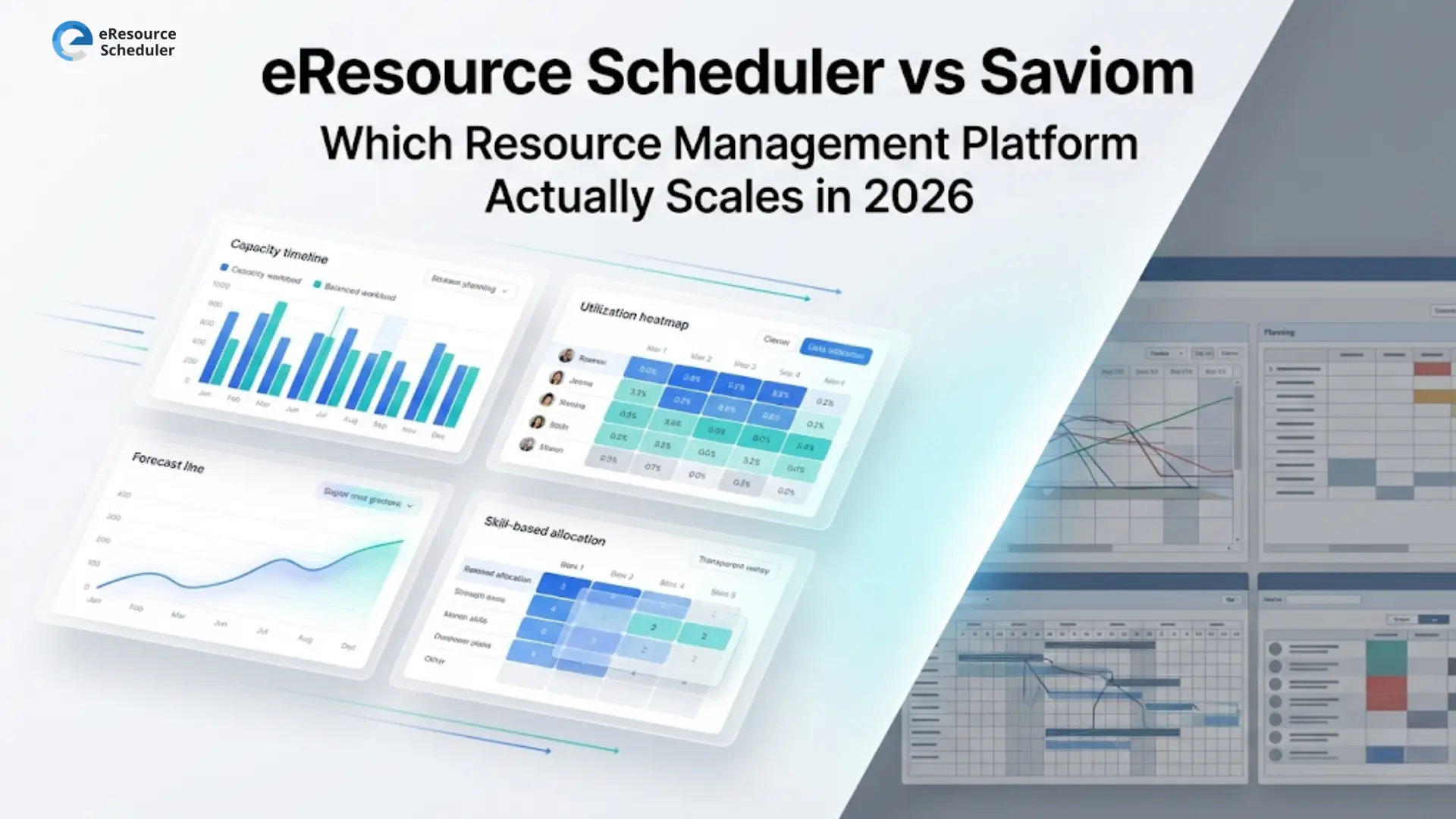
When enterprise and professional services leaders compare eResource Scheduler vs Saviom, the real question is not which tool has more features. Which one fits how organizations actually plan people, revenue, and Finances in 2026?
Both platforms are respected. Both solve serious planning problems. But they take very different paths to get there. After looking closely at resource scheduling, depth, usability, scalability, and real-world outcomes, eResource Scheduler emerges as the more practical and future-ready choice for most enterprises and professional services firms.
This analysis goes deep. Not surface-level. Not brochure talk. Just a clear-eyed look at where each platform shines, where it strains, and which one makes more sense for modern leadership teams.
eResource Scheduler is enterprise resource management and scheduling software designed around one simple belief. Resource planning should be visible, fast, and usable by the people who make decisions every day. eResource Scheduler focuses on giving leaders and planners immediate clarity into capacity, demand, utilization, and cost impact without heavy configuration.
It behaves like a control center rather than a modeling lab.
Saviom takes a more traditional approach. It is designed for organizations that want deep configurability, structured processes, and planning sophistication. The platform supports advanced simulations, complex hierarchies, and governance-heavy environments.
It behaves like a planning engine rather than a dashboard.
Scheduling in eRS feels intuitive. Managers can see overloads instantly and act without waiting for management reports.
Saviom excels when scheduling must follow strict organizational rules.
This supports faster weekly and monthly decisions.
Powerful, but often requires specialist involvement.
This works well in fast-moving environments.
Works well for highly standardized organizations.
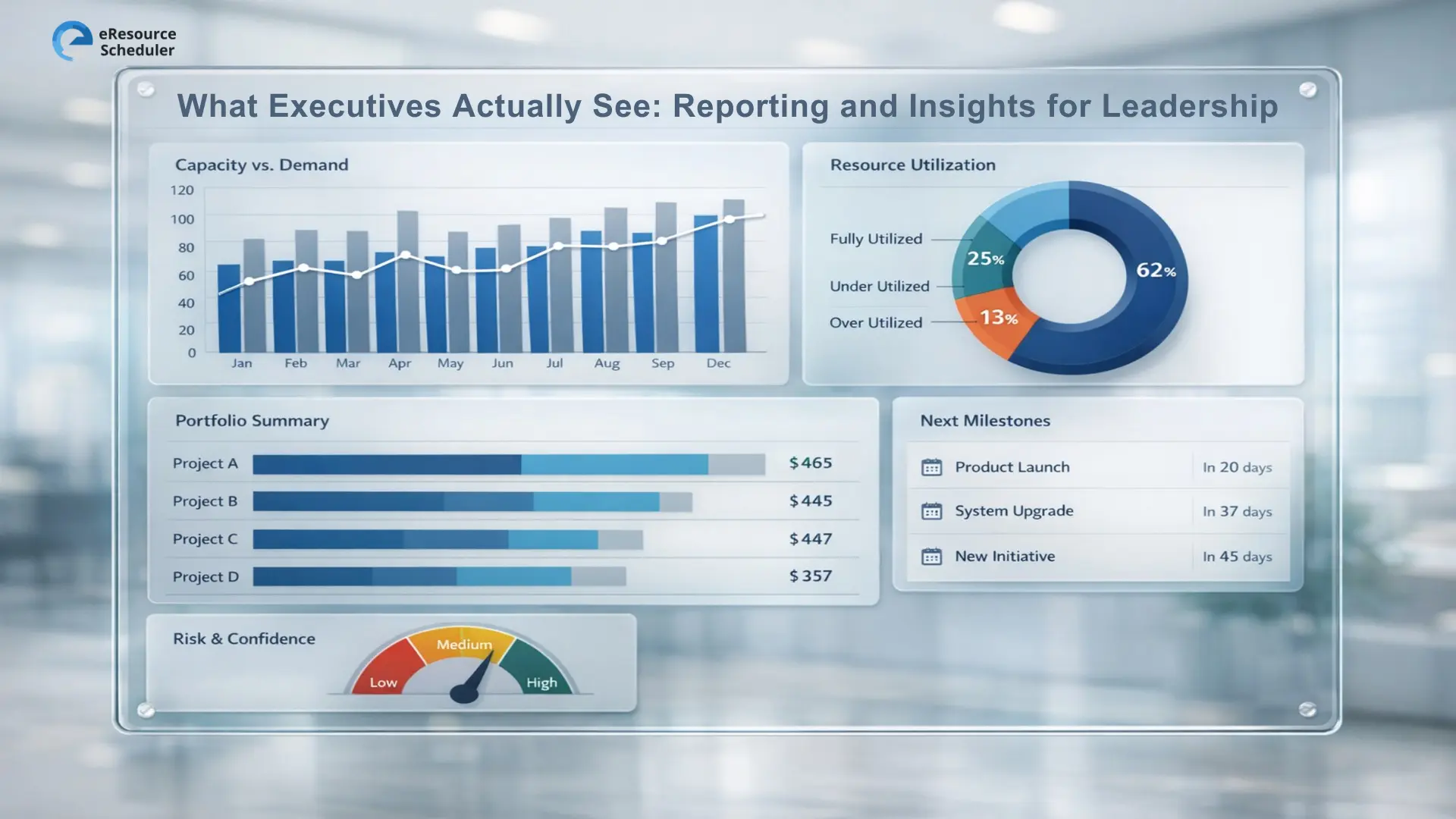
eResource Scheduler prioritizes reports that leaders actually read. Utilization trends, cost impact, and delivery risk are visible without heavy interpretation.
Saviom offers highly customizable reports with granular detail. The trade-off is time. Reports often require configuration and explanation.
For executive teams, speed of insight often matters more than depth.
An enterprise resource planning tool should integrate cleanly, not compete for control.
eResource Scheduler complements ERP systems by focusing on the people layer. It connects planning with execution while leaving financial systems intact. Saviom can function as a central planning hub. This works well in enterprises that want resource planning tightly governed and centrally owned.
For organizations seeking flexibility, eRS fits more naturally. For enterprise and professional services leaders, the decision comes down to intent. If the goal is precision with speed, adoption across teams, and actionable visibility, eResource Scheduler is the stronger choice.
If the goal is deep modeling within a highly governed enterprise structure, Saviom remains relevant. In most modern organizations, clarity beats complexity.
Professional services firms need precision without friction.
eResource Scheduler supports:
This allows leaders to respond quickly to demand changes.
Saviom supports complex service catalogs and global delivery models. It is strong in large firms with formal resource offices.
For mid to large professional services teams, eRS offers faster operational value.
A global tech firm uses eResource Scheduler to align product teams with shifting roadmaps. Leaders gain weekly visibility into capacity gaps without running complex simulations.
The same scenario in Saviom would support deeper modeling, but require more setup and planning cycles.
A consulting firm uses eRS to balance utilization across regions while tracking cost impact. Decisions happen in real time during leadership reviews.
Saviom would support this at scale, but often with longer lead times.
| Dimension | eResource Scheduler | Saviom |
| Time to value | Fast | Moderate to slow |
| Usability | High | Moderate |
| Planning depth | Practical | Advanced |
| Executive visibility | Immediate | Configured |
| Professional services fit | Strong | Strong at scale |
| ERP alignment | Flexible | Centralized |
At its core, the eResource Scheduler vs Saviom decision is about intent. Not scale. Not feature volume. Intent. One platform is built to help leaders act faster with confidence. The other is built to help organizations model complexity with precision. Both are capable. Only one aligns naturally with how most enterprises and professional services firms actually operate in 2026.
Resource management is no longer isolated. It influences delivery timelines, revenue predictability, utilization health, and leadership trust in numbers. A tool that slows insight creates hesitation. A tool that simplifies reality enables action. This is where many leaders feel friction with overly engineered systems. Planning should clarify decisions, not add another layer of interpretation.
eResource Scheduler fits organizations that value visibility across teams, faster planning cycles, and alignment between operations and financials without heavy governance. It works especially well where leaders want one shared view of capacity and demand.
Saviom fits environments with centralized planning offices, strict process ownership, and long-range workforce modeling needs. It performs best when supported by dedicated resource management roles.
The smartest way to decide is not through demos alone. Look at who will use the tool weekly. Look at how often plans change. Look at how quickly leadership expects answers. If agility, adoption, and clarity matter most, eResource Scheduler will feel natural. If governance and simulation dominate priorities, Saviom may still serve a role.

In the eResource Scheduler vs Saviom comparison, eResource Scheduler stands out as the more balanced and future-ready platform for 2026. It delivers the insights leaders need without slowing them down, supports professional services realities, and integrates smoothly into the enterprise ecosystem.
For teams that want control, confidence, and momentum, eResource Scheduler wins.
Start a 14-day free trial of eResource Scheduler and experience resource planning without friction.
1. Is eResource Scheduler better than Saviom for enterprises in 2026?
In most cases, yes. eResource Scheduler offers faster insights and easier adoption for enterprise teams.
2. Can eResource Scheduler handle complex professional services planning?
Yes. It supports utilization, staffing, and cost visibility without heavy configuration.
3. Does Saviom work better as an enterprise resource planning tool?
Saviom fits well in highly governed environments, but eResource Scheduler integrates more flexibly with ERP systems.
4. Which tool offers better executive reporting?
eResource Scheduler provides clearer and faster reporting for leadership decision-making.
5. Why does eResource Scheduler win the comparison overall?
Because it balances depth, usability, and speed in a way that aligns with how organizations operate today.

Plan Smarter. Schedule Faster. For Free.
Join thousands already using eResource Scheduler to align teams, time, and tasks seamlessly.
 ALL FEATURES INCLUDED