Learn more
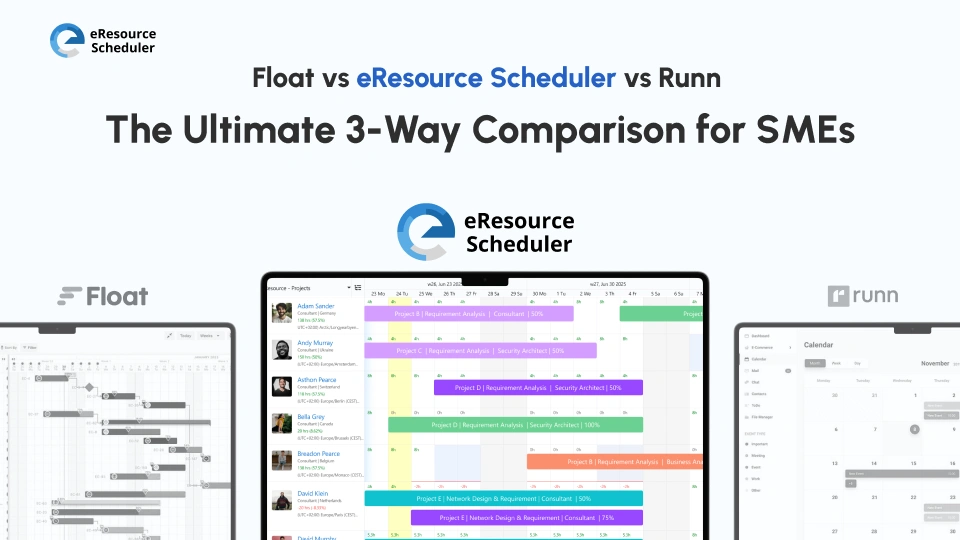
If you’re comparing eResource Scheduler vs Float vs Runn in 2026, you’re likely way past the “do we need a tool?” stage and deep into which one actually fits our business. SMEs today don’t just want pretty schedules, they want confidence when they allocate resources, clarity across teams, and fewer surprises mid-project.
This guide gives you a side-by-side comparison of all three tools. You’ll get clear overviews, practical comparison criteria, and tables under each section so you can make an informed choice without jumping around.
Before diving into the detailed comparison, it helps to understand what each tool is actually designed to do. Although all three software support scheduling, they are built with very different priorities in mind.
One focuses on simplicity and quick setup, another emphasizes control and long-term visibility, while the third is designed around forecasting and data-driven planning. Understanding this intent upfront makes it much easier to evaluate which tool truly fits your team’s way of working.
eResource Scheduler is a purpose-built enterprise resource management and scheduling software focused on delivering scheduling, capacity planning, financials, management reports, and timesheets to give organizations complete resource visibility, control, and forward planning. This resource scheduler is designed for managers who need to see who is doing what, when, and for how long across multiple projects.
This resource management and scheduling software is especially popular with SMEs that manage ongoing work, client commitments, and future demand without wanting an overly complex and outdated system.
Float is a clean, modern scheduling tool aimed at simplicity. It’s easy to adopt and visually appealing, making it a favorite among small creative teams and startups. Its strength lies in short-term planning and quick adjustments rather than deep forecasting.
Runn positions itself as a planning and forecasting platform with strong financial intelligence. It combines scheduling with revenue, cost, and utilization forecasting.
It’s powerful, but also more structured, making it best suited to teams that are comfortable working with data-heavy planning.

Instead of focusing on surface-level features, the comparison looks at how each platform performs in real working conditions, from planning depth to everyday usability. The goal is to help you see not just what each tool can do, but how well it supports growing teams over time.
Planning and scheduling depth is the foundation of any scheduling tool, and it’s one of the clearest points of contrast between eResource Scheduler, Float, and Runn.
While Float focuses on quick, short-term scheduling, eResource Scheduler is built for structured planning across multiple projects, and Runn goes deeper into long-term, scenario-based planning. How much depth you need here will strongly influence which tool feels right for your team.
| Criteria | eResource Scheduler | Float | Runn |
| Short-term scheduling | Strong | Strong | Strong |
| Long-term planning | Excellent | Limited | Excellent |
| Multi-project visibility | Yes | Basic | Yes |
| Role-based allocation | Yes | Limited | Yes |
eResource Scheduler offers structured, long-range planning without friction. Float is ideal for quick, near-term schedules. Runn matches eRS on depth but requires more setup and discipline.
Forecasting, utilization, and capacity planning are areas where the differences between eResource Scheduler, Float, and Runn become much more obvious. Float offers limited forward-looking insight, eResource Scheduler focuses on practical forecasting that managers can act on, and Runn delivers deeper, data-heavy projections.
The real question here is not how much data you get, but how usable that insight is for everyday planning.
| Criteria | eResource Scheduler | Float | Runn |
| Future workload forecasting | Practical | No | Advanced |
| Utilization tracking | Clear | Basic | Detailed |
| Over/under-allocation alerts | Yes | Limited | Yes |
| Actionable insights | High | Low | Medium |
eResource Scheduler focuses on usable capacity planning that helps managers act early. Runn offers deep projections tied to financials. Float keeps things lightweight, which can limit foresight as teams grow.
Ease of use, adoption, and team experience are critical because even the most powerful scheduling tool is useless if your team does not actually use it.
Float is extremely intuitive and easy to adopt, making it ideal for small teams or fast-moving projects. eResource Scheduler balances usability with managerial control, allowing both managers and team members to work efficiently without unnecessary complexity. Runn, while powerful, has a steeper learning curve and works best for teams comfortable with data-driven processes.
How quickly your team can get productive with the tool will often be a deciding factor.
| Criteria | eResource Scheduler | Float | Runn |
| Setup time | Fast | Very fast | Moderate |
| Learning curve | Low | Very low | Medium–high |
| Manager control | High | Medium | High |
| Team acceptance | High | Very high | Medium |
Float wins on instant usability. eResource Scheduler balances ease with control, making it practical for managers and teams alike. Runn delivers power but expects more process maturity.
Reporting, integrations, and operational fit are where eResource Scheduler, Float, and Runn really show their differences in supporting day-to-day decision-making.
eResource Scheduler provides clear visual dashboards, actionable reports, timesheets, and smooth integrations with common project tools, making it easy for managers to act on real data. Float keeps reporting and integrations simple, which works well for small teams but offers limited insight for larger projects. Runn delivers deep financial reporting and integration with accounting systems, but the complexity can overwhelm teams that just need clear operational visibility.
Choosing the right tool here depends on whether your priority is simplicity, clarity, or data depth.
| Criteria | eResource Scheduler | Float | Runn |
| Visual dashboards | Yes | Minimal | Dense |
| Custom reporting | Flexible | Limited | Advanced |
| Integrations | Common PM tools | Few | Finance-focused |
| Operational clarity | High | Medium | Medium |
eResource Scheduler prioritizes clarity over complexity. Runn shines in financial reporting but can overwhelm non-finance users. Float keeps reporting intentionally.
Not every small and medium-sized enterprise needs the same thing.
For many agencies and engineering firms, the balance eResource Scheduler offers between visibility and simplicity is often the deciding factor.
When comparing tools, SMEs often focus on features and miss these factors:
eResource Scheduler tends to score well here because it’s built around everyday management questions, not just analytics.
When you step back and look at eResource Scheduler vs Float vs Runn, the real difference is not about features on a checklist. It’s about how each tool supports everyday decision-making as your business grows.
While one works best when speed and simplicity are the top priorities, the other one shines in environments where forecasting, utilization metrics, and financial projections drive most planning decisions. For data-mature teams, it can be extremely powerful, but it also demands time, structure, and buy-in.
eResource Scheduler sits between these two approaches. It delivers the visibility and forward planning SMEs need, without overwhelming teams with complexity or forcing rigid processes. For many growing organizations, especially those managing multiple projects and shared resources, that balance is exactly what makes it sustainable long term.
If your goal is to plan confidently, stay flexible, and keep both managers and teams aligned, eResource Scheduler often proves to be the most dependable choice.
Start a 14-day free trial of eResource Scheduler and see how it supports real-world planning with your actual projects and people.
1. Which tool is best overall for SMEs: eResource Scheduler vs Float vs Runn?
For most SMEs, eResource Scheduler offers the strongest balance of forecasting, usability, and operational control. It supports scale without forcing heavyweight processes or fragmented tools.
2. Is Float too limited for growing teams?
Float works well early, but growing teams often outpace its depth as complexity, dependencies, and forecasting needs increase. Simplicity turns into manual workarounds.
3. Does Runn replace project management software?
No. Runn focuses on forecasting, capacity, and revenue modeling, not day-to-day execution. Teams might still need a PM system to manage tasks, timelines, and delivery accountability.
4. How does eResource Scheduler compare to Float for capacity planning?
Compared to Float, eResource Scheduler offers stronger capacity planning by allowing teams to plan further ahead, track utilization more clearly, and adjust workloads before problems arise.
5. Can eResource Scheduler replace spreadsheets for resource planning?
Yes. Many SMEs move to eResource Scheduler when spreadsheets become difficult to manage. It offers clearer visibility, better forecasting, and fewer manual errors compared to spreadsheet-based planning.

Plan Smarter. Schedule Faster. For Free.
Join thousands already using eResource Scheduler to align teams, time, and tasks seamlessly.
 ALL FEATURES INCLUDED